Covers (1951-1964). Culture, youth and rebelliousness
|
Covers (1951-1964)
Culture, youth and
rebelliousness
From 2 October 2012 to 3 February 2013
Academia exhibition room - La Nau
From
Tuesday to Saturday, from 10 to 14 and from 16 to 20 h.
Sunday, from 10 to 14 h.
|
|
Video [+] |
| |
|
 |
| |
|
Organised by
Universitat de València
Produced by
General Foundation of Universitat de València
Sponsored by
Bancaixa
Curators:
Justo Serna and Alejandro Lillo
In the years following World War II, the Unites States
underwent an unprecedented expansion of its population
and economy. As from the 1950s, the upward trend of the
families’ standard of living seemed unstoppable: America
showed its supremacy off to the world. At the same time
the country feared and opposed the Communists and their
infiltration from remote sites. It was the Cold War.
The welfare levels reached had been simply unthinkable
just a few years earlier. That prosperity, present in
American everyday life, could also be seen in the media.
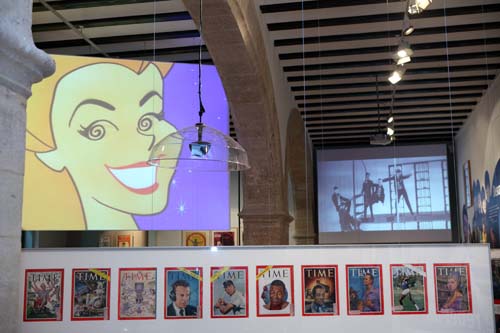
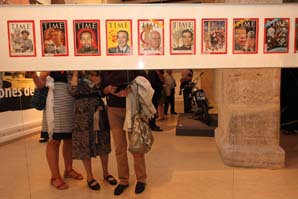
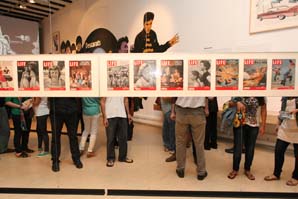
Satisfaction and achievement made it to the covers of
the magazines. Wealth and prosperity were flaunted.
Adverts featured smart and casual clothes and
herringbone suits, dresses and skirts, hats for the
gents and stiletto shoes for the ladies, bright jewels,
pointed sunglasses, swimsuits, and fine,
figure-enhancing lingerie.
Life Magazine was a loyal witness to the period's
fashion trends. And so were television comedies like
I Love Lucy. But advertising also focused on cars,
motorbikes, refrigerators, food processors, television
sets: all types of appliances to meet different human
needs, small luxuries to make life more comfortable and
to speed it up! In retrospect, these accessories and
machines have a cool, vintage touch. Some of the ads are
glamorous even by today's standards.
But material joy also conceals a discomfort that goes
unnoticed by some. The uneasiness of the American youth
is not negligible at all. Restless youngsters seen from
a restless perspective. They make known their
dissatisfaction in an attitude of contempt, to the
adults' dismay. They seem to scorn their inheritance,
the world of adults, or the prosperity they benefit
from. And they do so by dressing differently, uniformed
in differentiating clothes, whether jeans or leather
jackets or tight-fit trousers. And with music, singing
along songs that express their unease and longings:
love, desire, the body, speed… |
| |
 |
 |
| |
|
Radio and television report on their changes. The future
is not long enough and young people want it all now.
Their eagerness, rejection and insolence become
characteristic features of subsequent generations. The
rebels and their gangs, doing the steering, asserting
themselves, and standing up against adult hypocrisy:
they are The Outsiders, as recreated by Susan E.
Hinton years later (1967) and Francis Ford Coppola
(1983).
Covers
is about the roots of this discomfort. The exhibition
helps us ‘hit the road’ in a trip to an opulent and
anxious nation, one needing soothing therapies and
psychoanalysis. It is an invitation to return to a
country which showed the uneasiness and rebelliousness
of the young for the first time they way we know them
today. Our travel to the US takes us back to the 1950s
and the early 1960s.
J. D. Salinger publishes
The Catcher in the Rye
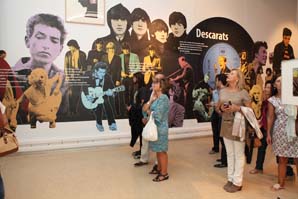
in 1951. In 1964 The Beatles and The Rolling Stones
arrive in the US for a TV show with Ed Sullivan, and
they go on tour. The outset of young rebelliousness can
be tracked down to the period between both dates, with
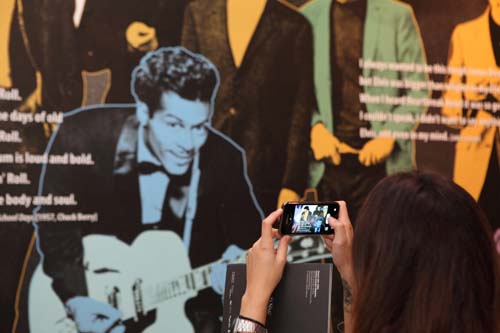
Marlon Brando becoming an icon of the wild side. Rock
and roll is born and Elvis Presley becomes a star,
swivelling his hips. From the mid 1950s to the mid
1960s, James Dean and John F. Kennedy enter the scene,
hit the headlines and die young: they live quickly, take
drugs and enjoy sex to the full. It is the Beatniks’
time. Youth revolution is unleashed, and the waves it
causes are strong. This cultural boom changed looks,
everyday life, lifestyles and values. Nothing would be
the same ever again. But not everything was serious.
There was happiness and optimism: the twist was danced
by many in the early 1960s. |
| |
 |
 |
| |
|
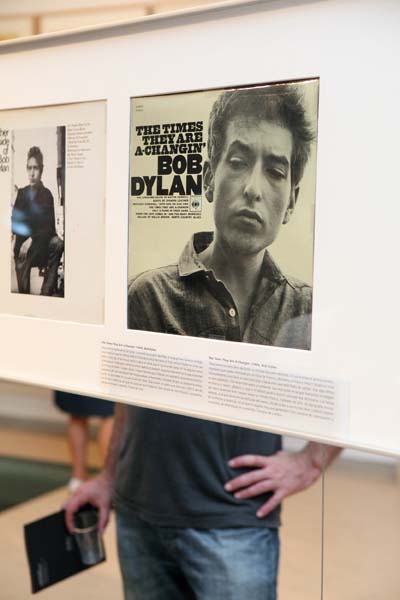
By means of these different cultural expressions, images
and looks, Covers aims to show the origin of
contestation and rebelliousness, the eagerness to live
fast and die young. With film sequences, record jackets,
songs, photographs and literary works, Covers
uncovers the identity of those pioneers and their
values, and what took them to the cover pages: What do
the covers show and conceal? What was affluent America
like? What were those young rebels like? What music did
they listen and sign along to? What songs did they turn
into new versions?
Covers
is actually a version: it reiterates something
which is already known but with new elements. The lyrics
express wishes and confirm yearnings. Expectation and
frustration –repeated over and over- lie in that legend.
Mass culture is all about that: repetition. How did
those youths present themselves then and how do they
present themselves to us now? Countless copies of those
models and roles have been made: versions and replicas.
The Presentation of Self in Everyday Life,
by Erving Goffman, was published in 1959: a sociological
study of the social dramaturgy, relations and
representations of Americans. Pure theatre. With and
without a script, and with background music. And a
soundtrack.
Welcome to warm, friendly and colourful America. Welcome
to the rock ‘n’ roll years.
|
| |
 |
 |
|
|
|
 |
|
|
|
 |
|
|
|
|
|

