Orange Groves
|
Orange Groves
Cultural views of
a scenery
From 12 December 2012 to 24 March 2013
Exhibition room of the Botanic Garden
of Universitat de València (Quart, 80)
|
|
Vídeo |
|
 |
|
|
|
Curator: Adrià Besó Ros
A project by Universitat de València
Organised by the Department for Culture and Equality,
Universitat de València
Produced by the Botanic Garden and the General
Foundation of Universitat de València
In cooperation with València City Council
Orange trees are common in gardens for their aesthetic
qualities. In Valencian cultural tradition, the concepts
of orchard and garden have been closely related. Early
experiences in orange tree growing with a commercial
purpose and large benefits date back to the late 18th
century and can be found among upper-class circles. At
the beginning, oranges were grown only in the towns of
La Ribera and La Plana de Castellón. They developed very
slowly at first and it was not until the mid 19th
century that conditions were met for exportation to
European countries. But from 1880 to the 1930s, orange
trees became widespread all along the coastline between
La Plana de Castellón and La Safor. Thanks to important
financial benefits, the aesthetic qualities of orange
trees as garden trees were spread all over a well tended
landscape.
From the onset, orange groves were assigned an aesthetic
value, as can be seen in the stories written, for
several reasons, by Cavanilles, Madoz, Lassala, Bodí,
the Countess of Gasparín, etc. At the beginning, this
perception was only found in people working in different
scientific areas or in foreign visitors. But it was
during the golden age of citrus production, between 1880
and 1930 –especially in the transition from the 19th
to the 20th century- that the bourgeoisie
took the lead of the expansion of Valencian agriculture
and orange production and drew the attention of writers,
artists, photographers and film producers who raised the
orange grove to the category of landscape, transmitting
values later assimilated by different social strata.
It is striking to see how diverse cultural
manifestations come together when conveying a fairly
similar idealised concept of the grove and in locating
the grove landscape par excellence in Alzira and
Carcaixent, where the high number of farms makes the
scenery as sublime as to arouse aesthetic experiences
that then come true as different artistic expressions. |
|
|
|
 |
 |
|
|
|
The exhibition takes us closer to orange groves and
orange tree sceneries by means of the images of
photography, literature and films between 1880 and 1930.
The exhibits are structured into three blocks:
0.Audiovisual: Orange groves. The creation of the
Valencian orchard
This section explains the shift from the use of orange
trees as garden trees to the expansion of the orange
trade, the bourgeois concept of orchard/grove and the
foundations of its aesthetic value.
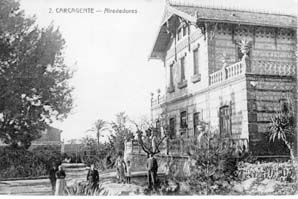
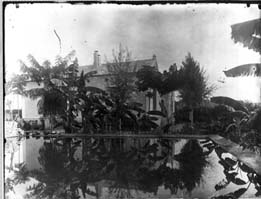
1. The orange tree garden
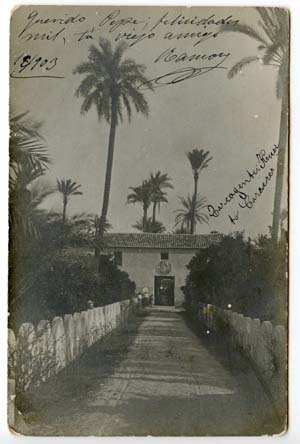
The bourgeois standard orchard or garden consisted of an
orthogonal walled plot with orange trees, crossed by two
axes. Surrounded by an ornamental garden, the house was
in the centre and next to it were the reservoir and an
irrigation motor. The paths were ornamented by trees,
palms and plants. The different elements that made up
the standard bourgeois orchard are analysed in this
section: orange trees, palm trees, cypress trees, the
entrance patio, the house, water and the garden.
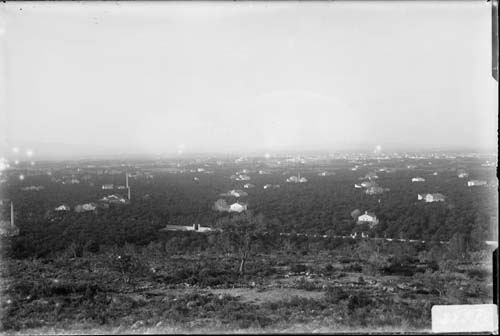
2. Panoramic views
This section offers panoramic views of a landscape
characterised by a single crop. Orange ‘forests’ from
which farmhouses, palm trees, garden trees and water
towers stand out. A scenery of trees and fields that
could also be seen from the balconies of the houses or
some natural elevations. For writers, the Muntanyeta del
Salvador in Alzira was the best viewpoint. |
|
|
|
 |
|
|
|
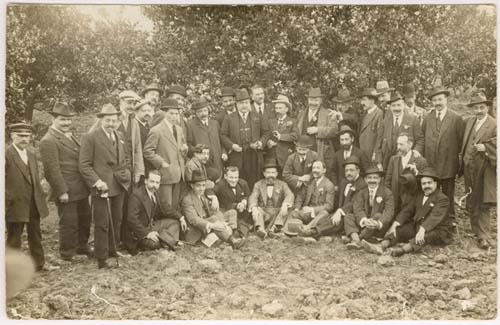
3. A landscape alive
This area shows us the relationship between the scenery
and the people whose work and dedication made it
possible. It is about the ‘señoritos’ (rich young men),
their orchards being a symbol of social prestige, about
their manor houses, where they would spend the summer
with their families and friends, about dedicated farmers
who took great care of their fields, about housewives
who did their household chores but also worked at the
packing house. In 1937 the exceptional circumstances of
the Civil War prompted the Republic government to turn
some farms into school camps for evacuated children
fleeing from the bombing of Madrid. There, they managed
to have a happy ideal stay, far from the horrors of the
war.
4. Today’s reality
A source of inspiration for poets and writers in the
first decades of the 20th century, the orange
tree scenery also drew the attention of artists,
photographers and film makers. The landscape remained
more or less unchanged until the last decade, when it
started to decline slowly, a trend that has been more
noticeable in recent years. The comparison of today's
images with those of the rest of the exhibition is a
graphic testimony of what survived but is now
threatened.
5. A look ahead
The cycle of oranges as an intensive crop is now
completed in the counties where it was first developed.
This has opened the door to deep short-term landscape
transformations which can already be seen and with a
varying scope. We are undergoing important changes; the
triumph of some of the alternatives will mark a new
landscape image for the new cycle. This exhibition area
includes current images of such alternatives: farming
land given new land uses, new crops like avocado,
custard apple or persimmon, trees for timber, leisure or
agritourism. |
|
|
|
 |
|
|
|
 |
|
|
[<] Back
|
|

