|
|
Facultad de Psicología |
|

|
Docencia (Teaching) |
Métodos y Diseños de
Investigación (Research
Methods in Psychology) |
|
|
2011/12 Grupo
P |
|
Profesora (Professor) |
María Dolores
Frías-Navarro |
Atención a Alumnos (Horario):
Consultar el tablón de
anuncios del Departamento de Metodología o enviar correo electrónico a la profesora
|
|
Prácticas 2011/12. Horario |
|
|
|
|
|
|
|
||
|
|
|
|
|
|
|
|




Research Methods
Ψ Course Objectives
1)
To gain conceptual understanding of statistical analyses to advanced research
designs.
2)
To gain practical experience in the interpretation and communication of
statistical analysis in a manner appropriate for those involved in
psychological research.
3)
To capacity to understand and critically analyze quantitative psychological
research
Computer Software Program for Statistical Analysis:
Some
homework assignments require the use of computers. We will use SPSS (version 14.0)
as the software program for statistical analysis.
This course beginning with an exploration of the
foundations of the scientific method. The students
will learn the methods of data analysis and the general logic behind
statistical inference as well as the use of alternative measures such as effect
size.
The
Judd and McClelland text presents a process of data analysis where the
following simple equation is of prime importance:
DATA
= MODEL + ERROR
The
meanings of DATA, MODEL, and ERROR are fully discussed in your text. Briefly,
DATA are scores you have that you want to statistically evaluate. MODEL is a
method of describing the DATA in a more, or less, simple manner. Finally, ERROR
is the amount of error you make in representing the DATA with your MODEL.
Effect
sizes are quantitative indexes of the relations between variables found in
research studies. They can provide a broadly understandable summary of research
findings that can be used to compare different studies or summarize results
across studies. The
effect size is simply a measure of the degree to which the null hypothesis is
false. For example, if one group has had an
‘experimental’ treatment and the other has not (the ‘control’), then the Effect
Size is a measure of the effectiveness of the treatment.
There
are many different possible effect sizes, including the difference between
treatment and control group means divided by the standard deviation (Cohen’s
d), the correlation coefficient between the independent variable and the
outcome, and the difference in proportions of individuals experiencing a
particular outcome.
The recently
more popular measure of effect size is Cohen's d, which expresses the
difference between means in terms of standard deviation units.
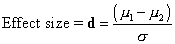
Where s = the
estimated standard deviation of the population(s).
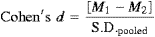
When the sample N
is equal between groups, Cohen's d
requires the computation of a pooled standard deviation (SD) taking the form
of:

When N is
not equal between groups, however, a pooled SD weighted by sample size needs to
be calculated to obtain Cohen's d
using:

The noncentrality parameter
is:
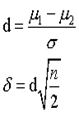
Noncentrality
parameter of the F distribution is the square root.
Rosenthal
and Rubin (1979, 1982) have argued that even small effects can be important.
Rosenthal has argued in several places that just because an effect size is
small doesn’t mean that it isn’t important.
Jacob
Cohen (1988) gives very rough guidelines about estimating
effect sizes. Typically, these effect size magnitudes have been
interpreted based on rules of thumb suggested by Jacob Cohen (1988), whereby an
effect size of about 0.20 is considered “small”; about 0.50 is considered
“medium”; and about 0.80 is considered “large”. The Cohen guidelines are only
broad generalizations, however, covering many types of interventions, target
populations, and outcome measures. Nevertheless, it has been standard practice
for researchers and policymakers to interpret effect size estimates using these
guidelines. The effect sizes should instead be interpreted with respect to
empirical benchmarks that are relevant to the intervention, target population,
and outcome measure being considered. Thus, it is important to interpret a
study’s effect size estimate in the context of natural growth for its target
population.
|
Effect Size |
d |
Percent Overlap |
|
Small |
.20 |
85 |
|
Medium |
.50 |
67 |
|
Large |
.80 |
53 |
To
evaluate d we need to go to tables of
power:
|
POWER: POWER AS A
FUNCTION OF d AND SIGNIFICANCE LEVEL (a) |
||||
|
|
Two-tailed a |
|||
|
d |
.10 |
.05 |
.02 |
.01 |
|
|
|
|
|
|
|
1.00 |
.26 |
.17 |
.09 |
.06 |
|
1.10 |
.29 |
.20 |
.11 |
.07 |
|
1.20 |
.33 |
.22 |
.13 |
.08 |
|
1.30 |
.37 |
.26 |
.15 |
.10 |
|
1.40 |
.40 |
.29 |
.18 |
.12 |
|
1.50 |
.44 |
.32 |
.20 |
.14 |
|
1.60 |
.48 |
.36 |
.23 |
.17 |
|
1.70 |
.52 |
.40 |
.27 |
.19 |
|
1.80 |
.56 |
.44 |
.30 |
.22 |
|
1.90 |
.60 |
.48 |
.34 |
.25 |
|
2.00 |
.64 |
.52 |
.37 |
28 |
|
2.10 |
.68 |
.56 |
.41 |
.32 |
|
2.20 |
.71 |
.60 |
.45 |
.35 |
|
2.30 |
.74 |
.63 |
.49 |
.39 |
|
2.40 |
.78 |
.67 |
.53 |
.43 |
|
2.50 |
.80 |
.71 |
.57 |
.47 |
|
2.60 |
.83 |
.74 |
.61 |
.51 |
|
2.70 |
.85 |
.77 |
.65 |
.55 |
|
2.80 |
.88 |
.80 |
.68 |
.59 |
|
2.90 |
.90 |
.83 |
.72 |
.63 |
|
3.00 |
.91 |
.95 |
75 |
.66 |
|
3.10 |
.93 |
.87 |
.78 |
.70 |
|
3.20 |
.94 |
.89 |
'81 |
.73 |
|
3.30 |
.95 |
.91 |
.84 |
.77 |
|
3.40 |
.96 |
.93 |
.86 |
.80 |
|
3.50 |
.97 |
.94 |
.88 |
.82 |
|
3.60 |
.98 |
.95 |
.90 |
.85 |
|
3.70 |
.98 |
.96 |
.92 |
.87 |
|
3.80 |
.98 |
.97 |
.93 |
.89 |
|
3.90 |
.99 |
.97 |
.94 |
.91 |
|
4.00 |
.99 |
.98 |
.95 |
.92 |
|
4.10 |
.99 |
'98 |
.96 |
.94 |
|
4.20 |
- |
.99 |
.97 |
.95 |
|
4.30 |
- |
.99 |
.98 |
.96 |
|
4.40 |
- |
.99 |
.98 |
.97 |
|
4.50 |
- |
.99 |
.99 |
.97 |
|
4.60 |
- |
- |
.99 |
.98 |
|
4.70 |
- |
- |
'99 |
.98 |
|
4.80 |
- |
- |
.99 |
.99 |
|
4.90 |
- |
- |
- |
.99 |
|
5.00 |
- |
- |
- |
.99 |
Table from Howell, D.
C. (1997) Statistical Methods
for Psychology (4th ed.)
Increasing
emphasis has been placed on the use of effect size reporting in the analysis of
social science data. Reform of statistical practice in
the social and behavioral sciences requires wider use
of confidence intervals (CIs) and effect size
measures. For decades, many advocates of statistical reform have
recommended CIs as an alternative, or at least as a
supplement, to p values (Cumming
& Finch, 2001). The American Psychological Association’s (APA, 2001) Publication
Manual now calls CIs “the best reporting strategy”
(p. 22). The APA manual stated “because
confidence intervals combine information on location and precision and can
often be directly used to infer significance levels,
they are, in general, the best reporting strategy. The use of confidence intervals is therefore
strongly recommended” (APA, 2001, p. 22).
Formulas:
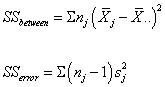

But,
eta squared is biased because it is optimized
for the particular set of data we have. Therefore we need to go to a less
biased statistic:

w 2 is always going
to be smaller than h 2, but generally it is only a little smaller.
References
Cohen,
J. (1988). Statistical Power Analysis for
the Behavioral Sciences, 2nd ed.
Hillsdale, NJ: Lawrence Erlbaum.
Hedges, L.V. (1982). Estimation of Effect Size
from a Series of Independent Experiments. Psychological Bulletin 92,
490-499.