Education at wartime 1936-39
|
Education at wartime 1936-39: The
Valencia Worker School in Walter Reuter’s works
From 13th October to 13th
November 2005
Sala Oberta - La Nau
From
Tuesday to Saturday, from 10 to 13.30 and from 16 to 20 h.
Sunday, from 10 to 14 h.
|
|
|
|
 |
|
|
|
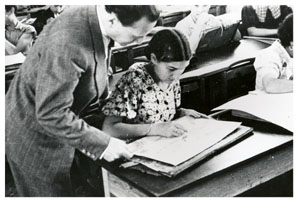
Worker Schools
Following a legal decree, in 1936 the Spanish Republic
Government set up the so-called worker schools (institutos
obreros) for those young willing to complete
compressed baccalaureate studies (reduced from 7 to 2
years). The candidates –over the age of 15- first had to
pass an admission test to prove they were fit.
The aim was to create 'student' workers to reconstruct
Spain after the fratricidal conflict, an elite of
intelligent workers.
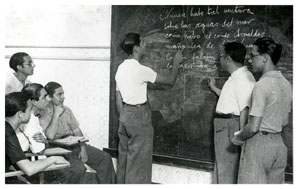
The classes started on February 1st 1937. For more than
two years (three full semesters) the best teachers of
the time lectured at the 'institutos': Samuel Gil Gaya,
Núñez de Arenas y de la Escosura, Rafael de Penagos,
Juan Renau, Rafael Pérez Contel, Francisco Carreño
Prieto, Alberto Sánchez Pérez... next to high stature
academics like Machado, Jacinto Benavente, León Felipe,
Jusep Renau etc., and classic characters like
Campesino and Pasionaria. The Worker School
institution participated in the Conference of
Anti-fascist Intellectuals (1937). Its students were
being prepared to work at the service of the Republic,
and so they were actually paid for studying. Worker
schools were set up in Valencia, Barcelona, Sabadell,
and Madrid. |
|
|
|
 |
 |
|
|
|
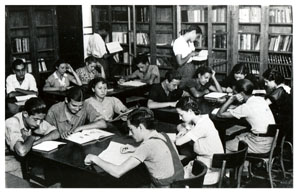
The Valencia Worker School of Secondary Education stood
out. Its premises were at the former Jesuits School – at
today’s Avenida Fernando el Católico. It was
refurbished to host the initial 143 students, 13 of them
being women. The number of students totalled 356.
A former student association was set up in 1987 in
Valencia and the book “El Instituto para Obreros" by
Prof. Fernández Soria" was published by the Valencian
Government. The council even named a street after the
School.
At present, its octogenarian students continue meeting
under the intellectual spirit they got impregnated of as
young men and women who went through experiences like
the war (Ebro battle…), imprisonment, refugee and
concentration camps (Argeles sur Mer, Sant Cyprian…) and
exile. |
|
|
|
 |
 |
|
|
|
WALTER REUTER 1906 – 2005, A PHOTOGRAPHY MASTER
Walter Reuter was born on January 4th 1906 in Berlin. Of
a working background, he grew up under the influence of
left-wing social and young movements in Weimar’s
Germany.
His first camera was a 6x9 Contessa Nettel. In the late
1920s he started documenting the plight of proletarian
families in the outskirts of Berlin. He took his first
15 photographs to the left-wing magazine AIZ (Arbeiter-Illustrierte
Zeitung). He was paid well. The money went to buying
a better piece of photographic equipment. In 1930,
chased by the Nazis for the publication of the
photographs of the demonstration against the National
Socialist Party, he fled the country. |
|
|
|
 |
 |
|
|
|
Reuter arrived in Spain in May 1933, after travelling
Switzerland and France. He travelled to Andalusia in
1934, where he participated in the ‘Teaching Missions’
and worked in a photographic documentary on La casa
de Bernarda Alba together with Federico García Lorca.
At the outbreak of the Civil War he joined the Malaga
militias of the Unified Socialist Youth. He was indeed
one of the most committed foreign photographers in the
Spanish anti-Fascist cause, like Robert Capa, Gerda
Taro, David Seymour, Hans Namuth and Kati Horna. He
defended the Republic with his camera and took part in
governmental propaganda projects, and so in 1937 he went
to Valencia to prepare a feature on the Instituto
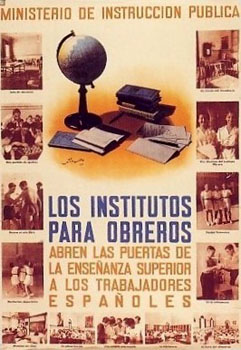
Obrero, the Worker School. One of his photographs
from this project was later used by Mauricio Amster in
the institution’s advertising posters. In October that
year, when the government was forced to move to
Barcelona, he also moved there. In May 1938 he presented
his works in the exhibition “Art at the service of
people”. In Barcelona he portrays the rearguard and
especially the children and the refugees. His activity
as a graphic war correspondent starts that way. He works
for the news agency Black Star in New York and London.
In Spain, Reuter’s photographs get published in Ahora.
Diario de la Juventud,
among others. |
|
|
|
 |
 |
|
|
|
The 1939 defeat causes him to exile to Paris. He manages
to escape from the Germans in France by going to
Casablanca, Morocco. But he gets arrested there and
taken to the Colombe-Bechar concentration camp in the
Sahara, to work in the construction of the Trans-Sahara
railway. In April 1942 he manages to escape and board
the San Thomé, a Portuguese ship heading for
America. He arrives in Mexico at the time of Lázaro
Cárdenas’ Mexican Revolution Party, together with his
first wife Sulamith Siliava and his son Jas.
He settled in Veracruz, where he kept in touch with the
republican Spaniards exiled in Mexico (Max Aub, Luís
Buñuel, Rodolfo Halffter, and Plácido Domingo’s family).
He also remained friends with Mauricio Amster, a Pole
living in Chile, with whom he had worked in Spain in the
photomontage of posters for the Ministry of Public
Instruction and Fine Arts. |
|
|
|
 |
 |
|
|
|
A precursor of today's graphic journalism, he
contributed to
Mexico's photographic panorama. He also made
documentaries and short films, always illustrating
social and cultural concerns with images. He worked for
the magazines Nosotros, Hoy, Siempre y Mañana,
in Mexico, and for the Musée de L’Homme of
Paris. He married his second wife in Mexico and had two
daughters, Yazmín and Hely Reuter. A few years ago, the
youngest one started to classify her father's works
together with a group of collaborators, around 120,000
negatives from Mexico, Germany and Spain.
A fugitive escaping from Nazi Germany, a Spanish Civil
War veteran and a 2nd World War and refugee
camp survivor, Walter Reuter died in Mexico on 20th
March 2005 at the age of 99. Despite his high stature as
a photographer and his humanity, he died in poverty and
oblivion.
He remained active until his death. His humanity and
solidarity make him a perfect example of the social
justice fight.
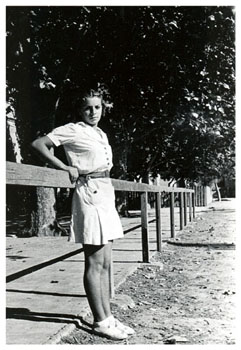
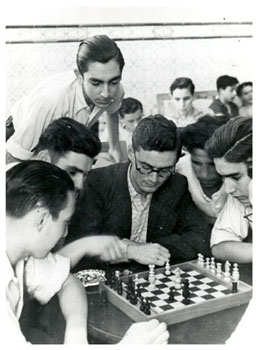
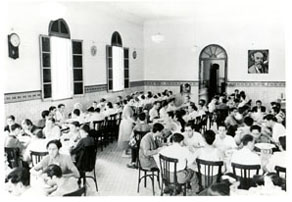
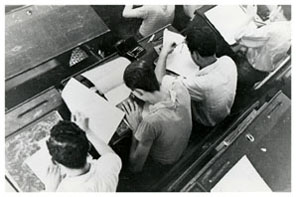
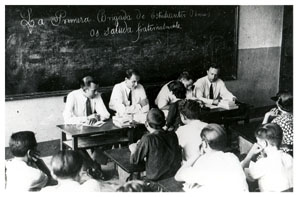
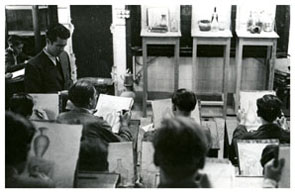
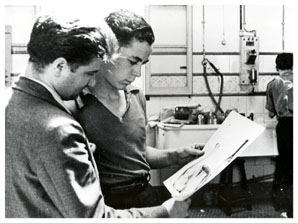
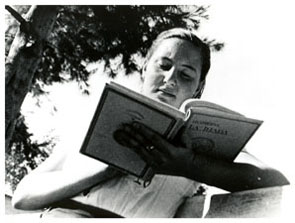
The photographs included in the exhibition “Education at
wartime” are part of those taken for his feature on the
Valencia Workers School in 1937. They are a copy of
those stored in Spain’s National Library.
Cristina Escrivá, Valencia 2005 |
|
|
|
 |
|
|
|
|

