Joan Fuster: Nosaltres, els valencians (1962-2012)
|
Joan Fuster:
Nosaltres, els
valencians
(1962-2012)
From 16 February 2012 to 18 March 2012
Estudi General Hall - La Nau
From
Tuesday to Saturday, from 10 to 14 and from 16 to 20 h.
Sunday, from 10 to 14 h.
|
|
Cartel [+] |
Hoja de mano [+] |
| |
|
 |
| |
|
Organised by Universitat de València (Department for
Culture and Joan Fuster Professorship)
Produced by General Foundation of Universitat de
València and Joan Fuster Professorship
With cooperation from the Interuniversity Institute of
Valencian Philology, the Institute of Catalan Studies,
the Town Council of Sueca, Universitat Jaume I de
Castelló, and Universitat d’Alacant.
A project by Ferran Carbó and Francesc Pérez i Moragón.
http://www.uv.es/catedra
Overview
2012 is the fiftieth anniversary of the first edition of
Nosaltres, els valencians (We, Valencians), an
essay of political, social and cultural history and a
milestone in Joan Fuster's extensive biography
(Sueca, 1922-1992).
The relevance of his book stems from its primordial
influence on the renewal of historiography and in
general on the human science study and discussion about
the Valencian Country. This influence was not
constrained to the academic realm. Rather, it
transcended society as a whole in diverse ways. It did
so in different periods and in situations of all sorts
over the past fifty years, from the last Francoist phase
to date.
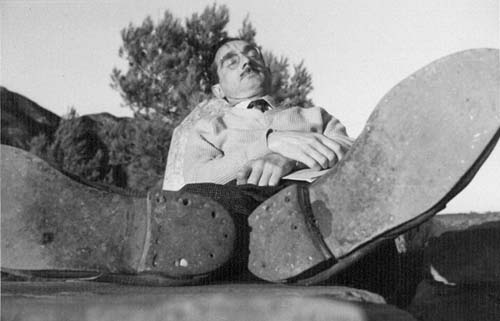
Through the documents kept by the author and based on an
overview of the author during the period when he wrote
the book, the exhibition is intended to illustrate Joan
Fuster's personality, the year 1962, the production of
the book, its immediate success and the difficulties
encountered as a result of censorship under Franco’s
regime. This aim has been a guiding principle in
choosing and arranging the exhibits.
Over the last fifty years, the book has been republished
on thirty occasions in Catalan and three in Spanish. Its
popularity with ordinary people but also with
historians, economists and politicians has been
enormous. This can be seen in all types of written
references, in favour or against, and in specialist
reviews —which is only logical, for the book was
published a long time ago. Besides, Fuster’s work has
certainly supplied the political and para-political
discussion with food for thought. In the selection of
the documents exhibited and reproduced in the catalogue,
such references have been limited to those
chronologically immediate to the publication of the
book. For two basic reasons. First, because it was
impossible to collect all known references and because
any absences would have been misunderstood. And second,
to avoid anachronism. |
| |
|
 |
 |
| |
|
In addition, the exhibition seeks to spread a very
significant part of Fuster’s tangible legacy, one which
is still little known, like his Sueca home, not yet
fully accessible to the public. Therefore, the exhibits
include a number of art pieces collected by the writer
—often gifts by the artists—, such as those by Andreu
Alfaro, Antonio Saura, Manuel Boix, Albert Ràfols
Casamada, Antoni Tàpies, Joan Ponç, Joan Miró, Rafael
Armengol, Artur Heras, Equipo Crónica, Josep Renau,
Equipo Realidad, Hernández Mompó, among others. Apart
from paintings and sculptures —sometimes reproduced in
photographs of the author— some samples of his graphic
work collection have been included.
The exhibition has been organised by the Department for
Culture, Equality and Planning and the Joan Fuster
Professorship of Universitat de València, with
cooperation from the Council of Sueca, the
Interuniversity Institute of Valencian Philology, the
Catalan Department of Universitat de València and the
Institute of Catalan Studies; and
the coordinators are Ferran
Carbó and Francesc Pérez i Moragón, Joan Fuster
Professorship (Universitat de València), and Brígida
Alapont (Casa Fuster, Sueca).
The exhibition will travel to Alacant, Castelló de la
Plana, Gandia, Sueca and Barcelona. |
| |
 |
 |
| |
|
 |
| |
|
 |
| |
|
[<] Back
|
|



