Trénor. An exhibition of a bourgeois family
|
Trenor. An exhibition of a
bourgeois family
Thesaurus exhibition room - La Nau
26 May 2009 –27 September 2009
From
Tuesday to Saturday, from 10 to 13.30 and from 16 to 20 h.
Sunday, from 10 to 14 h.
|
| |
|
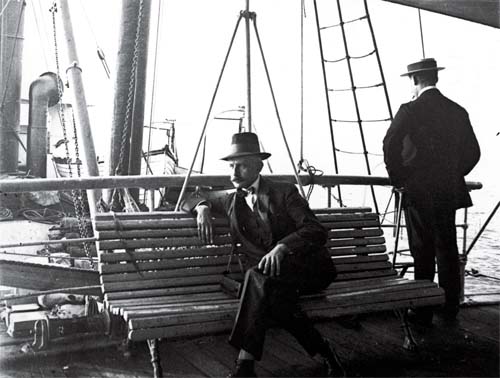
Colección Familia Trenor. |
| |
|
Organised and produced by Department for Culture,
Universitat de València
In
cooperation with València Council
Curators :
Justo Serna, Professor of Contemporary History,
Universitat de València
Anaclet Pons, Professor of Contemporary History,
Universitat de València |
| |
|
The Exhibition has two themes. On the one hand, the
anniversary of the Valencian Regional Exhibition held in
1909. On the other, the symbolic exhumation of its main
inspirer, Tomás Trénor, the member of a distinguished
bourgeois family in 19th and 20th
century Valencia, originally from Limerick (Ireland).
The exhibition recreates the evolution of this business
and industrial dynasty (one of the most relevant in the
1800s), 1909 being the starting point, and describes
Valencia and Europe at the time. It presents both the
inside and outside of the bourgeois world: their homes,
companies, streets, habits, costumes, hobbies, and
businesses.
In 1909 the world of business and industry in Valencia
opened up to the world. The Trenors were a source of
inspiration for the event but basically they embodied
the long modernisation process of Valencian society,
culture, and economy. They also devised a project for 20th
century Valencia. This exhibition seeks to reconstruct
the 19th century bourgeois world and explore
Valencia’s adaptation to the new industrious life and
society styles. In a way, the Trenors are our local
Buddenbrooks. With help from a family member, Tomás
Trenor Puig, we have been able to recreate that universe
with photographs, furniture, utensils, toys, original
and copied documents, explanatory panels, music, and
cultural and literary contextualisation. Past times will
be recreated at Thesaurus room: 1909 but also the whole
19th century. Visitors will first see the
Regional Exhibition theme: The exhibition is a flashback
tour, first travelling to Limerick, the dynasty’s
original motherland. From Valencia to Ireland, then. And
then from Europe back to Valencia.
In addition to the research conducted by the curators,
Justo Serna and Anaclet Pons, the catalogue includes
works by Tomás Trénor Puig, Josep Vicent Boira,
Alejandro Lillo, Amparo Ruiz and Concha Ridaura. |
| |
|
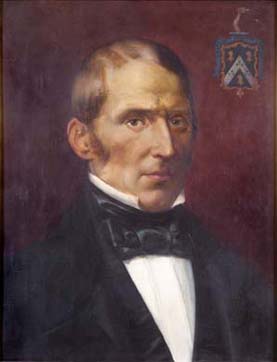
Ricardo Bucelli, Retrato de Thomas Trenor Keating
(1798-1858), 1847. Colección Familia Trenor. |
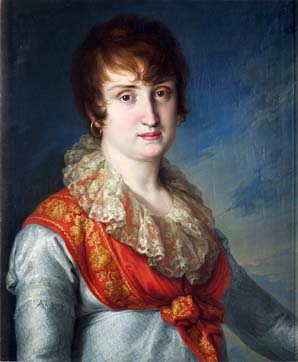
Vicente López, Retrato de Rita de Juna y Fuster,
1805 [ca]. Colección Familia Trenor. |
| |
|
1. Valencian Regional Exhibition, 1909
Contemporaries saw the 1800s as a century of progress,
acceleration and developments. A whole repertoire of
technical novelties were made available to industry,
agriculture, and even ordinary citizens. New equipment
and devices were created to make life easier and more
comfortable. But the key to such progress did not only
lie in manufacturing but in reaching everybody, for all
individuals to benefit. A material achievement that was
not made widespread was a poor achievement, as it was to
be validated by the market, be given a name recognising
its authorship and associated to a country that could
take pride of such an industrial exploit. That healthy
fight –as described by 19th century
chroniclers- soon led to a great many competitions,
meetings, and events of all sorts where manufacturers,
inventors, technicians, scientists and even rulers came
together. Not all events were equally transcendental or
important.
At the beginning, the meetings were either local,
regional or national. For instance, in 1845 a Public
Industry Exhibition was held in Madrid, with dedicated
exhibitors coming from all over Spain. It was actually
an expression of needy capitalism but an event, at the
end of the day. The prestige that the presentation of
new products could bring along was evident to
manufacturers, who took the risk to improve their
companies and product markets in this way. After the
meetings, the exhibitors went back home with medals and
awards, to which proud reference was made in their
corporate papers, leaflets, and store signs. But they
also came back with contacts and contracts, as the
meetings were very much like trade fairs, something that
had been invented by marketers many centuries ago. But
they now took on a different format: closed precincts,
with previously allocated areas, and with sample
collections and catalogues to guide visitors and
exhibitors.
But the greatest change in the new fairs was their
internationalisation in the 19th century.
That was a major shift indeed. It first happened in
1851, in London's Great Exhibition. This fabulous
event was a dream come true, one that set a milestone in
the history of England, a country transformed into a
factory and a display cabinet of industrial progress. It
was an example to follow by all those great men willing
to foster similar initiatives in the future. From then
onwards, the events were to be held in an adequate site
such as Crystal Palace, the 1851 venue, with large
facilities, to dazzle exhibitors and avid visitors.
Besides, the Great Exhibition was so successful and
received so many visitors that it really meant the start
of organised, modern tourism. Therefore, cities were to
be tidied up, streets ornamented and accommodation
catered for, to welcome thousands of travellers. That
success triggered the addition of other attractive
features to industrial shows. One of those new features
was the creation of areas for historical and cultural
evocation where past scenes were recreated. This was
definitely luring to visitors looking for fun and
happiness in their lives.
|
| |
|
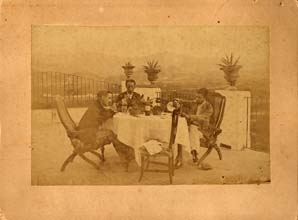
Hermanos Trenor Palavicino en la terraza del Monasteria
de San Jerónimo de Cotalba.
1855
[ca]. Colección Familia Trenor. |
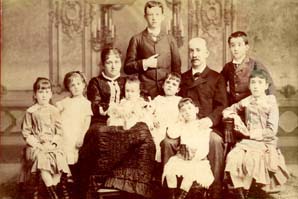
Familia de Ricardo Trenor Palavicino.
1880 [ca]. Colección Familia Trenor. |
| |
|
The city of Valencia was alien neither to the whirl of
events nor to the opportunities that exhibitions meant.
The Real Sociedad Económica de Amigos del País
had often fostered competitions and awards. The
authorities had even created the so-called July Fair in
1871, an event sometimes comprised of exhibitions; in
1872 an agricultural conference was held; in 1883 the
first Regional Exhibition was successfully promoted.
However, it was only held a few years later, in 1909.
The dream came true between July 1909 and November 1910
thanks to the Ateneo Mercantil and above all its
president and former mayor of the town, Tomás Trénor
Palavicino. The exhibition was first regional and later
national. With an area of more than 150,000 square
metres, a new walkway to the Alameda --the most elegant
walk in town--, about 20 impressive buildings, some
small pavilions, and more than 2,000 exhibitors, its
catalogue of new products praised Valencian agriculture,
its productive richness and the industrial expansion
generated by the new agro-industry… It included farming
produce but also metalwork objects, agricultural
machinery, railway materials, representatives of the
fertilizer and explosive sectors or from the furniture,
lighting, and leather tanning sectors, leather goods,
foodstuffs, etc.
The opening took place on 22 July 1909. King Alfonso
XIII and an entourage of authorities and outstanding
figures attended the ceremony. Tomás Trénor clearly
recalls the king's arrival: “People took the streets
very early in the morning. Troops filled the city with
their music in their marching to the opening site (…).
The royal train arrived at the platform. A few minutes
later a gun salute was heard, the army received the King
in Valencia with full military honours as music played”.
Numerous expressions of all sorts followed from that day
to early January the following year: horse-riding
competitions, athletics, cycling, stamp-collecting
contests, hot-air balloons and animals shows, automobile
rallies, meetings of all types, numerous conferences,
etc. Valencia had prepared for a great deal of
activities under the supervision of the organiser.
Tomás Trénor wrote: “Exhibitions are like receptions,
banquets and balls to social life; fairs and festivities
to citizenship; they show off strength, greatness and
vitality”. Valencia had to join in and follow the avenue
opened up in the new century, as other world events had
done before -Paris, London or Barcelona in the 1800s-
and keep the momentum of the regional exhibitions of
Madrid (1907) and Zaragoza (1908). That mission was
accomplished spectacularly, erecting not only a single
building but several ones along the lines of event:
trade fair, entrepreneurial pride, a city' show, and
leisure for the masses. That's very much the way the
exhibition was organised. But something must be added:
the incarnation of what those people understood to be
the Valencian region and Spain. That idea was fully
expressed in the symbols and décor of the buildings,
full of coats of arms and agricultural motifs.
What is left from all that? The city underwent
considerable changes: improved access, remodelled
streets, electricity, more hotels, restaurants and
leisure facilities. Yet, the final triumph was that of
architecture, with its remarkable Gothic style, a choice
that made reference to a glorious past looking for
bygone brilliant moments. With the Regional Exhibition,
Valencian elites entered mass society, making the
represented, desired and imagined virtual space their
own: industry and agriculture were not exactly as shown
at the Exhibition but the event actually recreated such
this reality as a trade public show. Its effects still
remain. |
| |
|
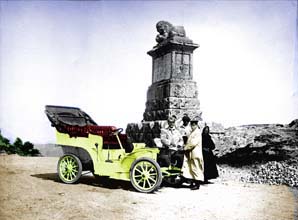
Tomás Trenor Palavicino en el Alto de
los leones. Colección Familia
Trenor. |
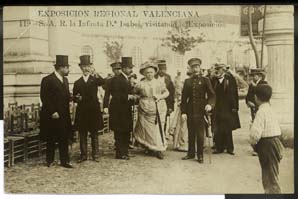
Visita de S.A.R la Infanda Dª Isabel a
la exposición Regional Valenciana.
1909. Archivo Gráfico de José Huguet. |
| |
|
2. Trénor. An exhibition of a bourgeois family
Thomas Trenor was born in Dublin in the late 18th
century in a family of merchants. Like many of his
neighbours, he emigrated to Spain. Apparently, he
arrived in the Iberian Peninsula during Napoleon's War
or shortly afterwards, following some of his relatives.
Philip Keating-Roche had come to fight as lieutenant
colonel of the 17th lancers regiment, the
so-called Light Dragoons of the British Army. He
was promoted during the conflict; in fact he is known as
General Roche. Among other merits, he commanded the
troops that beat Marshall Suchet in Mutxamel on 23 April
1812. Another relation of his was Henry O’Shea, who was
quartermaster general in the same army. After the war,
both Henry and Thomas were in Spain, the former in
Valencia and the latter in Cadiz, where many compatriots
did business. Physical distance did not seem to separate
them. Rather, their geographic choice possibly helped
their common businesses as partners and correspondents.
But possibly their trade was not too successful or maybe
circumstances changed, as Trenor soon moved to and
settled down in Valencia, maybe to be closer to his
relatives. We know that, when Enrique de O’Shea moved to
Madrid in 1824, Thomas took over the company previously
run by Henry. A year later, in May 1825, both of them
set up a joint corporation called Henrique O'Shea,
Trénor y Compañía, the merchant Guy Champion also being
a partner. The company focused on imports and exports,
paying special attention to the British market.
In fact, that very year the
company was leased the rights for the importation of
cod, a monopoly which had been regulated the year
before.
In the 1820s Thomas Trenor finally settles down in
Valencia under the umbrella of family businesses. He
starts a business of his own in the raisin export market
operating from the Port of Denia, closing down his
business in Cadis in 1827. Two years later, on 22 July
1829, he travels to Malaga to marry Brigida Bucelli, the
daughter of a family acquaintance, Pedro Fabio Bucelli.
Already rooted in Valencia, he resumes and expands his
businesses. In the mid 1830s, for example, he goes into
partnership with a British national living in Alicante.
Their company - Satchell and Trenor- trades with
different goods, especially vine-related products. In
1837, he empowers Antonio María Peyrolón to manage the
contract for “the steam boats that clean the Puerto del
Grao". The following year he takes a great opportunity,
namely the acquisition of the monastery of Sant Jeroni
de Cotalva in Alfahuir, among other, which had been
expropriated as a result of the Spanish
Desamortización.
But the purchase was not the only thing he did. He made
all efforts to improve the estate, resorting to all the
necessary measures. On the one hand, he maintained a
classic farming exploitation type of Valencia, that is,
leasing the land in small plots. On the other, he
introduced farming changes, dedicating part of the
estate’s land -then uncultivated- to grow vines. These
transformations involved other investments that would
stimulate productiveness and the distribution of
agricultural products, particularly raisins. Above all,
his investment went to this productive activity, as he
also distributed the products, especially as contacts
had been made in the areas of Safor and Marina.
|
| |
|
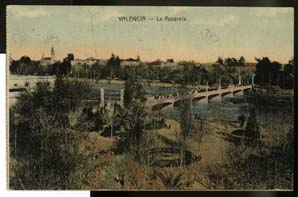
Vista de la pasarela construida sobre
el cauce del río túria. 1910
[ca]. Archivo Gráfico de José Huguet. |
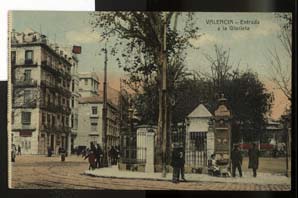
Entrada a la Glorieta.
1900 [ca]. Archivo Gráfico de José Huguet. |
| |
|
But his activities did not only concentrate on land
ownership and product distribution. In the late 1820s,
in 1828, his partner Guy Champion had granted power of
atterney to Henry O’Shea to rent a silk factory located
in Vinalesa, upon which a pact had been reached and
formalised in a deed with the corporation Combey y Cía.,
the owner and manager until then, as it had been evicted
by the Commerce Court. Years later, in 1842, Thomas
Trenor ended up buying it but an acquisition agreement
was likely to have been reached earlier. Perhaps he had
even bought part of it already. In this way, the
reinvestment of the profit made in his business
activities went to both agriculture and industry, in
this case the traditional silk manufacturing sector. The
silk factory in Vinalesa became one of the facilities
with a high level of innovation, as revealed by news at
the time. Among existing textile factories, three
spinning mills were said to undergo considerable
transformations, basically tanks to the application of
steam. One of the three was Trenor’s mill who “runs the
site of Vinalesa on behalf of an English company”.
Two initiates put forward later rounded up this trend.
In 1845 he bid in an auction to buy a house at Calle
Trinquete Caballeros in which he had lived as a
tenant. It was to become his home in the coming years.
In 1847 he starts a new business, Peruvian guano, thanks
to the English company Antony Gibbs & Sons, which had
been leased part of the monopoly by the Republic of
Peru. All that led to the incorporation in 1854 of the
company Trenor y Cía, initially in partnership with his
nephew Guillermo Mathews and, since 1858 with his eldest
sons. His five children were born between 1830 and 1840:
Federico, born in March in 1830; Enrique, in July 1832;
Tomás, in August 1835; Elena, in October 1837; and
Ricardo, in July 1840. In 1858, his two eldest sons
were 28 and 26 years old, respectively. They were the
only ones who could work with their father, as they were
already over the age of consent, 25 at the time, while
Tomás had enrolled at the military academy of engineers
and Ricardo was still too young.
Tomás Trenor died soon after setting up the company with
his sons, in September 1858, while staying at Panticosa
spa. Upon his death, his heirs made an inventory of his
assets. Apart from the already mentioned investments, it
included shares in several large companies such as the
railway lines Madrid-Zaragoza-Alicante and Almansa-Valencia-Tarragona,
financial firms like Crédito Mobiliario Español,
Valenciana de Seguros Marítimos or Crédito Valenciano,
and the partial ownership of different boats. Yet, the
family decided not to split the inheritance they were
legally entitled to. The eldest brothers (Enrique and
Federico) continued managing the company and the
inheritance, paying their mother and the other children
5% yearly interest each based on their corresponding
divisible amount. Enrique and Federico would give their
brothers and sister their inheritance as they became
emancipated. In 1861, Federico married the daughter of
the Marquis of Misarol, Maria de la Concepción
Palavicino Ibarrola. The youngest brothers got married
too: Tomás married his sister in law, Desamparados, in
1862 and Ricardo married Josefa in 1864, while Federico
got married to Julia Montesinos Sacristán in 1860 and
Elena to Juan I. de Llano White in 1862.
Despite these marriages and the many children they all
had, the family company continued operating throughout
the century, doing the usual business and other
activities. Among such activities is the Colonial
Refinery of Badalona, which manufactured sugar lumps.
The famous Marquis of Comillas would go into partnership
in this company later on. Another example is the
sulphuric acid and fertilizer factory of El Grau, one of
the first in Spain and a pioneer in phosphate
solubilisation using this acid. By then, at the
beginning of the century, some of the grandchildren were
already partners in the company, like Tomás Trenor
Palavicino. Born in 1864, he was named after the
dynasty’s founder, like his father. He shared something
else with his father: he enrolled at the Military School
of Artillery in 1881. He was a member of parliament from
the conservative party, representing the constituencies
of Albaida and Vinaròs, in 1903 and 1907, but most
importantly he was the promoter of the 1909 Regional
Exhibition of Valencia, an initiative that awarded him
the title of Marqués de Turia and caused him
considerable economic pain too, as he had to meet a part
of the deficit of the event. Married to Margarita de
Azcárraga, the daughter of the famous military and
politician Marcelo Azcárraga, the Marqués de Turia
died in Madrid in March 1913. |
| |
|
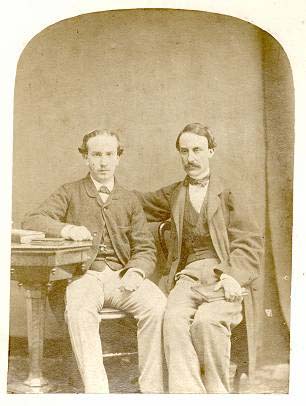
Hermanos Tomás y Federico Trenor
Bucelli, 1870 [ca]. Colección Familia Trenor. |
| |
|
|

