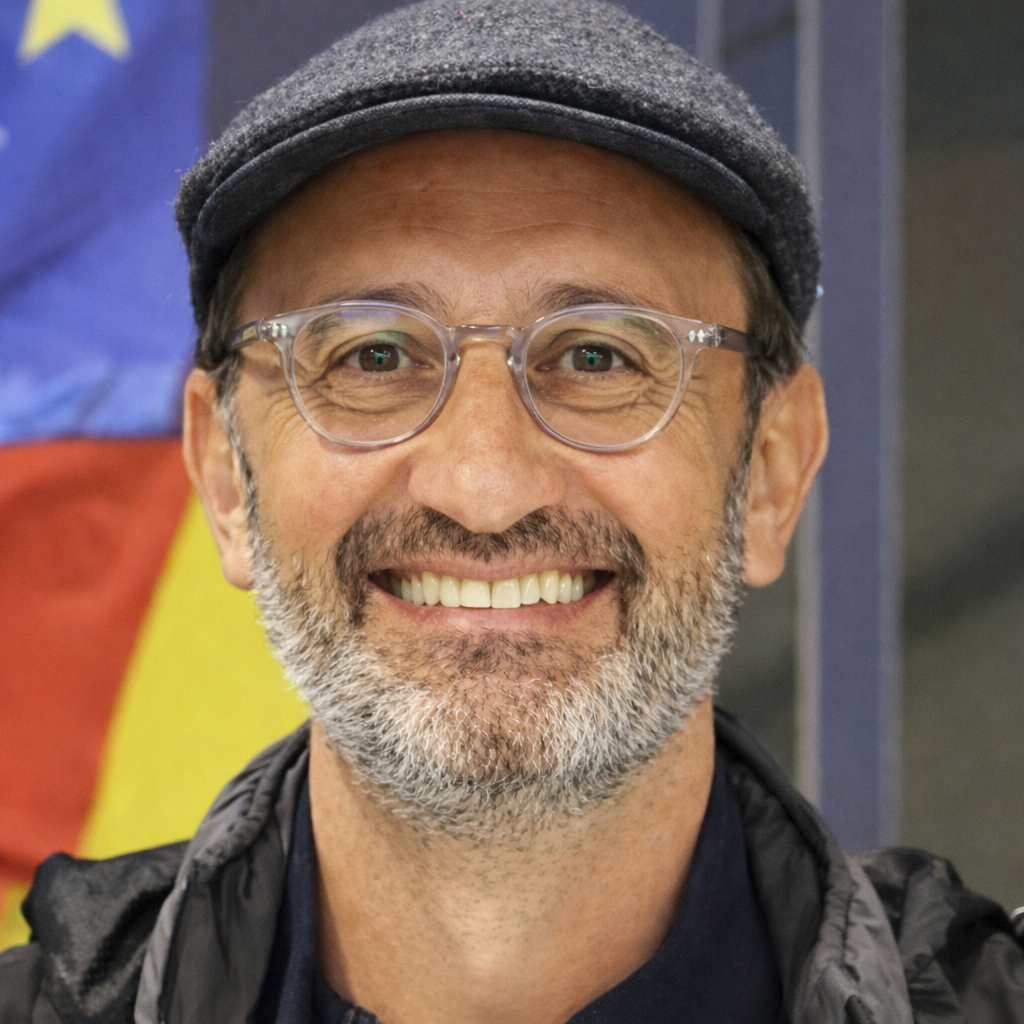
Gustau Camps-Valls
Gustau Camps-Valls

Gustau Camps-Valls

Research vision

My work lives at the intersection of machine learning and Earth sciences. I focus on AI algorithms that not only predict but advance our understanding of the Earth system. Causal and equation discovery, as well as hybrid models that integrate domain knowledge, help build a more resilient and trustworthy understanding of our changing climate.

My research pathway

I have a big problem: polymathic curiosity—genuinely interested in almost everything.

My PhD thesis tackled ML in a pressing bioengineering context: optimizing drug dosages to reduce the risk of kidney rejection while avoiding patient intoxication. The problem was challenging from a statistical viewpoint: high-dimensional data with few samples, unevenly sampled time series, noise sources, multi-criteria objectives, and domain shifts across centers. That was the early 2000s, and Support Vector Machines rocked (and still do!). Though I learned a lot, I eventually decided to pivot domains.

I spent many years developing kernel methods for image and signal processing , spanning segmentation, estimation, interpolation, deconvolution, information theory, compression, and denoising. The next leap occurred when I moved from still images to the exciting realm of satellite remote sensing. I began tackling remote sensing problems using both neural networks and kernel machines , ranging from parameter retrieval to classification, anomaly detection, and change detection using Earth Observation (EO) data.

This led me to explore global problems in the geosciences and climate sciences. My journey began with uncovering fundamental patterns—from the spatiotemporal dynamics of carbon and water cycles and global crop photosynthesis to defining new vegetation indices, characterize information and memory, and develop novel indicators for monitoring the Earth system and impacts of climate change. Actually we have advanced ML to predict and understand risks and extreme events, from droughts and heatwaves , to floods and wildfires .

To move the field toward process-based reasoning, I helped establish the current paradigm of hybrid modeling—combining deep learning and process understanding for Earth system science. I also contributed to foundational books on both kernel machines and deep learning for the geosciences, a field that started to be dominant. But prediction is just a tiny bit of our scientific endevour. AI must not only predict but also respect physical laws—a philosophy that has evolved into next-generation Earth system models. This requires a distinct attitude: interdisciplinary collaboration and fostering genuine curiosity and serendipity.

In recent years, my work has placed more emphasis on decoding the why behind climate extreme events. This includes inferring the causes of ecosystem change and providing a roadmap for causal inference in time series, as well as discovering laws and equations from observational data. We are now pushing the boundaries of AI foundation models for Earth and climate science and building early warning systems for complex climate risks, ensuring that machine learning provides transparent, physically consistent insights for a sustainable future.

This is a brief summary of my interests and contributions—none of which would have been possible without the invaluable help of the collaborators, students, and colleagues I've met along the way. I am very lucky to have found such an incredible group of people.

About me, the person

Outside of research, I am driven by jazz 🎷, basketball 🏀, the philosophy of science 📖, and the art of photo-haikus 📸✍️. Actually, if you want to read my thoughts in between AI, philosophy, art and life just read my stories in Medium.

Current Positions

Past Positions & Honors

  • Invited Researcher: UC3M (2001), UNITN (2005), MPI (2009)
  • Invited Professor: EPFL (2013)
  • IEEE Distinguished Lecturer: GRSS (2017-2020)
  • IEEE Fellow: GRSS & SPS (2018)
  • ELLIS Fellow: Program Coordinator for Earth & Climate
  • AGU Fellow (2025)
  • Fellow of European Academy of Science (2022)
  • Fellow of Academia Europeae (2022)

Awards

  • Carl-Zeiss-Humboldt Research Award (2025)
  • Blaise Pascal Medal by the European Academy of Sciences (2025)
  • IEEE David Landgrebe Award (2024)
  • ERC Synergy Grantee (2020)
  • ERC Consolidator Grantee (2015)
  • Highly Cited Researcher (2021-2025)

Curriculum Vitae

Find me, Read me, Know me

Research Funded By

UV ERC Horizon GVA ESA Microsoft ELLIS