
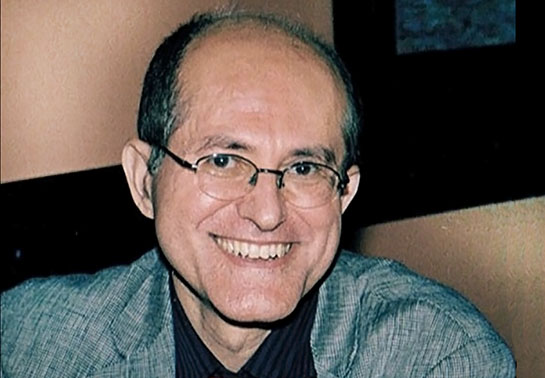
The researcher of the Institute of Corpuscular Physics (IFIC), José Wagner Furtado Valle obtained the Premio México de Ciencia y Tecnología of 2018, the highest award that the Mexican government gives to distinguished scientists of Central America, South America, the Caribbean, Spain and Portugal. The award recognises the trajectory of this researcher –one of the most quoted ones in high energy physics in Spain. He made relevant contributions to neutrino physics, one of the most abundant and mysterious elemental particles of the Universe.
José W. F. Valle (1953) started his studies of Physics in the University of Brasília located in Brasil, his homeland. His first steps in the high energy physics date back to his PhD in the University of Syracuse (New York, USA) in 1982. From there, he moved to the Rutherford Appleton Laboratory of the United Kingdom as a postdoctoral researcher. After a stay in the Universitat Autònoma de Barcelona, he arrived at the Institute of Corpuscular Physics of València in 1987, where he was the responsible of the Theoretical Physics Unit and he is the leader of research in Astroparticle Physics and High Energy (Astroparticles).
He is the author of more than 300 research articles with approximately 30.000 quotations, what makes him one of the most quoted high energy theoretical Physicians in Spain. He made important contributions to the research of neutrinos, an elemental particle that interacts with the ordinary matter and which is tough to keep valuable information about the early Universe. It is known as ‘ghostly particles’ due to the difficulties which it generates to be detected.
José Valle contributed to the development of models made in order to explain how the neutrinos acquire mass. The existence of mass in neutrinos was proved at the beginning of the 21th Century with the discovery of the phenomenon known as ‘neutrino oscillations’. This discovery, in which José Valle helped, meant for its finders receiving the Nobel prize of Physics in 2015. Furthermore, together with Joseph Schechter, he proposed a method to verify if the neutrino is itself antiparticle, a question which has not been resolved yet and which confirmation would explain one of the great questions of the origin of the Universe: Why are we constituted of matter?
In his position in the Institute of Corpuscular Physics´, Centre of Excellence ‘Severo Ochoa’ of the Universitat de València and CSIC, José W. F. Valle contributed to give formation to more than half a hundred of young researchers in the last 25 years, a lot of them came from Latin American, in particular, México. Thus, the called División de Partículas y Campos de la Sociedad mexicana de Física (Division of Particles and Fields of the Mexican Society of Physics) gave him its Medal in 2014 to recognise his science promotion efforts on both sides of the Atlantic. He also received the Research in Particle Physics Award of the Humboldt Foundation (2002) and the Iberdrola Award of Science and Technology in theoretical Science (1999) Moreover, the researcher developed a hard work in order to bond the cooperation among scientists in Latin America and Europe.
‘I am really pleased with this status for the neutrino Physics’, assures José Valle ‘because these elemental particles play an essential role in the microscopic compression of the Universe. And they have a great potential to clarify how the next step beyond the current paradigm of Physics will be.’ On the other hand, ‘the award is also a status of the effort of my team by creating scientific tables in Latin America over the last 25 years.’