
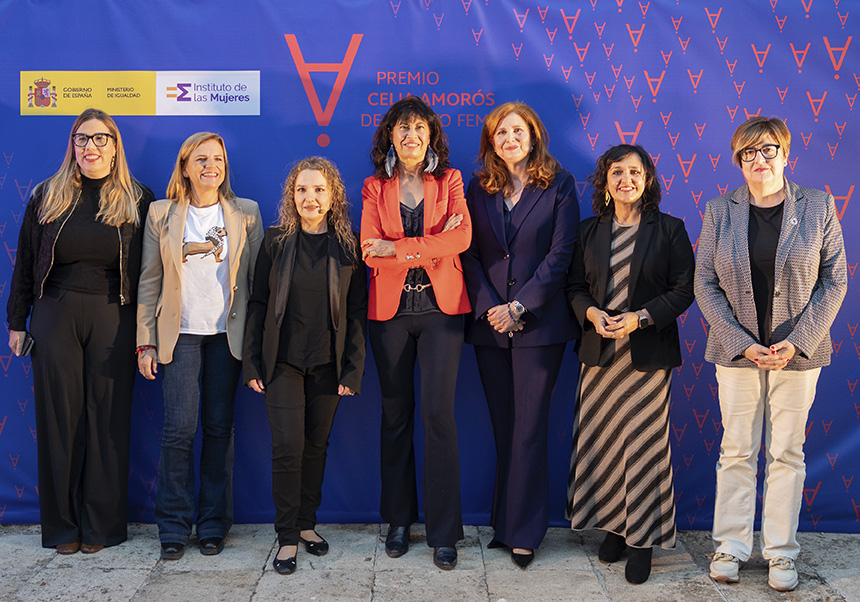
Elena Martínez, a professor of law at the Universitat de València, has been awarded second prize in the Celia Amorós Award for the best feminist essay. The professor received the award from the Minister of Equality, Ana Redondo, in recognition of her work on “The Practical Application of the Gender Perspective in the Spanish Criminal Justice System: Why, What For, and How.”
The jury for this 3rd edition unanimously decided to award the prize to the work ¨Los triángulos rojos. Exiliadas de Franco y deportadas de Hitler¨ (The Red Triangles: Exiled by Franco and Deported by Hitler) by Amalia Rosado Orquín, which explores the recovery of the memory of Republican women who were exiled and deported. In addition, the jury decided to award the runner-up prize to the essay ¨The Practical Application of the Gender Perspective in Spanish Criminal Justice: Why, What For, and How¨, authored by Elena Martínez García, a professor of Procedural Law at the Universitat de València.
The event was held at the headquarters of the Government Delegation in Valencia and was attended by Delegate Pilar Bernabé, Secretary of State for Equality and the Eradication of Violence against Women María Guijarro, and Director of the Women’s Institute Cristina Hernández.
The Celia Amorós Award for Feminist Essays was established in 2020 by the Women’s Institute, an autonomous body attached to the Ministry of Equality, to recognize and highlight excellence in feminist research across all academic disciplines and to promote the production of knowledge that contributes to transforming our society through gender equality.
The awards ceremony for this third edition took place in Valencia, the birthplace of philosopher Celia Amorós, the first woman to receive the National Essay Prize in 2006—an honor that has since been awarded to only five other women.
The award offers a prize of 15,000 euros for first place and, for the first time, 5,000 euros for second place. Winning either award entails a commitment by the Women’s Institute to publish the winning works, which will become part of the organization’s catalog of publications.
Accésit to the work by Elena Martínez
The work ¨La aplicación práctica de la perspectiva de género en la justicia penal española: por qué, para qué y cómo¨ (The Practical Application of the Gender Perspective in Spanish Criminal Justice: Why, What For, and How) has been awarded second prize for its innovative approach and its contribution to a largely unexplored area in Spanish academic law: the application of the gender perspective in the criminal justice system.
Its author, Elena Martínez García, is a professor of Procedural Law at the Universitat de València and a specialist in judicial protection and transnational protection against gender-based violence. She is also the founder of the Master’s program in Law and Gender-Based Violence at the same university and has an extensive track record in international research. The essay offers an accurate, in-depth, and rigorous analysis that adequately contextualizes the current situation and provides a detailed overview of the evolution of legislation. One of its main merits is its constructive critique of the system, precisely identifying the areas where the legal framework still has significant shortcomings.
The jury highlighted that, despite the complexity of the subject, the work strikes a balance between technical rigor and clarity of exposition. Its accessible style, combined with a careful literary approach, makes the content accessible to a wider audience and facilitates understanding of the current legal framework.