
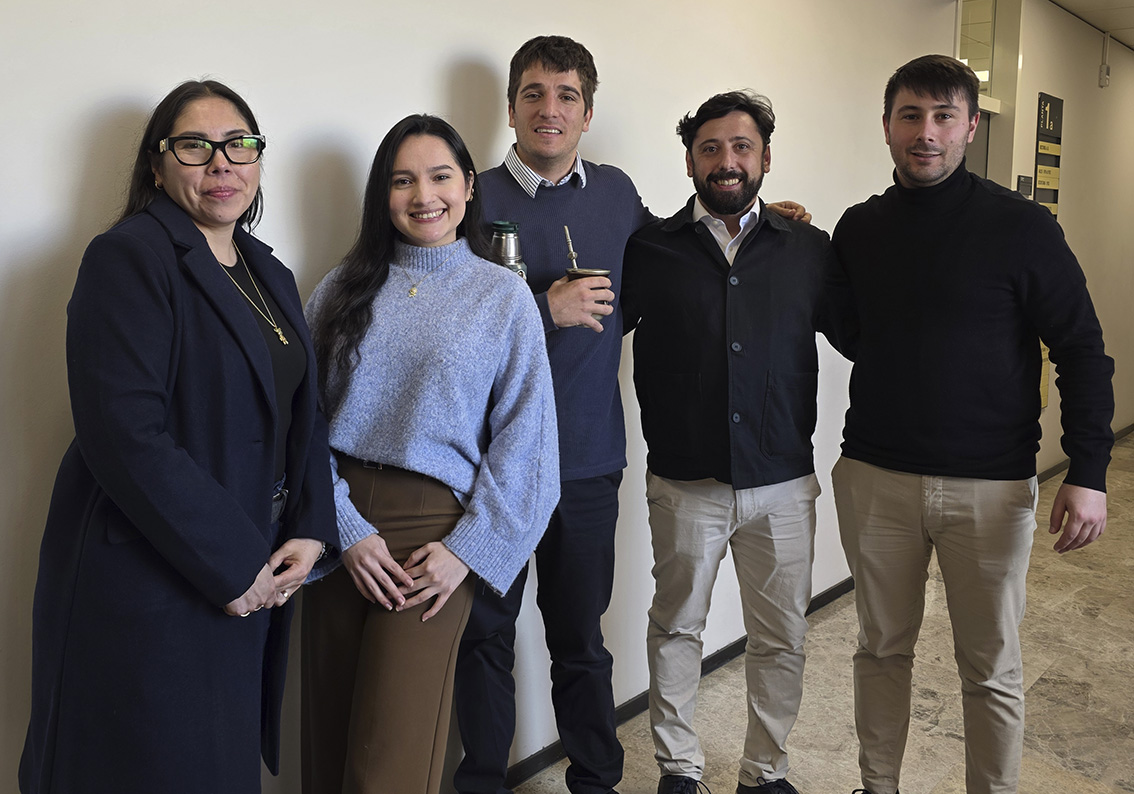
The blended programme of the Master’s Degree at the Universitat de València (UV), coordinated and conducted by Carlos Esplugues and Silvia Barona, gathers every year professionals and graduates from different countries, who want to further their legal training from an international perspective. Through an academic proposal combining specialised teaching, research and seminars with professors from several legal systems, the programme offers the students a global vision on Law, and the opportunity to set professional networks in a more and more interconnected global context.
On the way to the Doctoral degree
Ignacio Otazo is from Chile and has been working as a lawyer for 15 years. When he enrolled the Master’s Degree in Law, Business and Justice at the Universitat de València, he decided to get on the path towards research, without neglecting his job as a lawyer in his country. What interested him most about the UV programme was that it enables the access to a Doctoral degree, since it “combines methodological subjects with others related to different fields of law in a wide and holistic vision that allows us to have a cross-disciplinary development” underlines the lawyer.
Concerning the Doctoral degree, the line of research of Ignacio Otazo is focused on the branch of public law. “I am very interested in how the Universitat de València reconciles this vision of commercial law within public law and the models of economic constitution, as well as its application to the State's contractual regime.", he explains.
However, Otazo is not the only Latin American lawyer who is interested in continuing the academic career with this Master’s Degree at the Universitat de València. Carlos Esplugues, coordinator and professor of this Master’s Degree explains that “this is the continuation of a doctorate programme we had in Bolivia, which was funded by the Generalitat Valenciana (Valencian government). Then, when the programme was finished, we realized there was an educational lack and besides, the price there is absolutely exorbitant. Consequently, we thought that we could carry out them in Spain, and that, for the same or half the price they pay in their corresponding countries, they could have a Master’s Degree by a Spanish prestigious university — one of the bests in Europe —, experience living out of their country, travel across Europe, and on top of that, study a Master’s Degree”.
His approach to Latin America manages to attract more and more lawyers from Chile, Colombia, Argentina or Peru.
According to Marjorie Castillo-Rivas, Chilean lawyer, in her country lawyers have a more limited vision aimed at applying the current legislations more than the methodological preparation for research. The lawyer has several interests and, thanks to the programme she was able to explore them all: from arbitration, mediation and business law to constitutional law. Additionally, she points out that she found congresses and seminars on artificial intelligence extremely interesting and useful for the current digital context.
The Master’s Degree final project of the Chilean lawyer is focused on international family mediation applied to child abduction, a more and more common phenomenon, specially between couples of several nationalities. What happens with children when these families split? Castillo-Rivas explains that the proposal of her Master’s Degree final project is to avoid that children and teenager rights are violated. “If we go to our Family Courts, we could spend three, four or five years with an international abduction case; mobilising the Interpol and other processes could take so many years that when they come to a solution, the damage on the child is irreparable” complains Marjorie Castillo-Rivas.
Her desire to continue the Doctoral degree at the Universitat de València became stronger after studying the Master’s Degree. “Previously, I had a more lawyer-like profile, I only cared about the current regulations and that was enough for me, because that was what we were taught in Chile; now I feel like I am other type of professional that wants to know more, research and go beyond national issues” recognises the lawyer.
Blended learning
Blended learning allows the students to combine their job in their corresponding home countries with a short-term stay in Spain, accompanied at all times by top-level teachers, such as Carlos Esplugues, who is well-known in Latin America, and Silvia Barona Vilar, renowned professor that is at the forefront of the Alternative Dispute Resolution (ADR) protocol.
“It is a special Master’s Degree, which is specifically designed for people that is already working. That’s why this Master’s Degree can be studied in two years without a price increase, applying a blended learning method, and taking only 10 weeks in València that are also scheduled when their holidays are”, explains Professor Carlos Esplugues.
People interested in this programme are usually “lawyers, corporate lawyers, lawyers at law firms, judges, notaries, administration staff, senior civil servants, etc., that want to complete their education, refresh their knowledge, while having the opportunity to go abroad and spend an amazing time in a country like ours” notices Esplugues.
“The two-intake system was very helpful for me. Since I am a Teaching Assistant at the University of Lima and also the Head of Legal at a financial services company, I can get quite overwhelmed at times. Having the opportunity to complete the program in two modules is really interesting” explains Karen Sánchez, student of the Master’s Degree and lawyer in Peru.
According to the students, the programme offers a comprehensive preparation that allows a foreign lawyer to get to know the Spanish legal system, and learn about other countries’ law, including their own country. “Professors here not only know about the Spanish legal system, but they also know about many legal systems in Latin America, including ours, thus, we not only learn about Spain, but we also learn about American countries”, explains Otazo.
Immediate implementation
“I started studying this Master’s Degree because it was being difficult for me to find a job in Spain; all the companies claimed: “All right, you have studied Law, incredible, but it is not Spanish Law”” mentions Massimo Di Pietro. Currently, the Italian lawyer works for a well-known insurance company, and thanks to this programme he is specialising in insurances of multi-risk companies.
Being able to attend the programme either full-time or divided in two courses is usually a very attractive option for professionals that still carrying out working and family life. Many people attend university face-to-face only for a few months, however others, like Massimo Di Pietro, have found their place in València.
After completing the programme, Di Pietro has noticed a dramatic change in his ideas about the legal profession: “this Master’s Degree has taught us other ways to solve things, such as mediation or arbitration, which are legal tools I love, because it is not a litigation, you know? We won’t be arguing in front of a judge…”
For Massimo Di Pietro is essential to unblock the legal system, which has been collapsing for years in Italy: “I believe that mediation and arbitration are not an alternative option, they are crucial to solve this problem”.
Professor Silvia Barona Vilar explains that the ADR protocol, or Alternative Dispute Resolution, has existed for a long time, but since 2025, a long list of procedures was recognised in Spain. These procedures make it easier to solve conflicts through agreements, avoiding the collateral time, costs, and psychological damage that involve attending courts of justice and legal proceedings.
“With them it is accepted to seek a mutually agreed solution, assuming that it will always be better the agreement than the judicially imposed decision. The major problem is the lack of an ADR-based culture; there is still a culture based on conflict and legal solutions, and a great deal of effort is needed to disseminate ADRs and professionalize those who use them, as well as to show society that, although they are not the solution for every type of conflict, they do offer 'multi-door justice' that, in case of ending without agreement, it leaves the way open to attend the courts”, warns Barona Vilar.
“Silvia Barona opened up a world to me, because ADRs are not studied in the degree, and now they appear everywhere; it is a topic, that if you spend a little time searching, you can find a great amount of articles; people have written a lot about it”, notices Ana Olivares, jurist and criminologist by the Universitat de València and student of the Master’s Degree.
The Italian lawyer is already getting the most juice possible to the Master’s Degree. He explains that working for an insurance company involves most of the times going to court. What he pretends now is to see “if for once, they are able to sit at a table with the mediator and achieve mediation or arbitration”, concludes Di Petro.
Jerónimo Frittayón, Argentinian lawyer, is especially thankful for the real approach to legal proceedings in Spain throughout their training: “One comes here and everything is new; we know how trials in our country are, but being able to watch legal proceedings from the inside and not only through books or lectures, was very rewarding”.
“What we want is that they achieve a practical knowledge about Spanish reality, so we organise events designed for that purpose. Consequently, they visit from the Tribunal de las Aigües to the courts, where they see in a practical way how Spanish law works”, adds Esplugues.
A window to the world
The Master’s Degree on Law, Business and Justice is qualified to both attract foreign talents, and project its enrolled students into a global stage where professors from Austria, Italy, Colombia, Peru, and Brazil are welcomed, which enables students to enjoy a holistic vision of the subjects, as well as setting useful contact networks for the future, both with colleagues, and research staff on Law.
“We don’t know if we will find ourselves litigating internationally in the future; but we will have the opportunity to reach out local lawyers. I am completely sure that we will continue nurturing and maintaining the friendships we have made after the Master’s Degree”, believes Raissa Murillo, lawyer in Colombia and student of the programme.
In the case of Maryam Alrefae, from Kuwait, her desire to become an ambassador led her to study abroad. After graduating in Law in London and making the decision to learn Spanish, she wanted to broaden her horizons as a diplomatic at the UV: “my Master’s Degree final project is about international justice; I will focus on Palestine, Sudan, and Ukraine, what is happening there, and how international law works different in those cases”, explains Alrefae.
Besides, the Chinese student Zhijan Peng, who studied his Degree in Law in Spain, is doing the Master’s Degree final project about data collection by autonomous vehicles, that is, driverless vehicles. Peng believes that these vehicles violate individual rights and privacy because they collect biometric data without the corresponding informed content through 360-degree cameras. When he finishes, Peng wants to continue his education as a lawyer in Spain through the Master’s Degree in Law.
Regarding Massimo Di Pietro, the influence of a multicultural environment is clear. After getting to know all his classmates— most of them from Latin America, another from Italy, and two Spanish girls—, he told his boss about moving to work for a year halfway around the world. “It’s possible that I live there too”, mentions the Italian lawyer.
Jerónimo Frittayón specifies that what was most remarkable for him was the wide orientation to Law, Business, and Justice from an international point of view. The Master’s Degree final project of Frittayón is focused on the digitisation of the legal system, underlining the most vulnerable groups, such as people with disabilities, and elderly people.
The Argentinian lawyer warns that, although digitisation is being developed for years in his country, and in the rest of the world, when one thinks about digitisation, the benefits it involves are the first thing one pays attention to. Conversely, Jerónimo Frittayón’s research is focused on those groups that may be negatively affected by this current and unstoppable project: “I am conscious of the disadvantages it involves, apart from generative AI and so on… my point of view consists on analysing the disadvantages and putting both groups on the table”, states the Argentinian lawyer.