
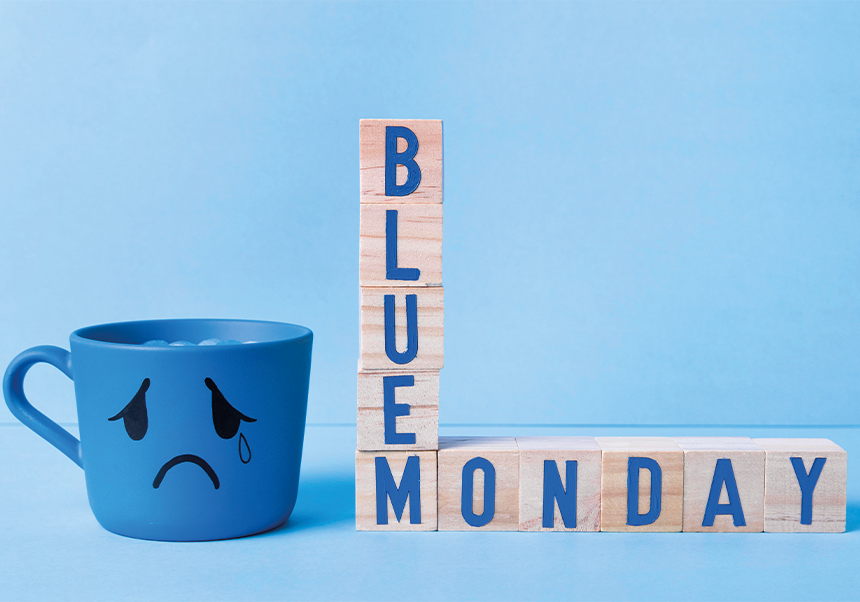
Every third Monday of January, the concept of Blue Monday floods social media, the news, and everyday conversations. This day is known as the saddest day of the year, and the term is closely linked to Anglo-Saxon culture and the English language.
- Why blue? In English, the colour blue is associated with sadness, restlessness, and melancholy. Its origin is debated: some trace it back to nautical traditions (hoisting blue flags to signal the loss of a captain or crew), while others point to classical literature, where it was already used to describe low moods—feeling blue. In Spanish or Catalan, we would use different expressions, such as estar de capa caída, or we might associate sadness with the colour grey.
- We also cannot forget the musical genre blues. This genre emerged as an expression of the sadness and hardships experienced by African and African American communities subjected to enslavement on North American plantations.
The True Story Behind the Term
Unlike other significant dates, the history of Blue Monday goes back just over two decades and originates with psychologist Cliff Arnall. He claimed to have identified the saddest day of the year using a formula that took into account various factors, such as winter weather, debts incurred during the Christmas holidays, the return to routine after time off, and a lack of motivation regarding New Year’s resolutions.
The term Blue Monday was coined in 2005 in the United Kingdom as part of a marketing campaign for a travel agency. To lend the idea some authority, Arnall’s theory was used. Although the theory may seem convincing because it reflects common experiences, it lacks scientific backing and has been widely discredited—even by Arnall himself. Nevertheless, this has not prevented the concept from influencing everyday life, particularly in marketing and sales, where businesses promote their products as solutions to this artificially induced sense of sadness.
Evolution: From Marketing to Mental Health
Today, the debate no longer focuses on whether the third Monday of January is mathematically the saddest day of the year, but rather on how the language we use can affect our mental health. Blue Monday has become an opportunity to talk about resilience and about how terms borrowed from other cultures influence the way we experience winter.
Ultimately, regardless of the accuracy of its formula, Blue Monday is a fascinating example of how a linguistic construction can shape the behaviour and emotions of millions of people around the world.