.jpg)
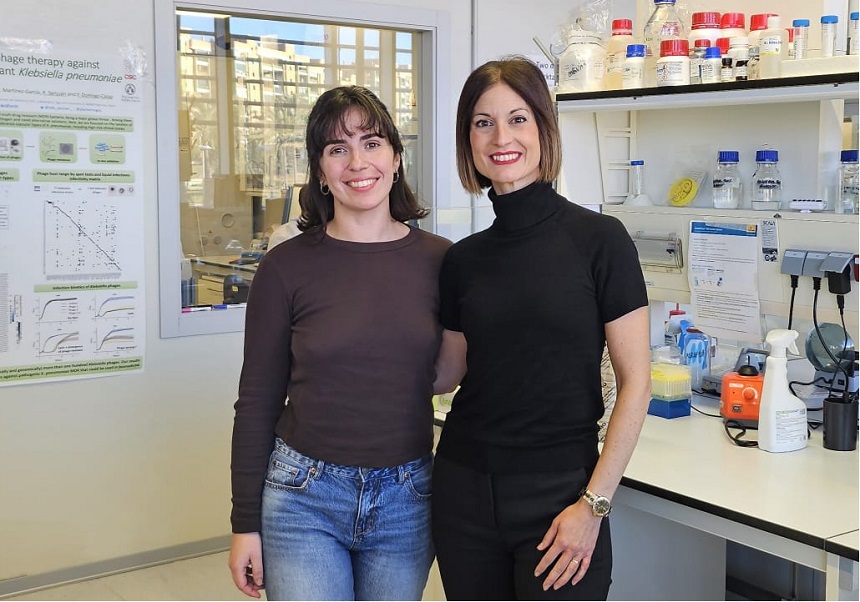
A study led by Celia Ferriol-González and Pilar Domingo-Calap, researchers at the Institute for Integrative Systems Biology (a joint centre of the University of Valencia, UV, and the Spanish National Research Council, CSIC), reveals the evolutionary mechanism used by phages — viruses of therapeutic interest — to infect multidrug-resistant bacteria. The findings, published in PLOS Biology, open new avenues for developing more effective therapies against these bacteria.
Phages, also known as bacteriophages, are viruses that infect and destroy bacteria. They are present in all ecosystems and are considered a promising tool for combating antibiotic-resistant bacteria. This study examines how phages adapt to target different species of bacteria of the genus Klebsiella, responsible for severe hospital-acquired infections and highly resistant to antibiotics.
These bacteria possess a kind of external “shield” called a capsule, which varies greatly between strains and acts as a barrier against phage entry and antibiotic activity. Previous studies by the Environmental and Biomedical Virology Group, led by UV Genetics professor Pilar Domingo-Calap at I²SysBio, demonstrated the specificity of the capsule of most Klebsiella phages.
To infect a bacterium, each phage must recognise this capsule — but not all do so in the same way. Specialist phages attack only one specific type of capsule, whereas generalist phages can infect multiple strains with different capsules. Through this work, the researchers have identified the mechanisms that allow certain phages to expand their range of attack, a key insight for designing more effective treatments against multidrug-resistant bacteria.
Their results show that the key to this adaptation lies in specialised proteins used by phages to recognise the bacteria’s protective capsule. These proteins, known as receptor-binding proteins, are far more “flexible” in generalist phages, enabling them to evolve rapidly and attack multiple types of capsules. By contrast, specialist phages have more rigid proteins, which limit their ability to adapt.
This research therefore contributes to understanding how different phages adapt to broaden their host range — that is, to infect multiple strains. “The main challenge of this study was monitoring the evolution of various phages within the same viral community and their adaptation to a complex environment composed of numerous bacteria with different capsular types”, explains Ferriol-González, co-author of the article.
In addition, the researchers observed that phages can exchange genes with one another, accelerating their evolution and further expanding their range of action. This discovery opens new paths for designing phage-based therapies against resistant infections, a growing public health concern.
Towards More Effective Treatments
Bacteria of the genus Klebsiella, the model used for the study, are included in the WHO’s list of priority bacterial pathogens. “Phages that infect Klebsiella are of great interest due to the challenges posed by this bacterium. Understanding how they evolve and adapt may be crucial for developing phage-based therapies that are more effective and tailored to each patient”, says Ferriol-González.
“This study is a step forward in the design of personalised phage-based therapies and opens the door to using directed evolution to optimise proteins of interest, as well as expanding the range, as we have demonstrated”, adds Pilar Domingo-Calap.
Domingo-Calap also emphasises that “the use of phages as therapy is increasingly gaining momentum, but there is still much to understand”. “Understanding phage–bacterium interaction mechanisms, viral evolution and adaptation, as well as ecological relationships, allows us to design more effective tailored therapies. From our research group, we continue advancing knowledge in this field, from fundamental science to therapeutic application through our spin-off, Evolving Therapeutics”, she concludes.
Reference:
Ferriol-González, C., Domingo-Calap, P. (2025). The host range of generalist and specialist phages in capsule-diverse Klebsiella hosts is driven by the evolvability of receptor-binding proteins. PLOS Biology, 23(11), https://doi.org/10.1371/journal.pbio.3003515