



New findings shed light on the formation and future of planetary systems
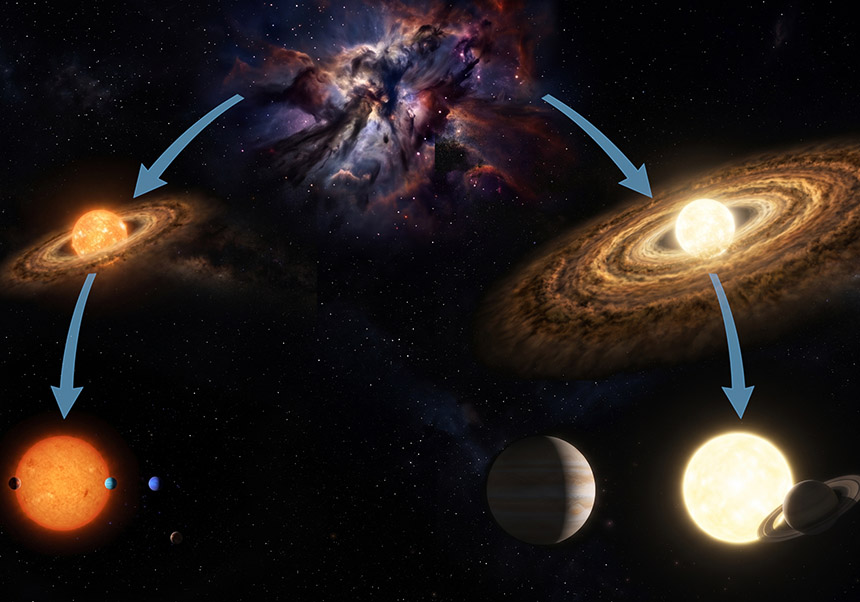
Schematic illustration of the genetic link between stellar properties and the architecture of planetary systems. Credits: INAF / UV/ image generation assisted by Gemini AI.
An international study co-led by the University of Valencia (UV) has revealed new findings on the formation and future of planetary systems. The research highlights that understanding the link between planets and their stars is key to the search for structures similar to the Solar System and other habitable worlds.
The catalogue of exoplanets is growing rapidly and already includes more than one thousand known multi-planet systems. In this context, the work, published in Nature Astronomy, emphasises that explaining the origin of this diversity is a fundamental challenge in understanding planet formation.
Camilla Danielski, researcher in the UV Department of Astronomy and Astrophysics, and Diego Turrini, researcher at Italy’s National Institute for Astrophysics (INAF), argue that there is a genetic link between planetary systems and their stars. This link “may predetermine the future of planetary systems and is key to the search for planetary architectures truly similar to the Solar System and for potentially habitable planets like Earth”, Camilla Danielski stresses.
In this regard, the researchers identify two distinct families of planetary systems that differ markedly both from each other and from the Solar System. The first family consists of large, massive systems, while the second comprises more compact systems with comparatively lower masses.
The study also emphasises that the differences between the two families extend beyond their planetary architectures. The planets also orbit stars with different properties, which means that the systems evolve differently. “Massive, extended systems, in particular, show clear signs of having been shaped by violent dynamic instabilities that have caused the loss of some of their original planets”, explains Diego Turrini.
The origin of planetary systems
The findings “demonstrate for the first time that stellar properties, which reflect those of the surroundings of the planetary formation, are fundamental to determine both the nature of a planetary system as a whole and the direction of its future dynamical evolution”, Danielski emphasises. In this respect, periods of violent instability and major impacts “may prevent habitable environments from emerging within these systems”, she adds.
This work was carried out as part of the European Space Agency’s (ESA) Ariel space mission, which aims to study the atmospheres of nearly a thousand exoplanets and is scheduled for launch in 2031. Spain is actively involved in the mission through institutions such as the University of Valencia. The exoplanets observed in this study are among Ariel’s scientific targets. In addition, Danielski and Turrini’s research team has incorporated some of the methods developed for the space mission into its research.
Spain is actively involved in the mission through institutions such as the University of Valencia. The exoplanets observed in this study are among Ariel’s scientific targets. In addition, Danielski and Turrini’s research team has incorporated some of the methods developed for the space mission into its research.
The study was supported by the International Space Science Institute (ISSI) in Bern through ISSI International Team project No. 558, Transformation of Planetary Systems by Environmental Perturbations, led by principal investigator Kruijssen. The Italian Space Agency, the Centrum Badań Kosmicznych PAN (Poland) and Uppsala University (Sweden), amongst other institutions, have also taken part in the study.
Article reference: Turrini, D., Danielski, C., Polychroni, D., Przyluski, R., Rickman, H., Bossini, D., Diederik, Kruijssen, J. M., Zinzi, A., Goodwin, S., Longmore, S. N., Chevance, M. and Ramambason, L. (2026). “Two families of multi-planet systems with distinct architectures and stellar hosts”. Nature Astronomy. https://doi.org/10.1038/s41550-026-02990-8





