



OpenMolcas brought the quantum chemistry community back to Valencia 20 years after the first workshop
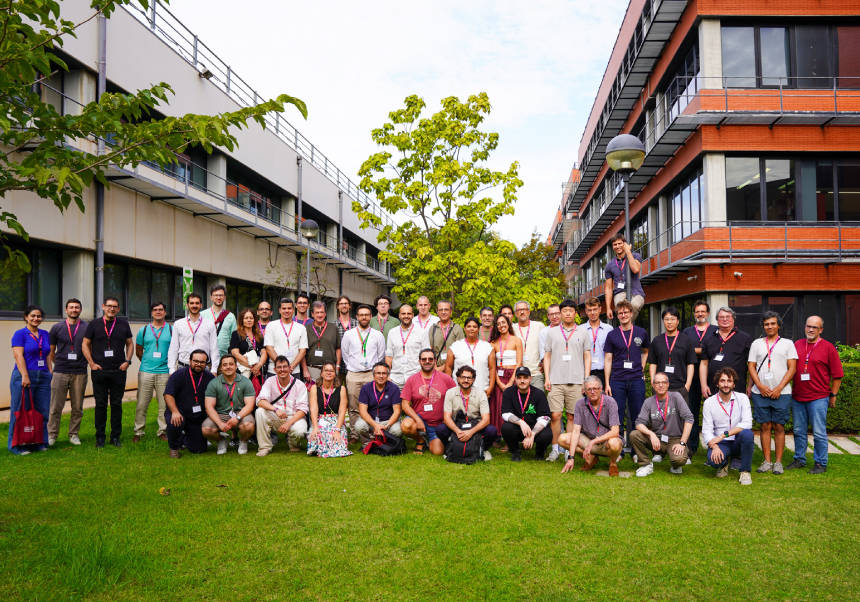
Group photo of the participants in OpenMolcas at the UV Science Park.
The Institute of Molecular Science (ICMol) of the University of Valencia (UV) hosted the 14th OpenMolcas Developers' Workshop from 5 to 7 October on the Burjassot Campus. The event brought together international developers and users of OpenMolcas, a quantum chemistry software package widely used for multiconfigurational calculations.
The event, at which new methodologies and technical developments were presented and the future evolution of the project discussed, took place exactly 20 years after the first Molcas training workshop was held in Valencia. Molcas was the name of the programme’s first version, which became open source in 2019 and has incorporated new methods, tools and interfaces thanks to international collaborative development over the past decade.
Daniel Roca Sanjuán, head of the Excited-State Quantum Chemistry (QCEXVAL) research group at the Institute of Molecular Science, highlights: “OpenMolcas is a key tool for simulating and understanding chemical processes activated by light”. According to him, “it is also an opportunity for the entire scientific community to appreciate how much the way we develop computational tools for studying molecules has evolved over the last 20 years”.
During the workshop, international experts in computational chemistry presented their work on topics as diverse as the simulation of photochemical processes, interactions between molecules and their environment, and new interfaces and tools for analysis and visualisation. Other research areas included artificial intelligence applied to the development of scientific software and the acceleration of calculations using GPUs.
The event featured lectures by international experts including Ignacio Fernández-Galván (Technical University of Dortmund, Germany), Chiara Cappelli (Scuola Normale Superiore, Italy), Giovanni Li Manni (Max Planck Institute for Solid State Research, Germany), Sandra Gómez (Autonomous University of Madrid, Spain), Luca De Vico (University of Siena, Italy) and Stefan Knecht (Algorithmiq Ltd, Finland).
The workshop organising committee was mainly composed of researchers from the Excited-State Quantum Chemistry (QCEXVAL) research group of the Institute of Molecular Science, a research group co-founded by Manuela Merchán and Luis Serrano. During the first day of the workshop, a tribute was held in honour of Luis Serrano (1996–2010), who developed his career at the Department of Physical Chemistry and the Institute of Molecular Science (ICMol) at the University of Valencia and was also a co-author of the Molcas software. The tribute highlighted his key role both in the scientific and methodological development of the programme and the training of new users.
What is OpenMolcas used for?
OpenMolcas is a quantum chemistry software package designed for multiconfigurational methods, which enable researchers to tackle complex electronic-structure problems. These methods are used in a wide range of fields, including the study of excited states, photochemical processes, spectroscopy, molecular dynamics and systems in which electron correlation requires advanced approaches.





