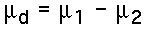
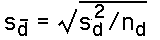
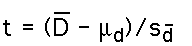
One Tail, Less Than 0
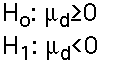 |
Two Tail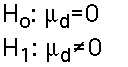 |
One Tail, Greater Than 0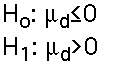 |
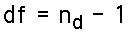
A sample of 5 patients is selected. During the week before treatment, the investigator records the severity of their symptoms by measuring how many doses of medication are needed for asthma attacks. Then the patients receive relaxation training. For the week following the training the research once again records the number of doses used by each patient.
Hand Calculations: The classical hypothesis testing steps are:
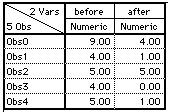
Computer Calculations: ViSta can be used to analyze these data, as specified in the ViSta Applet. We specified a directional T-Test: There will be fewer medication doses used after relaxation than before. Note that this differs from the book, where they use a non-directional test. We selected the "before" variable as the first variable and the "after" variable as the second one (the second variable is subtracted from the first).
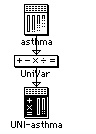
We obtained the following workmap:
 |
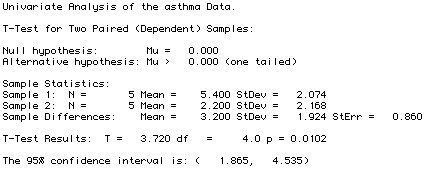
Report-Model: The analysis produces the following report, which corresponds with the hand calculations. In particular, p=.0102, which suggest we can safely reject the null hypothesis that there is no reduction in the number of medication doses after relaxation.
|
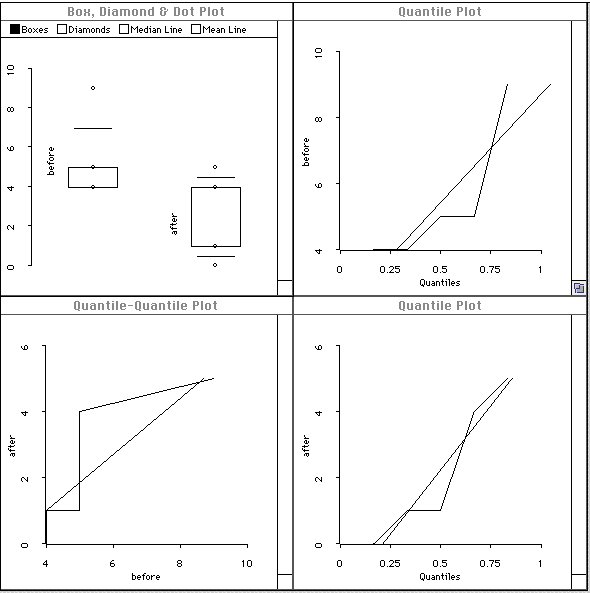
Visualize-Model: The visualization shown below suggests that the data are not normally distributed, since the jagged lines don't follow the straight lines in the quantile plots and in the quantile-quantile plot, and since the boxes in the box and diamond plot are not symmetric.
This implies that the assumption of normality underlying the T-Test is violated. Consequently, the p value (p=.0102) may be to optimistic. This value may be misleading, particularly with a small sample size.