Full Professor · Universitat de València

Gustau
Camps-Valls

Working at the intersection of machine learning and Earth system science — building AI that not only predicts, but helps us understand a changing climate.

IEEE Fellow ELLIS Fellow ACM Fellow AGU Fellow ESF Fellow EurASc Fellow Academia Europeae Fellow AAIS Fellow ERC Synergy ERC Consolidator Humboldt Award Blaise Pascal Medal Highly Cited Researcher
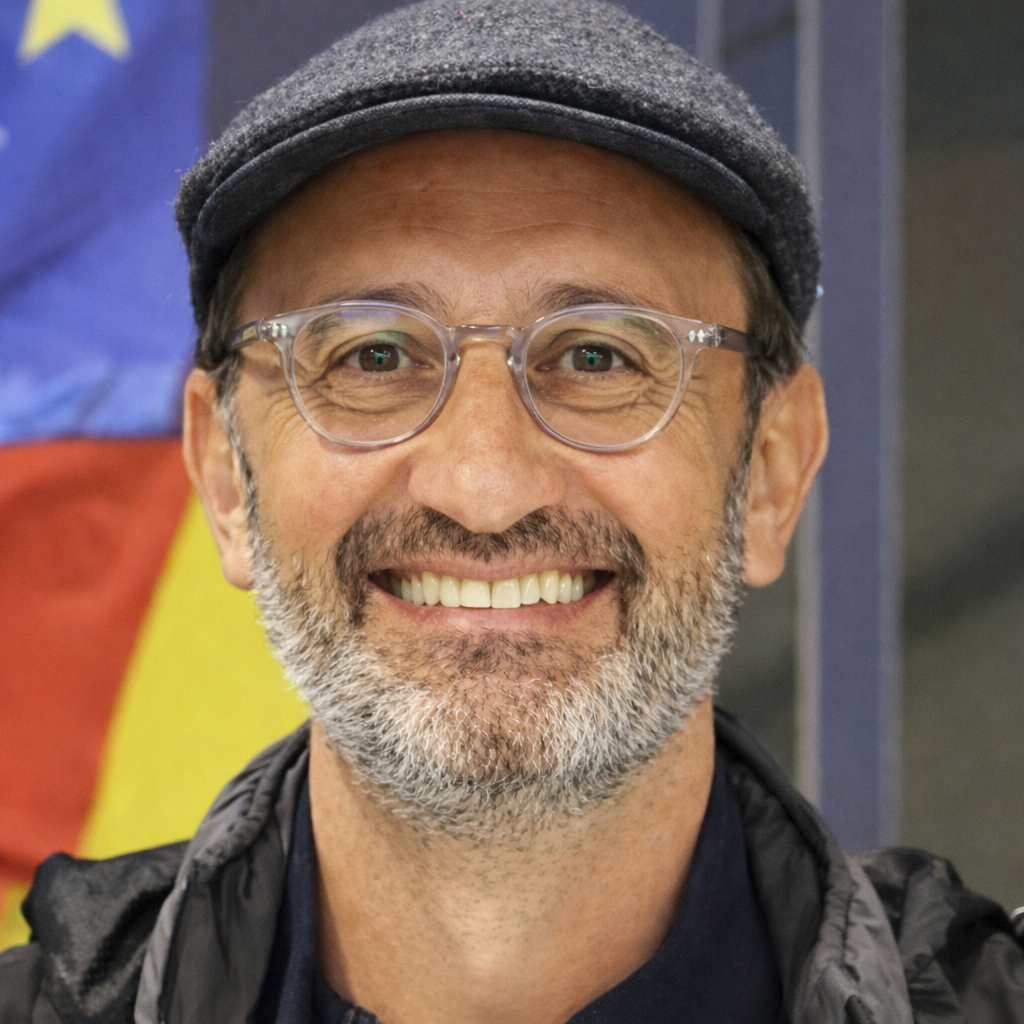
Gustau Camps-Valls
Scroll
Positions

Current &
past roles

Current
Full Professor, Electrical Engineering
Group Leader, ISP at IPL
Convener, AI for Good Seminars
ITU AI for Good · United Nations
Visiting Chair Professor
Humboldt Researcher
Visiting & Honorary
Invited Professor
École Polytechnique Fédérale de Lausanne (EPFL), Lausanne, Switzerland (2013)
Invited Researcher
Max Planck Institute (MPI) for Intelligent Systems, Tübingen, Germany (2009)
Invited Professor
Università di Trento, Italy (2005)
Invited Researcher
Universidad Carlos III de Madrid, Spain (2001)
IEEE Distinguished Lecturer
IEEE GRSS (2017–2020)
Research Vision

AI that understands
the Earth system

"My work lives at the intersection of machine learning and Earth sciences — not just to predict, but to advance our understanding of a changing climate."

I develop causal and equation discovery methods alongside hybrid models that fuse deep learning with physical laws — building more resilient, interpretable, and trustworthy Earth system models.

My path has traversed bioengineering, kernel methods for signal processing, satellite remote sensing, and now the geosciences — driven by what I call a polymathic curiosity: a genuine interest in almost everything.

Today I lead the Image and Signal Processing (ISP) group at the University of València, where we push the boundaries of AI for climate risk, extreme events, and Earth observation.

Research Pathway

A career
in five pivots

Early 2000s
Bioengineering & Support Vector Machines
PhD work optimising drug dosages for kidney transplant patients — high-dimensional data, few samples, multi-criteria objectives. An early encounter with the statistical challenges that still shape my thinking.
2005 – 2013
Kernel Methods for Image & Signal Processing
Deep work on segmentation, denoising, interpolation and compression using kernel machines. Co-authored a Wiley textbook on kernel-based digital signal processing.
2013 – 2018
Satellite Remote Sensing & Earth Observation
Applied neural networks and kernel machines to classification, parameter retrieval, anomaly and change detection from satellite imagery. Co-authored a Wiley book on ML for remote sensing. An ERC Consolidator grant started the causality revolution in Earth science.
2018 – 2022
Hybrid Models & Earth System Science
Established the paradigm of combining deep learning with physical process understanding. A 2019 Nature paper set the agenda for physics-informed ML in the geosciences. Co-authored a Wiley book on deep learning for Earth and climate sciences. An ERC Synergy grant started the field of hybrid AI for climate modeling.
2022 – Present
Causal Inference, Foundation Models & Climate Risk
Decoding the why behind extreme events — droughts, heatwaves, floods, wildfires. Building early warning systems and AI foundation models that are transparent, physically consistent, and actionable. Towards an AI that is humane, humanist and humanitarian.
My full medium.com story
Selected Publications

Defining works

A hand-picked cross-section of contributions — from foundational methods to recent breakthroughs.

Nature · 2019
Deep learning and process understanding for data-driven Earth system science
The paper that helped establish hybrid modelling as the dominant paradigm — combining physics-based models with deep learning for interpretable Earth system prediction.
Nature Reviews Earth & Environment · 2023
Causal inference for time series analysis in Earth system science
A roadmap for moving from correlation to causation in climate data — methods, pitfalls, and a vision for causal discovery at planetary scale.
Science Advances · 2021
A unified vegetation index for quantifying the terrestrial biosphere
Redefines the whole field of vegetation index based on kernel methods, providing a more robust proxy for global photosynthesis and biosphere health.
PNAS · 2014
Global monitoring of terrestrial photosynthesis from satellite data
Used machine learning to map global crop photosynthesis via solar-induced fluorescence, enabling near-real-time monitoring of Earth's carbon cycle from space.
PNAS · 2026
Accelerated north–east shift of the global green wave trajectory
Introduces a method to track the seasonal "green wave" of vegetation as a moving centroid across the globe, revealing an unexpected northeastward drift accelerating under climate and land-use change — a new unified metric for monitoring planetary biosphere dynamics from space.
Physics Reports · 2023
Discovering physical laws and equations from data
A comprehensive review of symbolic regression and equation discovery — how AI can recover governing equations from observational data without prior assumptions.
National Science Review · 2023
Soil and vegetation water content identify the main terrestrial ecosystem changes
Identified dominant spatiotemporal patterns in Earth's coupled carbon–water cycles using statistical learning, revealing signatures of climate change and land-use pressure.
Nature Geoscience · 2025
Serendipity's role in advancing geoscience
A personal reflection on how chance encounters and unexpected connections have shaped major advances in geoscience — and why cultivating openness to the unplanned is a scientific virtue.
Nature Communications · 2025
Artificial Intelligence for Modeling and Understanding Extreme Weather and Climate Events
A comprehensive review of how AI methods — from deep learning to causal inference — are transforming our ability to model, predict, and interpret extreme weather and climate events at global scale.
Nature Communications · 2025
Early warning of complex climate risk with integrated artificial intelligence
Introduces an AI framework for detecting early warning signals of compounding climate risks — integrating multiple data streams and models to flag dangerous conditions before they cascade.
Nature Geoscience · 2024
AI-empowered next-generation multiscale climate modelling for mitigation and adaptation
Outlines a vision for the next generation of climate models that embed AI across scales — from cloud microphysics to global circulation — enabling more accurate projections for both mitigation and adaptation policy.
Nature Communications · 2023
Exploring interactions between socioeconomic context and natural hazards on human population displacement
Uses explainable AI to disentangle how socioeconomic vulnerability and natural hazard exposure jointly drive population displacement, revealing non-linear interactions invisible to conventional analysis.
Nature Communications · 2019
Inferring causation from time series in Earth system sciences
A foundational review of causal discovery methods for Earth system time series — comparing frameworks, identifying pitfalls, and laying the groundwork for moving climate science from correlation to mechanism.
IEEE Transactions on Remote Sensing · 2004
Kernel-based methods for hyperspectral image classification
First introduction of kernel methods in remote sensing — starting a revolution for efficient high-dimensional satellite image processing.
My publications
Recognition

Awards &
fellowships

2025
Alexander von Humboldt Foundation
2025
European Academy of Sciences
2025
American Geophysical Union
2024
IEEE Geoscience & Remote Sensing Society
2022
Academia Europaea & EurASc
2022
European Science Foundation (ESF)
2021–25
Highly Cited Researcher
Clarivate Analytics
2020
European Research Council
2018
GRSS & Signal Processing Societies
2015
European Research Council
Ongoing
ITU AI for Good (United Nations)
The Person

Beyond
the research

Jazz

Music as a way of thinking — improvisation, harmony, and the unexpected. Jazz shapes how I approach research.

Read on Medium
Basketball

Team dynamics, reading the game, decision-making under pressure. The parallels with running a research group are endless.

Read on Medium
Philosophy of Science

What does it mean to explain? When does a model truly understand? These questions drive my work on causal and hybrid modelling.

Dissemination & opinion Read me on Medium
Photo-Haikus

Image and text, compressed to essence. Writing on AI, philosophy, art and life — where science meets the poetic.

Check it
Research Supported By