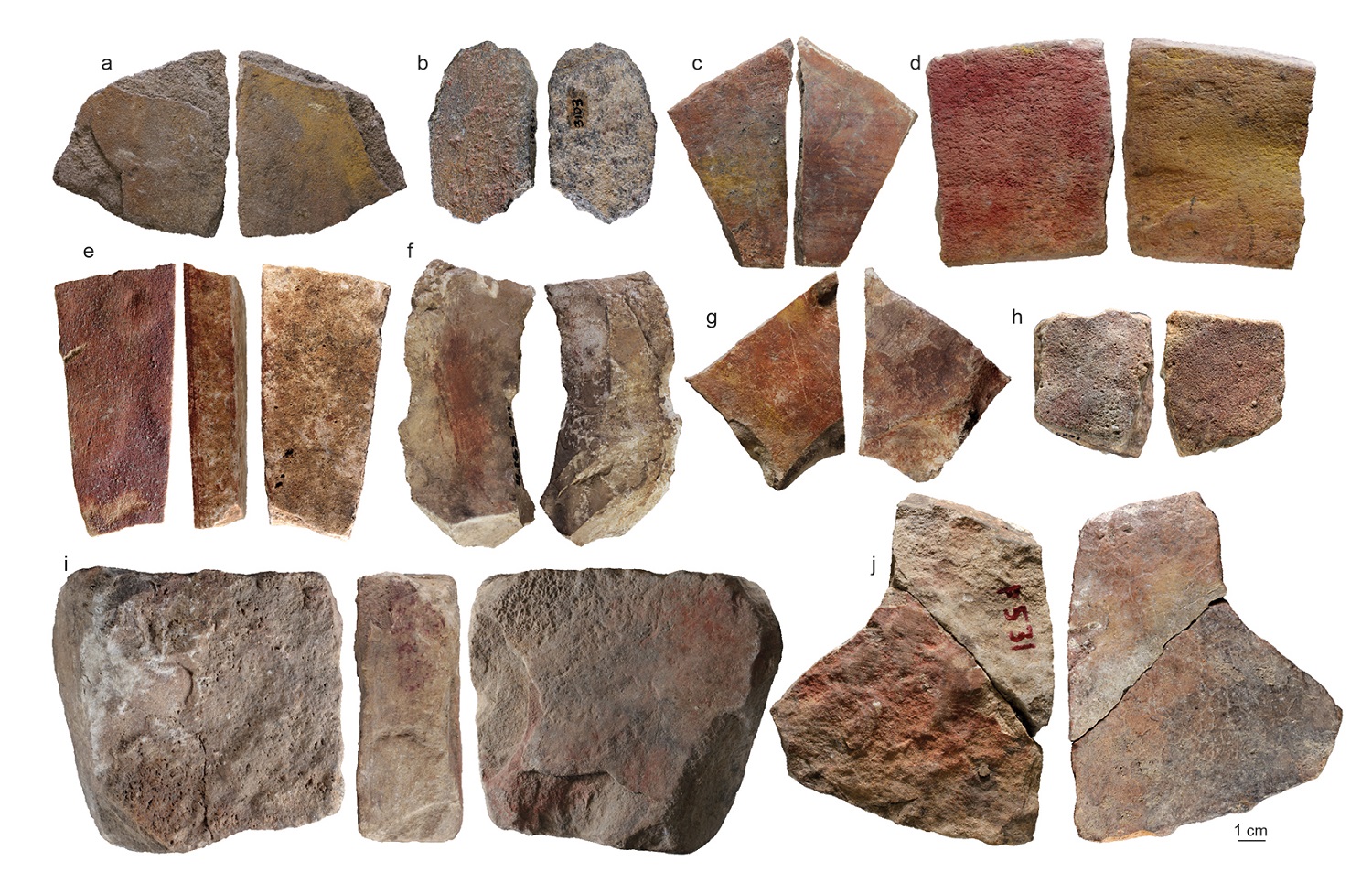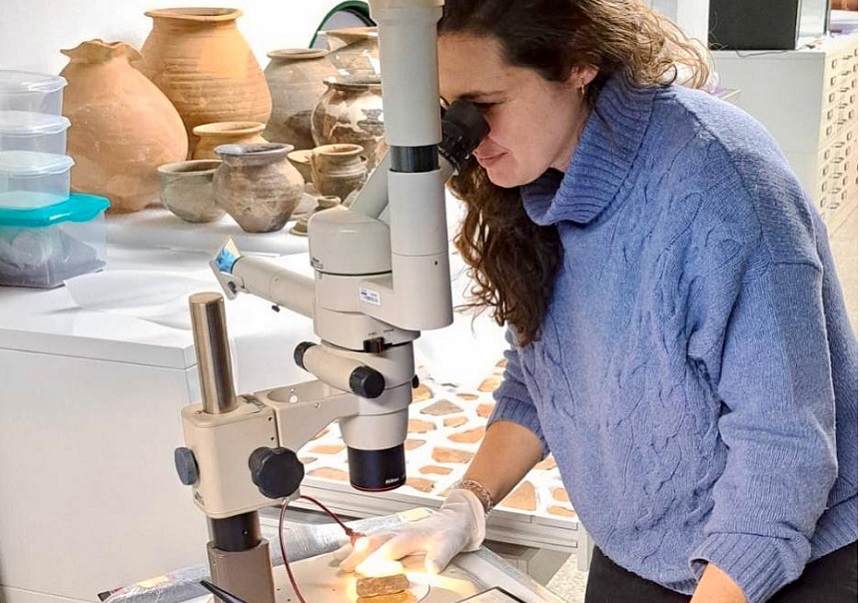
A study on the artefacts painted at the Parpalló Cave (Gandia) conducted by the research staff at the Universitat de València (UV) proves that limestone slabs were used as mills, pounders, and palettes for processing colorants, which highlights the complexity and variability of the use of colorant materials throughout the Upper Palaeolithic in the southeast of the Iberian Peninsula. The article, whose first signatory is Daniela Rosso, Ramón y Cajal researcher at the UV Department of Prehistory, Archaeology and Ancient History, was published at the journal Journal of Archaeological Science: Reports.
This new study on archaeological sites at Parpalló reveals that a great number of limestone slabs were used as tools for processing iron oxide and other colorant materials. This archaeological site provided one the most important collections of Palaeolithic portable art, including 4116 painted or engraved artefacts, mainly limestone slabs, dated from the Gravettian to the Magdalenian period. Through the combination of the analysis of usage marks and non-destructive physic-chemical technics, the study identifies a wide variety of technical practices, including grinding and crushing with firing pins and mills, and the preparation of colorant blends in palettes.
The study featured, apart from Daniela Rosso, member of the Prehistory of Western Mediterranean Research Group (PREMEDOC), Clodoaldo Roldán and Sonia Murcia, both researchers at the UV Institute of Materials Science (ICMUV), and Valentín Villaverde, retired professor of the UV Department of Prehistory, Archaeology and Ancient History.
The results proved the diversity and flexibility of the pigment operational chain, as well as the frequent reuse and recycle of objects for multiple functions. The evidence on the processing of colours and compositions –mainly red and highly ironed yellows- implies a repeated and varied use of tools over time.
Overall, the study underlines the complexity of using colorants at Parpalló Cave, involving a great variety of tools, technics, and raw materials. This variability, along with changes on the stratigraphic distribution of the painted artefacts, implies a long-term transformation of pigments usage, going from mainly artistic applications to a wider range of functional or symbolic practices.
The Parpalló Cave, renowned both for its long stratigraphic sequence, which comprehends from the Gravettian to the Magdalenian period, and its exceptional set of portable art, and it offers a unique opportunity to understand better the role of colour throughout an essential period for the development of complex cultures in the southeast of the Iberian Peninsula.
Reference of the article: Rosso, D.E., Roldán García, C., Murcia Mascarós, S., Villaverde, V., 2026. Processing colouring materials during the Upper Palaeolithic: Evidence from Parpalló Cave, Gandía, Spain. Journal of Archaeological Science: Reports 72, 105754. https://doi.org/10.1016/j.jasrep.2026.105754
Link: https://www.sciencedirect.com/science/article/pii/S2352409X26001896
Caption on the appendix:
- Processing instruments at Parpalló Cave.
Images: