
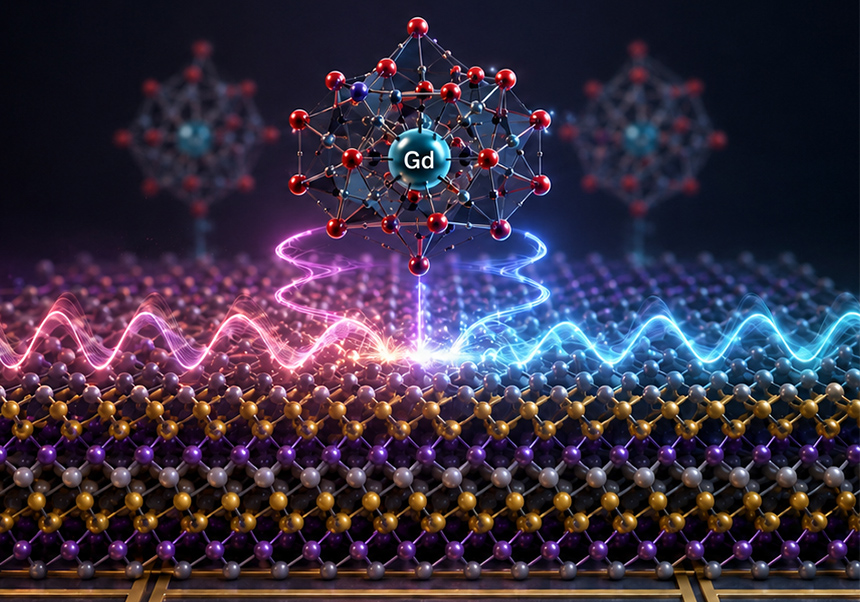
Joint research carried out by ICMol and INMA (Institute of Nanoscience and Materials of Aragon), involving Eugenio Coronado’s research group, has demonstrated a new way of strongly coupling magnetic qubits — the basic units of quantum information — with magnetic excitations known as magnons. The breakthrough, published in the journal Newton, could contribute to the development of future quantum technologies based on increasingly miniaturised solid-state materials.
The research was supervised by María José Martínez-Pérez, David Zueco and Eugenio Coronado. The contribution of the Institute of Molecular Science (ICMol) of the University of Valencia was particularly significant in the field of materials. Eugenio Coronado, together with Samuel Mañas-Valero, Carla Boix-Constant and Iván Gómez-Muñoz, participated in the selection, synthesis and integration into devices (cavities) of the magnetic materials designed for the study.
In quantum computers and other emerging technologies, one of the major challenges is ensuring that qubits can communicate with one another efficiently and in a controlled manner. Traditionally, this communication has been achieved using photons, the particles associated with light. However, when working with spin qubits — based on the magnetic properties of atoms or molecules — microwave photons do not couple effectively.
The new study proposes an alternative: the use of magnons. Magnons, also known as spin waves, are collective excitations that arise in magnetic materials. Much like a wave propagating through water, the magnetic moments within the material oscillate and propagate through the magnetic medium. As magnons can be confined to spaces much smaller than photons, they offer a more promising route for achieving strong coupling with spin qubits, potentially enabling more efficient communication between qubits.
To demonstrate this, the team combined two types of materials. On the one hand, they used CrSBr, a material consisting of magnetic layers. On the other, they employed GdW10, a magnetic molecule capable of behaving as a spin qubit. By placing the molecular crystal on the magnetic material, the researchers observed that the two systems not only interact, but also reach the so-called strong coupling regime, in which they exchange energy coherently.
One of the key findings of the work is that this interaction can be controlled easily by means of an external magnetic field. By changing the orientation of the field, the researchers modify the chirality of the magnons, that is, the direction in which their magnetic excitation propagates. This control makes it possible to activate or weaken the magnon–qubit interaction without redesigning the device, simply by changing the orientation of the applied field.
The result represents the first experimental demonstration of a magnonic cavity, a new quantum platform in which magnons replace photons as mediators of quantum interaction. This approach opens up new possibilities for studying and controlling spin qubits, which are particularly attractive because they can retain quantum information for long periods, although connecting them effectively has until now proved difficult.
In the long term, this strategy could contribute to the development of more compact and efficient quantum devices, the design of new methods of communication between magnetic qubits and the advancement of quantum technologies based exclusively on magnetic materials. The work also strengthens ICMol’s research focus on molecular and magnetic materials for quantum technologies, an area in which Eugenio Coronado’s group has a strong track record.
Article reference: García-Pons, D., Pérez-Bailón, J., Boix-Constant, C., Gómez-Muñoz, I., del Arco, X., Mañas-Valero, S., Coronado, E., Zueco, D. y Martínez-Pérez, M. J. “Strong spin-magnon coupling in a van der Waals magnet with tunable chiral symmetry”. Newton, 2026. https://doi.org/10.1016/j.newton.2026.100515