
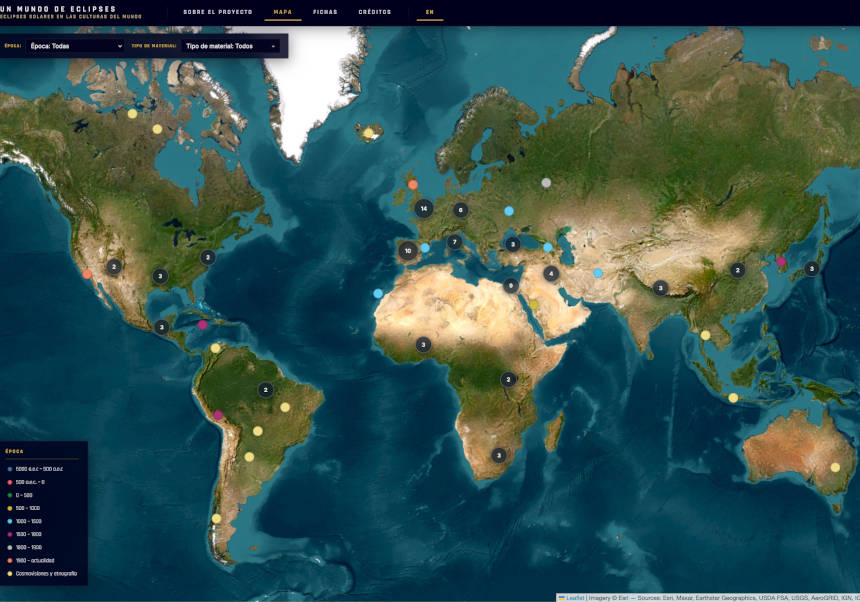
On Thursday, 18 June, the Spanish Astronomy Society launched A World of Eclipses, an interactive world map that allows users to take a virtual tour across the globe and discover a wide range of interpretations of solar eclipses through the rich cultural heritage in which this phenomenon has been recorded. The map is the result of an interdisciplinary collaboration involving around twenty specialists, including Amèlia Ortiz, an astrophysicist at the Astronomical Observatory of the University of Valencia.
For thousands of years, the sudden disappearance of the Sun inspired awe among our ancestors in cultures across all eras and regions. The fear it often provoked meant that eclipses were frequently associated with disastrous events, which in turn drove the need to understand, record and predict them.
This gave rise to a remarkable variety of interpretations in which natural explanations of the phenomenon — based on the astronomical knowledge of each time and place — intertwined with supernatural readings linked to the beliefs of individual cultures. Fratricidal battles between the Sun and the Moon, dragons, toads, squirrels devouring the Sun, or even the Sun’s death are among the interpretations that reflect the universal human need to make sense of a phenomenon that was as striking as it was mysterious.
These interpretations have now been brought together in a new visual and interactive online tool: the open-access map A World of Eclipses.
In total, more than 100 cultural manifestations have been compiled, selected for their historical, artistic or ethnographic significance and for their geographical and chronological diversity. Each entry includes a detailed information sheet. The collection includes Ugandan murals, biblical texts, Egyptian hieroglyphs, the first photograph of a solar eclipse, commemorative postage stamps, a Tintin comic strip, a Japanese manga, as well as Australian, Cherokee and Zulu myths and legends.
In Spain, a dozen different items have been identified, including the ceramic artefact known as the Agüimes vase from Gran Canaria, a medieval Hebrew poem and a carved stone block in Sos del Rey Católico. These are not just chronicles or archaeological remains from centuries past: there are also recent paintings, songs and even an episode of The Simpsons.
A multidisciplinary project
The map is the result of the joint work of a team comprising more than 20 specialists from around twenty research centres, universities and other institutions. Their expertise spans fields such as astrophysics, art history, ethnology, Egyptology and Sinology, alongside creators working in areas such as literature and photography.
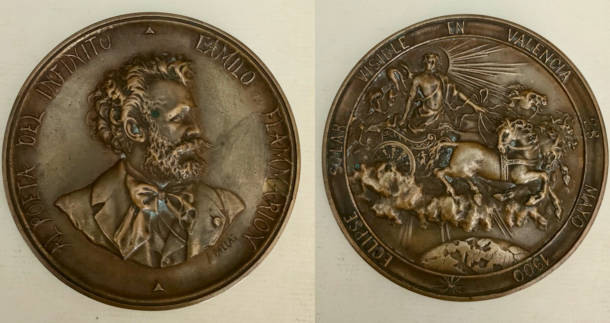
The University of Valencia is involved in the project through the participation of Amèlia Ortiz, an astrophysicist at the University’s Astronomical Observatory. She has produced several of the entries featured on the map, notably one on a commemorative bronze coin marking the total solar eclipse of 1900, designed by the Valencian artist Francisco Pallás y Puig. “The coin served as a tribute to the distinguished French astronomer Camille Flammarion, who observed and studied the eclipse from the Huerto del Cura in Elche”, explains the Valencian researcher.
Ortiz notes that the coin was “probably” presented to the French scientist during a dinner held in UV's Botanic Garden, attended by the renowned Valencian poet Teodor Llorente.
The coin — which belongs to a private collection — is reproduced in the volume Medallero Valenciano o sea Catálogo de Medallas (Valencian medal catalogue), preserved at the Royal Academy of Fine Arts of San Carlos in Valencia.
The project has been coordinated by astrophysicist Montserrat Villar, a CSIC researcher at the Centre for Astrobiology (CSIC-INTA), who highlights the initiative’s cross-disciplinary and innovative nature within the international landscape: “Our aim is for A World of Eclipses to educate, inspire and spark curiosity. We aim to become one of the most comprehensive online sources of information on the influence of solar eclipses across the world’s cultures, offering rigorous and accessible content presented with a clear public-engagement focus”.
The atlas is a free educational resource for teachers, students and the general public. It has been translated into English and adapted for people with visual impairments.
In the words of Minia Manteiga, president of the Spanish Astronomy Society, “this project demonstrates, in an engaging and inspiring way, how eclipses have sparked human curiosity in a wide range of cultures, giving rise to interpretations and artistic expressions unique to each society. Although we now understand their origin, they continue to fascinate us and have become a collective celebration of the beauty and wonder that observing them evokes”.
Science popularisation and artificial intelligence
The A World of Eclipses interface was designed using generative artificial intelligence tools. “This project demonstrates that AI can act as a catalyst for democratising the creation of highly complex digital experiences: technology ceases to be a barrier and becomes an amplifier of thought and public engagement with science”, says Sofía López, an AI specialist at the Spanish technology company Magnific and creator of the interface.
The project is particularly timely, as Spain is set to host an exceptional astronomical event: the so-called “eclipse trio”, with three solar eclipses visible in 2026, 2027 and 2028. This context reinforces the value of A World of Eclipses as a tool for bringing these phenomena closer to the general public from a multicultural perspective and for demonstrating how observation of the sky has influenced the cultural development of societies around the world.
Links: