By Maria-Magdalena Bărăscu
What have discourse analysis, systematic reviews, migrants’ informal settlement location and mindfulness in common? What is the approach in research on diversity and migration?
For one week, academics from six universities of FORTHEM alliance tried to find out what theoretical concepts of intersectionality, hybridism and boundaries have direct applications to diversity and migrant narratives from different fields and methodologies. First BIP course of the Alliance happened between 5 and 9th of June 2023 at the Faculty of Philology, Translation and Communication of the University of València, Spain.
Several academics from the universities of Palermo, Opole, and València were in charge of the live training sessions and that were structured as it follows:
Introduction into discourse research - Benno Herzog - Universitat de València
Words and actions that hurt: homophobic narration and the ways of active resistance. The Polish case - Marzanna Pogorzelska - Uniwersytet Opolski
Cultural productions analysis - Domingo Pujante González and Nerea Hernaiz Agreda Universitat de València
Content Analysis and other innovative methodologies - Carmen Carmona Rodríguez - Universitat de València
The “Rules” of Informality: Migrant Informal Settlements Location in EuroMediterranean Contexts, Between Survival, Irregular Condition and Right to The City - Vincenzo Todaro - Università degli Studi di Palermo
Systematic reviews: relevant aspects to be taken into account - Francisco González-Sala - Universitat de València
Mindfulness as an academic strategy Małgorzata Adams-Tukiendorf - Uniwersytet Opolski
Graphic literature as a research area in Diversity and Migration - Maricel Esteban-Fonollosa - Universitat de València
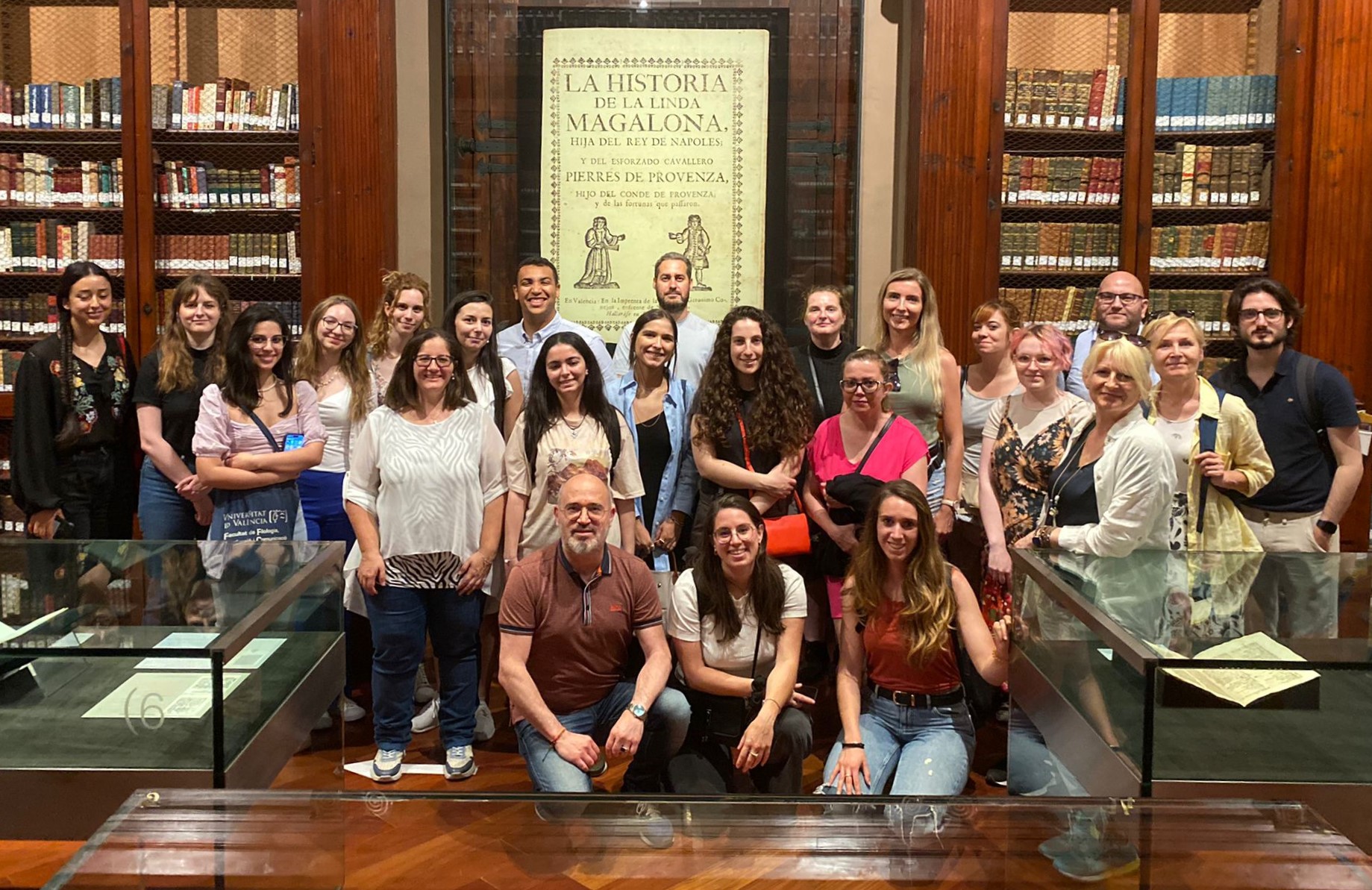
The participants also had access to non-formal education methods such as photovoice and live library. Inside the Cultural Centre of La Nau they were able to create their own library book together with the members of Activa Cultura project after visiting the oldest library in Europe. Several activities of the course included a projection of the Spanish documentary La Puerta de No Retorno, a visit to Refugi Serrans, La Nau and the live concert of Valencian band Parrusa Riot.
What is Blended Intensive Program (BIP)?
BIP is a one-week course on Intersectional Approach Research on Diversity and Migration Narratives credited with 3 ECTS, the equivalent of 90 hours of research. This program is a “blended” course and includes an online component and another one in person at the host university. The 1st BIP course took part at the University de València, in Spain between 5 and 9th of June 2023.
The courses are designed to be carried out in English with optional events in other European languages. Throughout this training, the students have the chance first to learn about the theoretical concept of Intersectionality, Hybridism and Boundaries and its direct applications to Diversity and Migrant Narratives from different fields and methodologies.
The program is financed and promoted by the FORTHEM Diversity and Migrations Lab. The involvement, knowledge, and expertise of the colleagues from the partner universities is essential for this event to take place.
The Intersectional Approach Research on Diversity and Migration Narratives course is open to incoming students from any Erasmus+ institution and to FORTHEM universities enrolled in the areas of knowledge of Social Sciences and Humanities.
The initial target group were 15-20 Ph. D. incoming students from any Erasmus+ institution and to FORTHEM universities. The 1st BIP course had PhD, master, and undergraduate students from universities of Palermo, Latvia, Jyväskylä, Finland, Lucian Blaga University of Sibiu, Opole in Poland, and University of Valencia.
Images:
.jpeg)