
.svg)



Aquatic exercise for elderly people to delay dependence and preserve autonomy
- Marketing and Communication Service
- June 25th, 2026
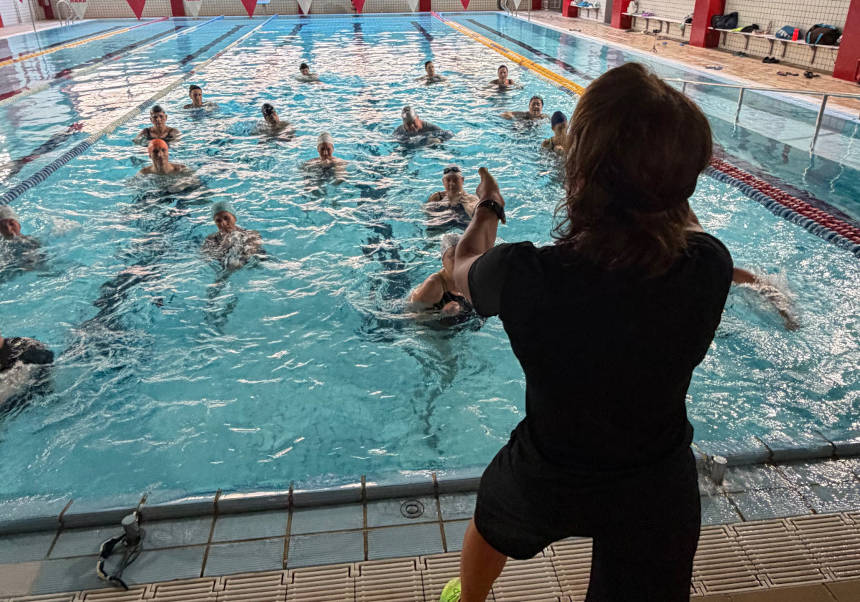
A specialist training elderly people in aquatic exercise
Juan Carlos Colado, Professor at the Universitat de València (UV) and Head of the Research Group on Prevention and Health in Exercise and Sport (PHES), bets on aquatic exercise as a healthy and accesible method to fight against ageing. In his opinion, this practice “delays dependence and preserves the autonomy of elderly people”.
According to international expert staff, Colado defends practising aquatic exercise as a tool that can contribute to facing one of the major health and social challenges of the following decades: ageing.
‘We are living longer and longer. However, society’s main challenge of society is not only to increase life expectancy, but to ensure that these additional years are lived with autonomy, mobility, brain health, and quality of life’ considers the professor of the Department of Physical and Sports Education at the UV.
The progressive lack of strength, balance, functional ability, and confidence to manage daily life activities is one of the main factors associated to dependence, fragility, falls, and the decline of quality of life in elderly people. This phenomenon –focus of study of Professor Colado’s research group– already affects millions of people and represents one of the biggest health, social, and economic challenges of the 21st century.
Given this reality, Juan Carlos Colado, renowned worldwide as one of the main specialists in aquatic physical conditioning applied to health and ageing, presents scientific advances and practical strategies intended to improve functional ability, mobility, strength, personal autonomy, and the well-being of elderly people through specific programmes of physical exercise made in the aquatic environment.
‘The aim is not only for people to live more years, but that they can continue to enjoy a full, active, and independent life for longer. We are talking about maintaining the ability to travel, to do physical activity, to play with their grandchildren, to participate in social activities, to walk with confidence, to maintain balance, to preserve personal autonomy, and to keep doing whatever provides your life with sense and quality.’, explains Colado.
The latest research developed by the Universitat de València and other international groups suggests that certain properly-designed programmes of aquatic exercise may contribute to preserving essential abilities for daily life, improving muscular strength, mobility, functional ability, body composition, and bone health. These adaptations are especially relevant to foster a more active, autonomous and healthier ageing.
Moreover, the scientific evidence generated by the research group led by Professor Colado indicates potential benefits for some of the biological processes, which are more closely related to ageing, including chronic low-degree inflammation, oxidative stress, brain health, and the maintenance of certain cognitive functions. ‘These findings reinforce the growing consideration of physical exercise as a key tool to promote not only a higher life expectancy, but also a better quality of life during these highly valuable years,’ he concludes.
Juan Carlos Colado presented these results at the Alicante Splash Workshop 2026 international meeting, in which specialists from different countries explained the role of physical exercise, particularly, aquatic exercise, in some of the major challenges associated to population’s ageing, the preservation of personal autonomy, and the promotion of quality of life during the new longevity.





