.svg)



IVAM and UV revive the art affected by the dana with the project ‘Rebrot’ on university campuses
- Marketing and Communication Service
- Maria Magdalena Ruiz Brox
- December 9th, 2025
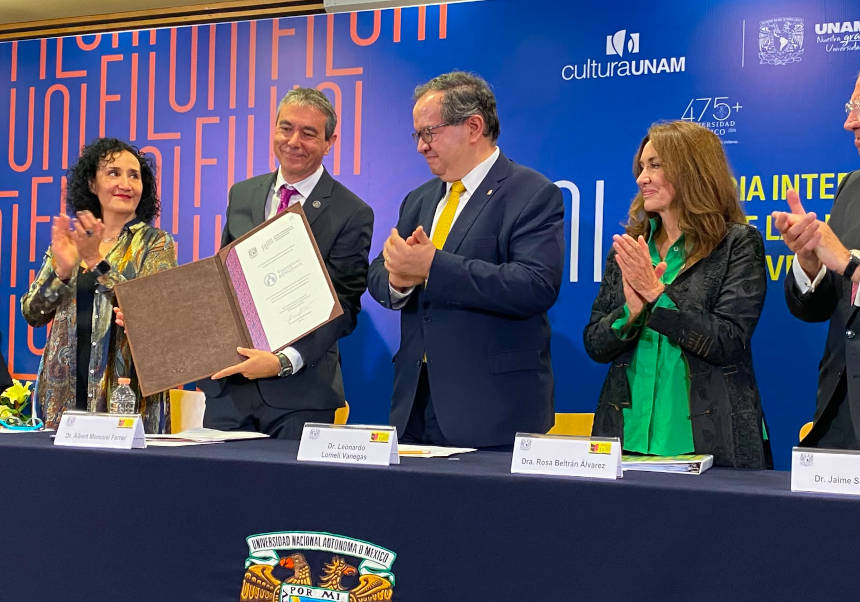
Principal of the Universitat de València, Maria Vicenta Mestre and dorector of the Valencian Institute of Modern Art (IVAM), Blanca de la Torre, have inaugurated ‘Rebrot’. It is a joint initiative between both institutions, that starts with an exhibition of some works affected by the dana.
Artists Miquel Navarro, Juan Carlos Nadal and Sanleón, have assisted to the presentation, as well as regional secretary Marta Alonso. Marta Alonso has said that ‘The project fulfills the aim of fostering dialogue between the IVAM collection and other institutions, while simultaneously showcasing all the works affected by the DANA event at the IVAM that have been restored, sending a positive message and supported by the affected artists’.
Director of the IVAM, Blanca de la Torre, has explained that a total of 11 pieces of art (8 sculptures and 3 paintings) from 6 artists -Alberto Corazón, Miquel Navarro, Juan Asensio, Juan Carlos Nadal, Andreu Alfaro and Sanleón- are exhibited. ‘All of the art pieces have been restored because they were damaged due to the flooding of the warehouse where they were stored, except for two pieces, one from Alberto Corazón and another by Miquel Navarro, which are part of the IVAM collection and that we wanted to include in the exhibition’, she said.
A total of 128 pieces of art of the IVAM collection were affected by the 2024 flooding. The museum’s restoration team established am action plan divided into three phases, according to the priorities for intervention. ‘During 2025, 70 pieces of art were restored. The remaining intervention work will continue in 2026", said Blanca de la Torre.
The act has been presented by Vice-Principal for Culture and Society of the UV, Ester Alba, has showed her satisfaction with the institutional collaboration. ‘By moving the IVAM pieces through different university campuses, the Universitat de València not only exhibits art, but also integrates patrimony in daily life. Classrooms, hallways and common areas are transformed into places symbolically inhabited, spaces for coexistence and learning’, she has reported.
Principal of the Universitat de València, Maria Vicenta Mestre, has defined ‘Rebrot’ as a ‘collective lecture about fragility and, at the same time, the capacity for reconstruction’. During the presentation, she pointed out that the tour through the different campuses ‘serves as a reminder of our material vulnerability, but also of what emerges when a community cooperates and knows how to face adversity with dignity and intelligence'.
Mestre has highlighted that the pieces ‘embody a regenerative impulse born of resistance and collective action', which defines the collaboration between the University of Valencia and the IVAM. Within this framework, she has emphasised the importance of bringing art to students: ‘The IVAM and the UV share a deep belief: culture is a tool for transformation. And when it is combined with public service, it is transformed into a strength that can broaden the rights, create opportunities and strengthen a critic and open citizenship’. The principal concluded that 'in the face of destruction it is always possible to rebuild, and in the face of uncertainty, to imagine new futures’.
The IVAM director has mentioned the book A Paradise Built in Hell by Rebecca Solnit, a piece of art that examines the collective and altruistic dimension that emerges in communities that have been damaged by disaster. ‘Against the narrative of looting, pillaging, and individualism, solidarity, generosity, and mutual support prevail even in contexts of devastation and ruin,’ stated Blanca de la Torre, who recalled that ‘only from a perspective sustained by ecodependence, collaboration, and citizen participation will we be able to promote this resurgence’.
With ‘Rebrot’, Universitat de València reinforces its commitment with the recovering of contemporary art and the support to the cultural sector affected by the dana. The IVAM, on its part, strengthens its paper as institute where the museum dimension converses with research and academic work.
A tour through eleven pieces of art: 8 sculptures and 3 paintings
The first phase of the ‘Rebrot’ project consists of eleven pieces of art of the IVAM collection in the three main campuses of the Universitat de València. This way, contemporary art and its renewed symbolism is integrated in the daily life of the university community.
The Blasco Ibáñez Campus has the vast majority of the art pieces. In the building of the Office of the Principal, Conversación con Brancusi III (2001) by Alberto Corazón, is exhibited. The Faculty of Medicine and Dentistry has two sculptures by Miquel Navarro: Figura puente (2003) and Tótem de luna (1995). At Espai Vives two pieces of Miquel Navarro are exhibited: Simbiosis (2003) and Templo sentado (2003). Lastly, in the 3rd Classroom Building Sin título (2006), by Juan Asensio and Haboob (2011), by Juan Carlos Nadal are exhibited.
At the Tarongers Campus, at the Faculty of Teacher Training Las afinidades electivas (1986), by Valencian sculptor Andreu Alfaro is exhibited.
Lastly, at the Burjassot Campus, the School of Engineering has three paintings. Specifically, artist Juan Sanleón presented three paintings: Flotó de Llebeig (2005), L'om (2006) and Nit (2006).
Categories: Cultura , Exposicions
Other News