
.svg)



The Universitat de València begins a new era for its performing arts with the presentation of a strategic plan
- Marketing and Communication Service
- Maria Magdalena Ruiz Brox
- October 1st, 2026
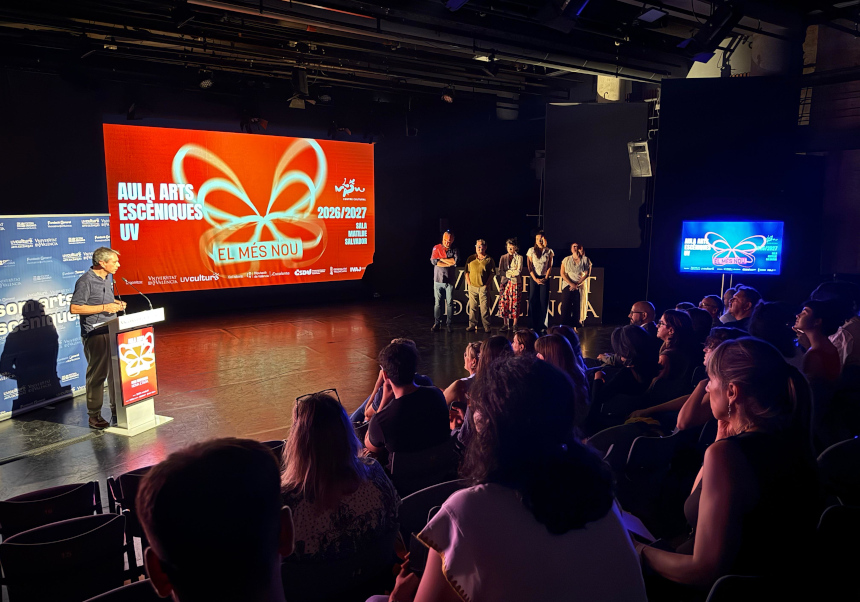
The Universitat de València presented on Thursday the new Strategic Plan of Transition and Consolidation of the 2026-2029 Performing Arts Class. This year, a new era starts for the performing arts of the institution. The new model intends to reinforce contemporary creation, expand training, reach new audiences, and delve into the connection between territory, cultural institutions, the university and European networks.
The presentation was held at the Matilde Salvador Hall of La Nau cultural centre. It had the participation of the vice-rector for Culture, Sports and Social Links, Albert Moncusí; the new coordinator of the Performing Arts Class, Josep Valero, and the general director of the Institut Valencià de la Joventut (IVAJ) (Youth Valencian Institute) of the Generalitat Valenciana, Vicente Ripoll. The event had a detailed staging, with the presentation of a new team for the class, the screening of two audiovisuals and an ad-libbing scene by the dance teacher of the Universitat de València, Noelia Arcos, accompanied by the musician Xavi Laserdisc, of the Col·lectiu Penja’m.
The Plan includes 21 actions around 5 areas: programme and creation; training and memory; publics and territory; alliances and cooperation; and internationalisation. The proposal aims to progress towards a university policy on performing arts that connects with creation, training, research, programming, and cultural transfer
The Vice-rector for Culture, Sports and Social Links, Albert Moncusí, remarked on the important moment that the Performing Arts Class is experiencing, and indicated that this new era is an opportunity to strengthen the social function of the university. In this sense, he considered the role of the university as a space for creation, dialogue and transformation, with the capacity to open up its environment and offer innovative ideas to society. Moncusí also underlined the value of hope as a necessary element at this moment, and highlighted that “society hopes that the university enlightens, moves, and proposes, both inside and outside”.
We haven’t invented the performing arts of the Universitat de València. We inherited them from this great tradition of the institution with 495 years of history.
Josep Valero, new coordinator of the Performing Arts class, presented the main lines of the Plan and highlighted the long history of Performing Arts at the Universitat de València. Valero recalled that this tradition dates back to the first centuries of the institution, 495 years ago, with experiences such as the university performances of Joan Àngel Goçàlbez and Llorenç Palmireno; the university theatre group of El Búho in the 20th century; and the artistic contributions of Fernando Miñana, Dámaso Alonso and Max Aub. In this sense, he explained that this new era comes from a legacy that the University inherited and now wants to project into the future: “We haven’t invented the performing arts of the Universitat de València. We inherited them from this great tradition”. The butterfly, which represents the new graphic identity of the class, specially symbolises this idea of transformation and continuity.
The general director of the Institut Valencià de la Joventut (IVAJ), Vicente Ripoll, highlighted the collaboration that the organisation maintains with the Universitat de València through the theatre project of Escena Erasmus, and announced that this cooperation will be now expanded with the university’s performing arts programme. The 430,000 people who hold the Carnet Jove de la Comunitat Valenciana (Youth Card of the Valencian Community) can get special conditions for the Performing Arts Class programme. Ripoll remarked on the IVAJ’s commitment to continuing to facilitate the access of young people to culture and strengthening alliances with university institutions.
Among the attendants of the event were the director of Escalante, Marylène Albentosa; María José Climent, from the Xarxa Alcover; Minerva del Toro and Natalyd Almirano, from AVETID; Lucía Sáez, from Comité Escèniques; José Montesinos, from the Escola Superior d’Art Dramàtic de València (School of Dramatic Arts); the full professor of the Universitat de València Toni Tordera, as well as representatives of different performing arts companies, and people from other institutions, along with members of the university community.
New artistic identity for the Matilde Salvador Hall and new initiative
One of the main novelties will be the new artistic identity of the Matilde Salvador Hall, which will reinforce its role as a university performing arts space with a programme focused on emerging creation, new contemporary languages, performing arts research, young creators, and hybrid formats. The hall seeks to establish its own space within the Valencian cultural programme, paying special attention to proposals that explore new languages and creative processes.
The new season will also incorporate a more determined proposal for contemporary dance, with the relaunch of the Workshop and Dance Group of the UV. It will be led by the dancer and creator Noelia Arcos. The university will also work on recovering the artistic facilities of Dansa València at La Nau and strengthening the connection between professional creation, research and university community.
Among the new initatives, NAUTEU stands out, a university theatre festival that serves as a meeting, exhibition, experimentation and training space, with university productions, labs, readings, workshops and exchanges.
The programme of La Nau will feature the new cycle “L’Escalante a La Nau”. In addition, projects that will connect performing arts with other areas of culture and knowledge, such as music, literature, heritage, visual arts, cinema, science, and thought, will be included. The first project will be “Diversos mapes del silenci” (Several maps of silence), curated by the theatre professor Antoni Tordera. It will take place in December with the collaboration of different areas of the university.
The new model will also strengthen its training. The class will progress towards a progressive training course in theatre, with different levels of initiation and specialisation. It will connect this training with performing practice, creative processes and the official groups of the university. In this field, the experience of Pep Sanchis, a long-standing professor and director of the UV Theatre Group, will be consolidated.
The Taller i Grup de Teatre per a la Gent Gran (Theatre Group for Old People) will also begin a new era. This group is aimed at members of the university community aged over 55, and it will incorporate the new actress and professor Júlia Fortaña. At the same time, the class will work with the Faculty of Philology, Translation and Communication on a theatre arts lab and initiatives related to theatre criticism.
A Class more open to audiences and territory
The new era incorporates a specific audience development policy with the creation of a University Audience Club, in collaboration with theatres and venues in València. The initiative aims to create a university community linked to the performing arts through meetings with artists, talks, courses, and mediation activities.
The university will also work with the Institut Valencià de la Joventut so that the Matilde Salvador Hall incoporates the benefits of the Carnet Jove and facilitates the access for new audiences, especially among the youngest generations.
The connection with the territory will be another line of the Plan. Through the cultural collaborators of the Vice-rector’s Office for Culture with Valencian municipalities, in coordination with UVSociety, shared processes of creation, research, mediation, and participation will be developed around issues such as memory, heritage, identity and the social history of the municipalities.
In terms of alliances, the class will reinforce the cooperation with the Institut Valencià de Cultura, Escalante Centre Teatral, the Escola Superior d’Art Dramàtic de València and the Conservatori Superior de Dansa de València “Nacho Duato”. They will also work on recovering the performing arts dimension of the Vives Network of Universities.
Escena Erasmus expands its European network
Internationalisation will be another line of the new Plan. Escena Erasmus will begin a new era with the objective of consolidating and expanding Erasmus Europe on Scene Network, with new headquartres in France, Portugal, Poland and Italy.
The network aims to boost the mobility of students and artists, international labs, collective productions and artistic circulation. Escena Erasmus will also collaborate with the Vice-rector for Internationalisation and Cooperation to reinforce the artistic dimension of the FORTHEM European Universities Alliance.
Ten proposals and 18 sessions until December
The first programme of this new era at the Matilde Salvador hall will run from October to December and will include ten proposals and 18 sessions of theatre, dance, contemporary creation and interdisciplinary projects
The season will begin on 21 and 22 October with “Un estiu”, by Clàudia Serra, performed by Lluna Plena Teatre, and will continue on 28 and 29 October with “El corral”, by Patri Garrigues, performed by La Ponentà.
In November, dance will have a special relevance with “Point”, by Manoamanodanza, on 4 and 5 November, and “Atelier”, by Cia. Onnana, on 18 and 19. This presence responds to the objective of progressively making contemporary dance one of the structural fields of the new Class.
The theatre programme will also include “Yo nací en un surco de judías”, by Laura Santos, on 10 and 11; “Cosas que no caen del cielo”, by Dora Cantero, on 12 and 13, as part of the “L’Escalante a La Nau” cycle, and “El acontecimiento”, based on the work by Annie Ernaux, on 25 and 26 November.
In December, “Diversos mapes del silenci” will arrive, curated by professor Antoni Tordera, who will connect performing arts, cinema, history, and democratic memory. The programme will begin on day 9 with the screening of “Cesare deve morire”, by Paolo and Vittorio Taviani, in collaboration with the UV Cinema Club. On 10 December, Antonio Ramírez Navarro will give the lecture “La fuerza de los débiles. Vida, prisiones y muerte de Vicente Talens Inglà (1892-1940)”, with the collaboration of the History and Democratic Memory Room. The project will end on days 16 and 17 with the performative lecture “Danzar en silencio”, performed by the Conservatori Superior de Dansa de València ‘Nacho Duato’.
Images gallery
Categories: Cultura , Arts escèniques , Teatre , Dansa
Other News

.jpg)





