
.svg)



The Universitat de València joins “Plastic Free July” – eating at the cafeteria, a cleaner and economic choice
- July 20th, 2026
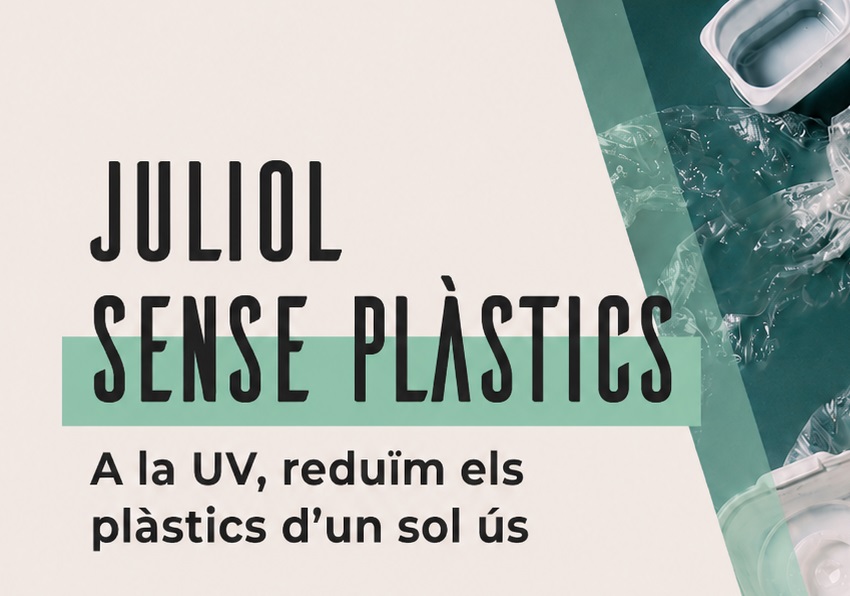
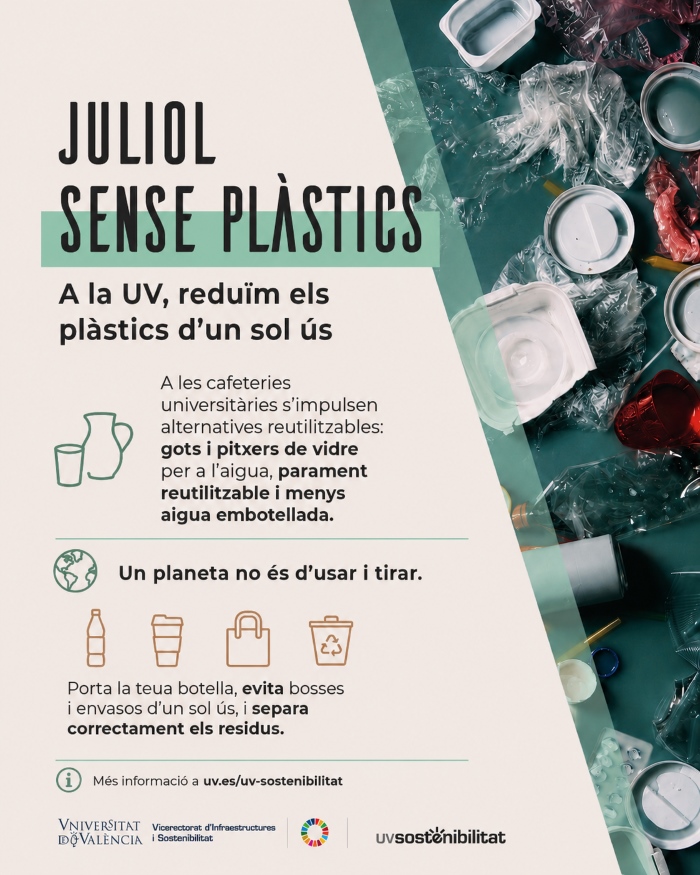
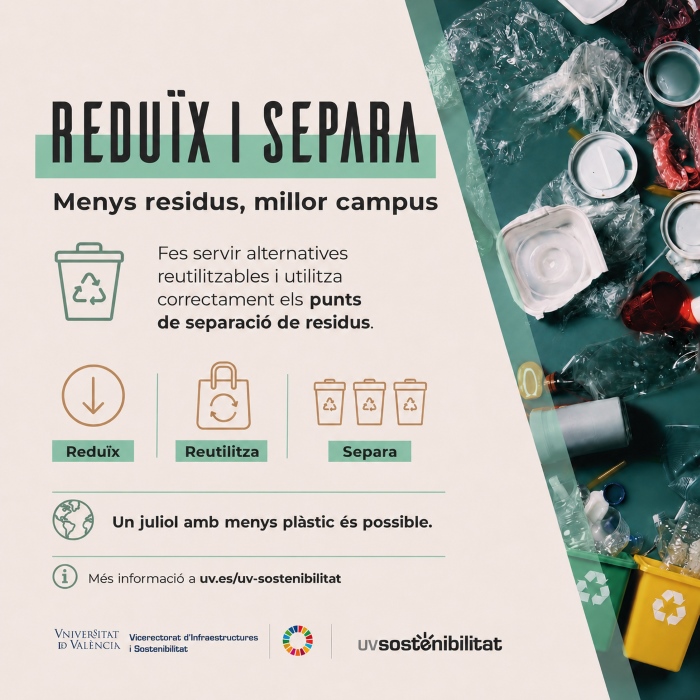
The Universitat de València commemorates, this month of July, the “Plastic Free July” global campaign, an initiative that intends to raise awareness on the environmental impact of disposable plastics. In a context where this waste represents the 50 % of the total generated worldwide and can take up to 400 years to decompose, the institution is strengthening its commitment to a zero waste campus model.
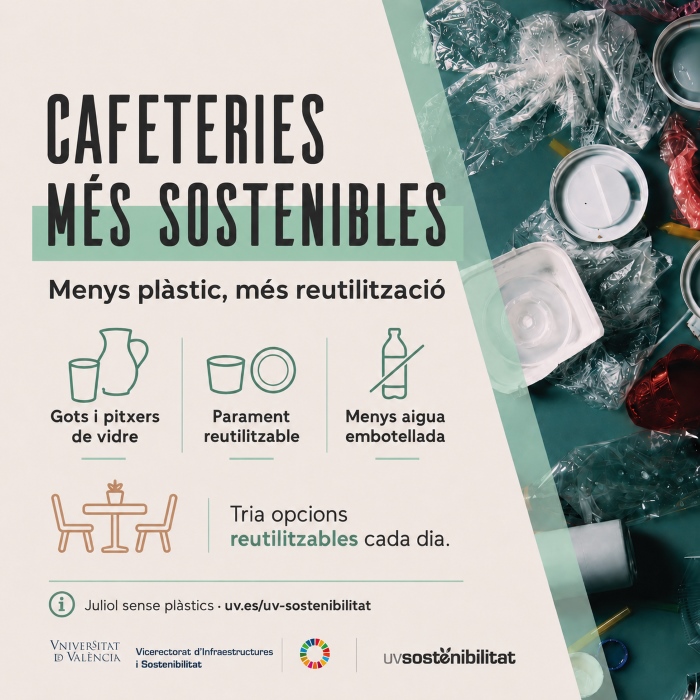
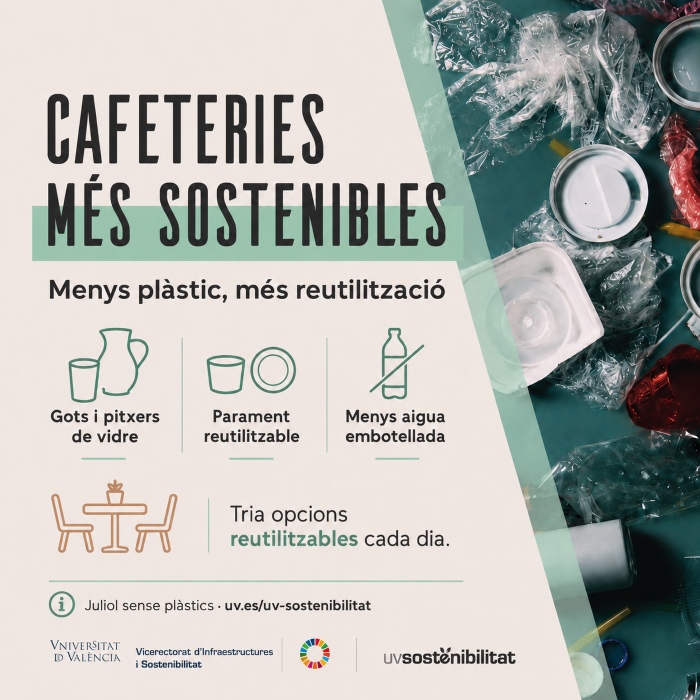
Within the UVsustainability strategy, the University implemented drastic measures in their services of restoration to eliminate the plastic footprint. According to the new tender documents of the cafeterias, the use of plastic bottles has been explicitly banned. They will be substituted with glass bottles of water or free self-service fountains.
Moreover, all the used tableware –dishes, glasses and cutlery– are made of reusable material, and the disposable tablecloth has been removed. Even the “no glass” option has been introduced at the vending machines, to promote the use of appropriate containers.
The impact of our choices: cafeteria vs. take-out food
One of the key aims of this campaign is to raise awareness of the great difference in the amount of waste generated, depending on where we decide to eat. Choosing the menu of the university cafeteria results in a substantial reduction in packaging waste, as it uses reusable tableware instead of disposable items that become waste after a single use.
On the contrary, choosing a similar menu but using supermarket take-out or ready-made meals, significantly increases the environmental impact. These products are often packaged in multiple layers of plastic and plastic wrap that, besides being difficult to recycle, they create a volume of waste that require substantial resources to process and often ends up in landfills.
Ironically, cafeterias that reduce the use of plastic bottles, wrappers, and packaging often end up dealing with plastic waste of food supplied by other businesses. Give an opportunity to the food freshly cooked in traditional dishes and cutlery. You will eat better, healthier, and you will generate less waste. Remember that you can order half menu, that products are fresh and seasonal, that you have fruit for dessert and that you can order the menu without a drink to use the fountains of refrigerated water.
As an additional measure to avoid food waste and benefit students’ savings, the food portions that have not been sold are offered at the end of the service at reduced prices.
Cut-price sustainability
Beyond the ecological benefit, the UV fosters that the sustainable option can’t be more expensive. Cafeterias offer compostable containers for those who need to take leftovers, but they also encourage to bring their own containers from home to avoid any waste.
This way, it is possible to enjoy a healthy, local and plastic-free food for the same or cheaper price than the industrial and packaged menu, closing, this way, the loop of circular economy at the campus.
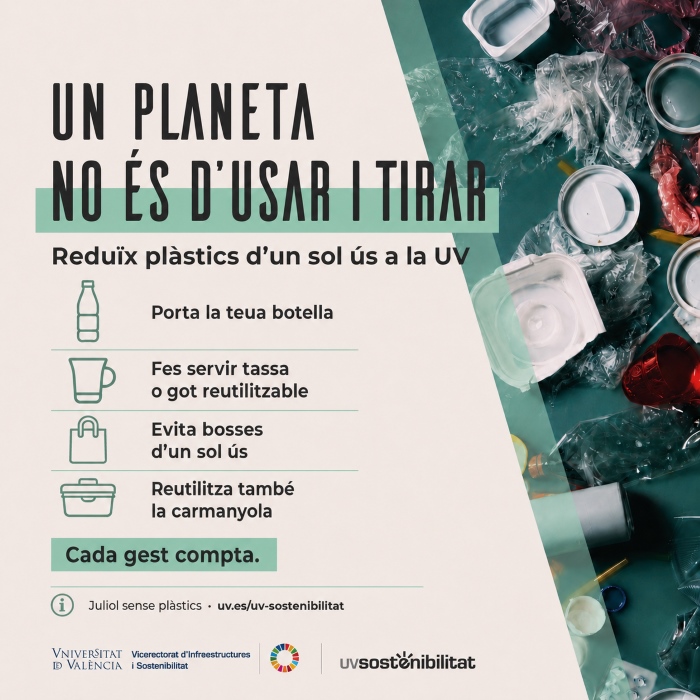
This July, the university invites the whole community to be more sustainable, by choosing options that take care of the planet and our pockets, bearing in mind that the best waste is the one that is never generated.
To delve into the necessity of taking action this month, the book Residuos ¿Un planeta de usar y echar?, edited by the Universitat de València, provides alarming statistics about the crisis of plastics that reinforces the value of every individual decision at the campus:
- An overflowing production: in 2022, approximately 400 million tons of plastic waste were generated globally, which is equivalent to 50 kg per person. Of this quantity, the 40 % corresponds to disposable plastics, as packaging and bags that we try to eliminate from our daily diet.
- The illusion of recycling: despite the efforts, less than the 10 % of the plastic waste is recycled effectively in the planet. The rest of it ends up in landfills, incinerators, or dispersed in nature, where it can persist between 500 and 1000 years before deteriorating completely.
- The invisible threat of microplastics: over time, plastic is divided into tiny particles (under 5mm) that have already been detected in isolated places such as the melting of the Marianas or the summits of Mount Everest. The most concerning thing is that these microplastics entered in the food chain and have met in the placenta, the blood and even in the human brain.
- The “Trojan horse” effect: beyond the physical damage, microplastics act as vectors of toxic substances. They contain chemical additives such as phthalates or *bisphenol A. In addition, they absorb heavy metals from the environment that are released in the organism once they are ingested.
This scientific context proves that reducing the use of containers is not only a point of order, but also an urgent measure of public health and protection of ecosystems. Every time we avoid a disposable plastic, we are cutting the loop of a waste that, otherwise, it would stay with us for centuries.
Residuos: ¿Un planeta de usar y tirar? | Publications of the Universitat de València


Categories:





