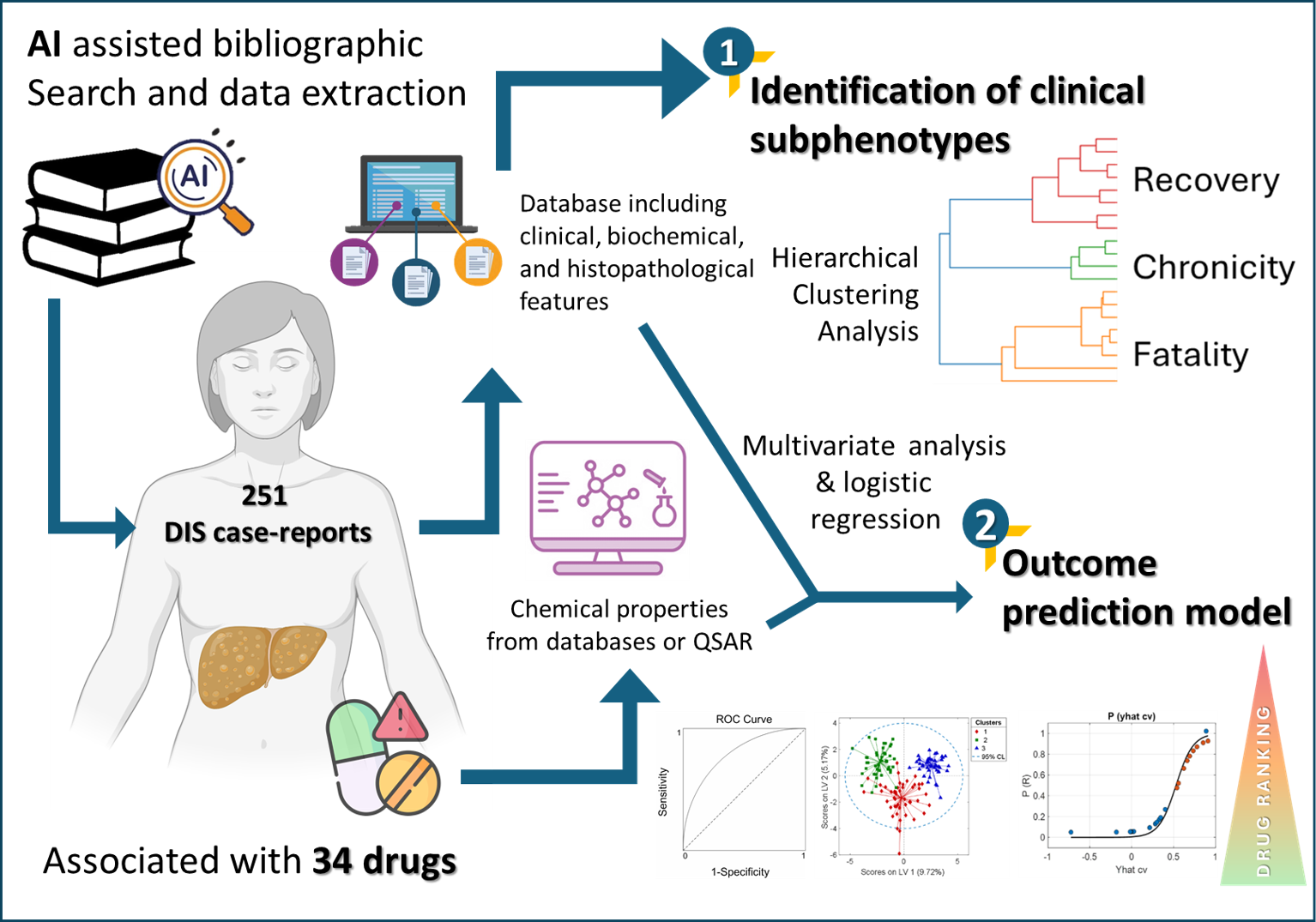
The analysis of more than 250 clinical casesreveals three clinical profiles of drug-related liver toxicity and enables prediction of recovery or risk using artificial intelligence.
The Experimental Hepatology UV-IIS La Fe team, a member of the CIBER of Hepatic and Digestive Diseases (CIBEREHD), has published a study that, for the first time, characterizes the different clinical subtypes of drug-induced fatty liver disease and develops a model capable of predicting patient outcomes.
The study, entitled “Unravelling drug-induced hepatic steatosis: Clinical sub-phenotypes, outcome prediction, and identification of high-concern drugs and hazardous chemical attributes” and recently published in Biomedicine & Pharmacotherapy, thoroughly analyzes more than 250 clinical cases reported in the scientific literature to better understand this form of liver toxicity, which remains underexplored despite its clinical relevance.
Three clinical profiles with different outcomes
The study identifies three main subtypes of patients with drug-induced hepatic steatosis, each associated with a distinct clinical outcome: recovery, chronic progression, or fatal outcome.
Researchers found that these subtypes present distinct clinical and histological characteristics. While cases with better prognosis tend to show more reversible forms of fat accumulation, more severe cases are associated with profound metabolic alterations, such as lactic acidosis, and a faster, unfavorable progression.
This finding demonstrates that drug-induced fatty liver disease is not a single entity but a group of conditions with different mechanisms and risks.
Identification of high-risk drugs
The analysis also identified the drugs most frequently associated with this condition and those linked to worse clinical outcomes.
Among the drugs associated with greater severity are some widely used compounds, highlighting the importance of proper monitoring in treated patients. In addition, the study shows that certain chemical characteristics of drugs directly influence their hepatotoxic potential.
Artificial intelligence to analyze clinical evidence
To conduct the study, the team used artificial intelligence tools to review thousands of scientific publications and systematically extract clinical data.
This approach enabled the construction of one of the most comprehensive databases to date on drug-induced hepatic steatosis, making it possible to identify previously unknown clinical patterns and risk factors.
A model to predict patient outcomes
One of the most relevant advances is the development of a predictive model that estimates the probability of recovery based on clinical variables and drug properties.
This model could help healthcare professionals make more informed decisions, anticipate complications, and personalize patient follow-up.
The Experimental Hepatology Group, an international reference in drug-induced liver toxicity research, highlights that these findings improve the understanding of the heterogeneity of liver injury and open new avenues for safer drug development.
The study involved international collaborators and was funded by thr European project ONTOX, the Instituto de Salud Carlos III, and other public and private entities.