On the 10th of march, at 11:00 , in the classroom of Lise Meitner, Faculty of Physics, Av. Vicent Andrés Estellés, 19. 46100 Burjassot, will take place the PhD thesis defense of Adam Griffiths that has been supervised by Miguel Angel Aloy Torás and Martin Obergaulinguer professors of that department.
Title:
The last five minutes of evolution of magnetic fields and rotation of massive stars
Abstract:
Massive stars are the progenitors of the energetic explosions known as core-collapse supernovae. Massive stars that rotate and host magnetic fields, as many do, may produce even more powerful magneto-rotational explosions, which are responsible for some of the most energetic events in the Universe. It is within these explosions that many of the heavy elements that make up our Universe are synthesised. The collapsing core ultimately forms either a neutron star or a black hole. The former may belong to the class of magnetars, which possess the strongest magnetic fields known, while the latter can be studied through gravitational-wave observations of black-hole mergers, enabling constraints on the mass distribution of their population. Therefore, understanding the fate of massive stars is a key question in astrophysics and, in the context of rotating and magnetised stars, remains only partially explored.
Core-collapse simulations are performed with multi-dimensional magnetohydrodynamic (MHD) calculations, which require suitable initial conditions. To study the progenitors of such events, researchers use stellar evolution codes to evolve massive stars from birth to collapse. Because these codes must cover a vast range of length and time scales, they are generally limited to one-dimensional calculations and rely on theoretical and observational prescriptions to approximate inherently multi-dimensional processes such as convection, rotation, and magnetisation.
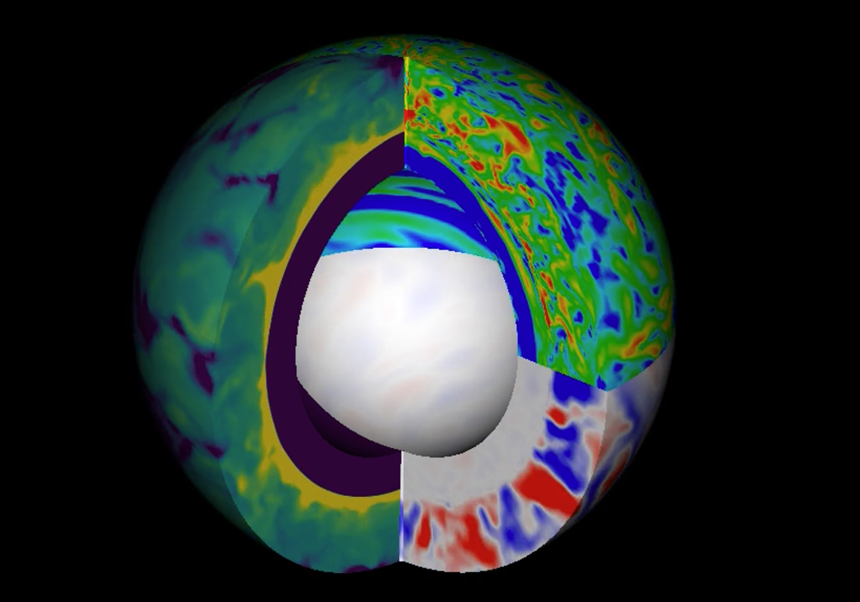
The core-collapse progenitors commonly used in supernova research can provide only approximate estimates of the magnetic-field location, strength, and geometry, typically based on local instability calculations. To advance our understanding of the internal properties of rotating and magnetised massive stars prior to collapse, we have, for the first time, simulated complete multi-dimensional MHD progenitors in the minutes leading up to core collapse.
To achieve this, we incorporated the effects of the magneto-rotational instability into the stellar evolution code GENEC and implemented several key missing ingredients needed to reach core-collapse conditions. From the one-dimensional progenitors we produced—along with additional models computed with MESA from Aguilera-Dena2020—we carefully mapped the hydrostatic stellar-evolution snapshots onto the MHD code Aenus-ALCAR. For this task, we developed a hydrostatic-equilibrium-preserving mapping algorithm based on Zingale2002. Convective regions are turbulent at the mapping stage, but if they are initialised with zero velocity, a transient period is required for turbulence to develop. To reduce this transient, we constructed initial perturbation velocity fields for convective regions and reconstructed a multi-dimensional rotation profile that more closely reflected the evolved stellar state. Using this pipeline, we produced two multi-dimensional rotating, magnetised core-collapse progenitors evolved for several minutes prior to collapse.
These simulations allow us to answer key questions regarding the internal magnetic fields of such objects, as well as other important aspects of silicon-shell nuclear burning, core-contraction dynamics, and the interplay between convection, rotation, and magnetic fields. We find that both convective and radiative regions of the star host strong magnetic fields, with convective regions exhibiting significant amplification due to turbulent motions. Importantly, we find that magnetic fields may survive within convective shells and that their topology differs substantially from those predicted in radiative zones. This stands in contrast to stellar evolution models, which typically describe magnetic fields only within radiative regions.
The stellar interiors of our models therefore exhibit magnetic fields with much larger coherence lengths, creating direct magnetic connections both within individual shells and between neighbouring shells. Such field geometries are crucial for the dynamics of the explosion and strongly influence the properties of the compact object formed at the centre of the collapsing star. Additionally, we find that the magnetic-field structure is sensitive to the behaviour of convection and rotation during the final minutes before collapse, particularly the rotation rate and the strength of convective motions. Our results provide tentative guidance for stellar-evolution models, especially regarding the treatment of mixing-length theory and rotation profiles during advanced burning phases, potentially enabling more accurate one-dimensional descriptions of core-collapse progenitors.
Finally, our models will serve as initial conditions for a new generation of magneto-rotational explosion simulations and support continued progress in our understanding of compact objects, gamma-ray bursts, and supernova explosions. We aim to apply our results to improve the modelling of rotation and magnetic fields in stellar-evolution codes and to develop effective prescriptions for generating more accurate initial conditions for multi-dimensional core-collapse simulations, without requiring full three-dimensional evolution of the final minutes before collapse.
We also have determined the geometry of the field in convective regions, which deviates from the classical dipolar field, most notably in convective regions, traditionally used in collapse simulations which also in turn will affect the explosion.
PhD Thesis announcement