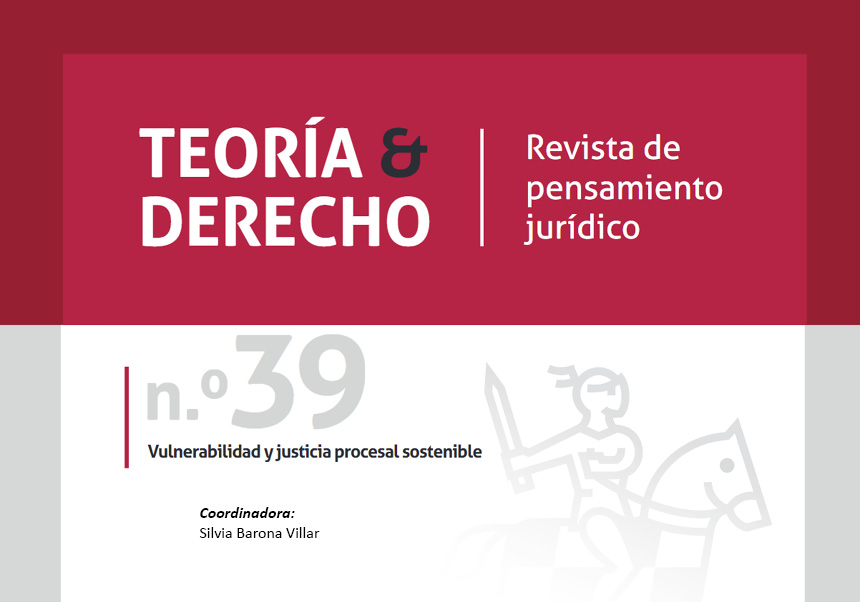
The Teoría y Derecho. Revista de pensamiento jurídico journal (Scopus), has published its 39th issue in 2025, a special issue called “Vulnerabilidad y Justicia procesal sostenible” (Vulnerability and sustainable procedural justice), coordinated by Dr Silvia Barona Vilar, professor of Procedural Law at the Universitat de València and main researcher of the JUSOST project (CIPROM 2023-64).
The issue counts with the participation of seven researchers linked to the JUSOST project, along with the collaboration with other experts. It is also a relevant contribution to contemporary legal debate about the incorporation of the vulnerability notion in the procedural justice field.
From a critical and multidisciplinary perspective, the issue begins with the consideration of vulnerability as an inherent condition to human existence, which achieves special legal relevance when it is addressed to effective access to justice and real exercise of procedural rights. The consolidation of vulnerability as an interpretative category, particularly boosted from International Law of human rights, requires reconsidering principles, institutions and traditional procedure exercises.
The collected works analyse how structural o circumstantial disadvantaged situations affected to procedural equality, highlighting the necessity of differentiated protection measures, reasonable accommodations and a more proactive legal proceeding aimed to guarantee a judicial, effective and material protection. Additionally, they reflect upon the role of the judge as guarantor of fundamental rights, the adaptation of the vulnerable groups process, and the incorporation of alternative channels, like the Appropriate Methods of Conflicts Solution (MASC).
The issue addresses key issues, such as the test in processes with vulnerable people, protection against re-victimization, the risk of paternalism or discrimination, and the challenges that a dynamic and multifaceted conception of vulnerability raises, including its future effect in relation with the following generations’ rights.
This special issue reinforces the research line of the JUSOST project, focused on the construction of a sustainable, inclusive and sensitive justice to vulnerability, and consolidates its scientific repercussion in the national and international field.