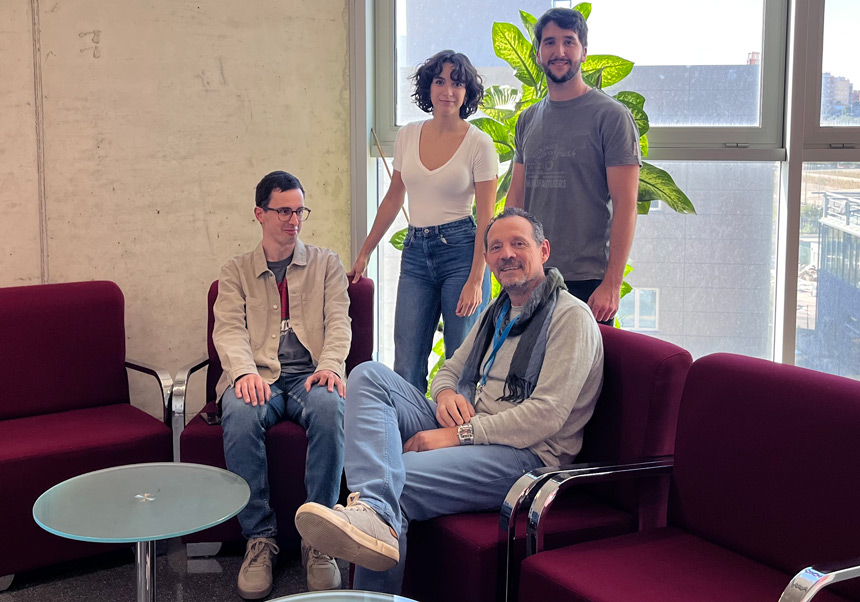
The Institute of Integrative Systems Biology (UV-CSIC) has obtained the first temporal map of the alterations associated with viroid infection suffered by a plant at the genomic level. The results are useful to discover mechanisms of resistance to infection that could be selected in varieties of agricultural interest.
A research group from the Institute for Integrative Systems Biology (I2SysBio), a joint centre of the Spanish National Research Council (CSIC) and the University of Valencia (UV), has obtained the first temporal map of the alterations suffered by a plant as a result of infection by viroids, the smallest known infectious agents. These alterations include malformations and discolouration of the different parts of the infected plant, which can lead to significant crop losses. The study, published in the journal Plant, Cell & Environment, will help to determine the basis of the molecular response of plants to viroid infection, which is very useful for selecting resistance mechanisms in agricultural varieties.
Specifically, the work led by Gustavo Gómez, CSIC scientist at I2SysBio, has studied the infection of the cucumber plant (Cucumis sativus) by the hop stunt viroid. It can infect a wide range of species, from vegetables to fruit trees, causing symptoms such as dwarfing, fruit spots and irregularities, and trunk furrows.
To characterise the molecular response of cucumber plants during infection, the researchers used massive sequencing techniques to determine which genes are activated (gene expression), as well as the accumulation of non-coding RNA (the material from which the viroids are made) and epigenetic changes (modifications in the DNA that, although they do not change the sequence of the genes, generate marks that influence their level of expression).
"This project has made it possible to characterise the response to viroid infection at different stages of the infection in an integrated way," explains Gustavo Gómez. In the early stage of infection, when the viroid reaches a non-inoculated plant tissue, they observed an increase in the expression of some genes, as well as changes in the identity of the transcribed genes, the process of generating an RNA copy from a DNA sequence of a gene.
Selecting mechanisms of resistance to infection
"In contrast, repression of gene expression predominated in the intermediate and late stages of infection," Gomez describes. This repression of gene expression was associated with epigenetic changes in the DNA, a process that modifies its function. For small non-coding RNAs, the alterations were limited and occurred predominantly at the end of infection. "This is the first temporal map of the alterations associated with viroid infection considering epigenetic changes and changes in the expression of coding genes and small non-coding RNAs", says the CSIC researcher.
According to Gustavo Gómez, "this work will help to elucidate the basis of the molecular response of plants to viroid infection. This could be very useful to discover mechanisms of resistance to infection that could be selected in varieties of agricultural interest".
Reference:
Márquez-Molins, J., Villalba-Bermell, P., Corell-Sierra, J., Pallás, V. & Gomez, G. Integrative time-scale and multi-omics analysis of host responses to viroid infection. Plant, Cell & Environment, 46, 2909–2927. https://doi.org/10.1111/pce.14647
Source: CSIC, Delegación en la Comunitat Valenciana.