

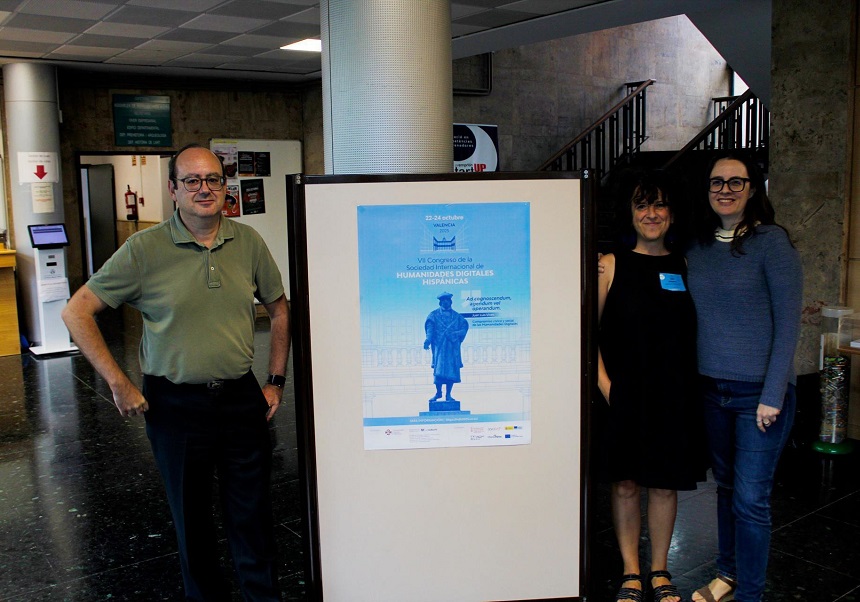
The VII International Congress of Hispanic Digital Humanities featured the presence of colleagues from the ChemiNova project. Members of the research team participated as speakers, moderators, and audience members in the sessions held from Wednesday, October 22nd, to Friday, October 24th at the faculties of Geography and History and Philology, Translation, and Communication at the University of Valencia.
The meeting, organised jointly by the departments of Spanish Philology, English and German Philology, and Art History, brought together leading academics and specialists in Hispanic digital humanities who, from the fields of arts, humanities, and social sciences, and with different approaches and methodologies, contribute to the reflection on new ways of approaching research facilitated by digital tools.
The researchers involved in the ChemiNova project presented initiatives and papers related to their field of study, such as the TinajAR initiative and the use of artificial intelligence and computer vision for the predictive conservation of heritage at risk.
In this sense, several sessions were devoted to ChemiNova itself. This action will run from February 2024 to January 2027 and aims to develop an intelligent computational system that goes beyond current technologies to address the structural and chemical damage suffered by European monuments and heritage collections as a result of two specific man-made threats: climate change and civil conflicts.

ChemiNova is funded by the European Union through grant agreement number 101132442. The views expressed are the sole responsibility of the authors and do not necessarily reflect those of the European Union. Neither the European Union nor the granting authority can be held responsible for them.
Images:
.JPG)
.JPG)
.JPG)
.JPG)
.JPG)
.JPG)