

-
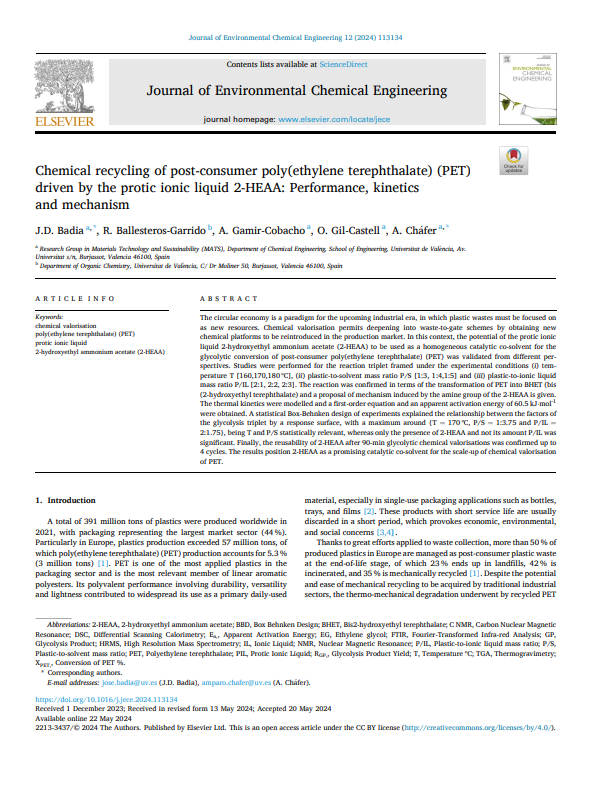
Chemical recycling of post-consumer poly(ethylene terephthalate) (PET) driven by the protic ionic liquid 2-HEAA: Performance, kinetics and mechanism
J.D.Badia, R.Ballestero-Garrido, A. Gamir-Cobacho, O.Gil-Castell, A. Cháfer
(2024). ArticleThe circular economy is a paradigm for the upcoming industrial era, in which plastic wastes must be focused on as new resources. Chemical valorisation permits deepening into waste-to-gate schemes by obtaining new chemical platforms to be reintroduced in the production market. In this context, the potential of the protic ionic liquid 2-hydroxyethyl ammonium acetate (2-HEAA) to be used as a homogeneous catalytic co-solvent for the glycolytic conversion of post-consumer poly(ethylene terephthalate) (PET) was validated from different perspectives. Studies were performed for the reaction triplet framed under the experimental conditions (i) temperature T [160,170,180 ºC], (ii) plastic-to-solvent...
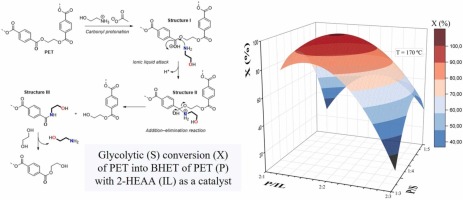
The circular economy is a paradigm for the upcoming industrial era, in which plastic wastes must be focused on as new resources. Chemical valorisation permits deepening into waste-to-gate schemes by obtaining new chemical platforms to be reintroduced in the production market. In this context, the potential of the protic ionic liquid 2-hydroxyethyl ammonium acetate (2-HEAA) to be used as a homogeneous catalytic co-solvent for the glycolytic conversion of post-consumer poly(ethylene terephthalate) (PET) was validated from different perspectives. Studies were performed for the reaction triplet framed under the experimental conditions (i) temperature T [160,170,180 ºC], (ii) plastic-to-solvent mass ratio P/S [1:3, 1:4,1:5] and (iii) plastic-to-ionic liquid mass ratio P/IL [2:1, 2:2, 2:3]. The reaction was confirmed in terms of the transformation of PET into BHET (bis(2-hydroxyethyl terephthalate) and a proposal of mechanism induced by the amine group of the 2-HEAA is given. The thermal kinetics were modelled and a first-order equation and an apparent activation energy of 60.5 kJ·mol-1 were obtained. A statistical Box-Behnken design of experiments explained the relationship between the factors of the glycolysis triplet by a response surface, with a maximum around {T = 170 ºC, P/S = 1:3.75 and P/IL = 2:1.75}, being T and P/S statistically relevant, whereas only the presence of 2-HEAA and not its amount P/IL was significant. Finally, the reusability of 2-HEAA after 90-min glycolytic chemical valorisations was confirmed up to 4 cycles. The results position 2-HEAA as a promising catalytic co-solvent for the scale-up of chemical valorisation of PET.
Read more Hide DOI: doi.org/10.1016/j.jece.2024.113134 -
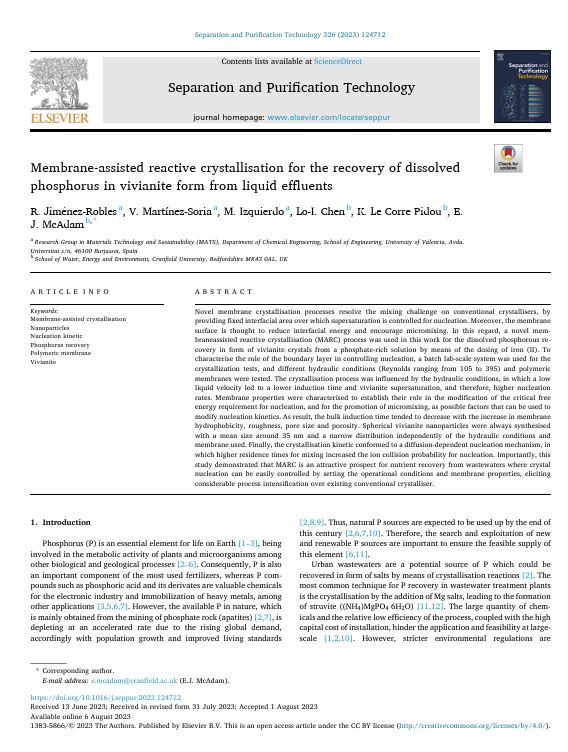
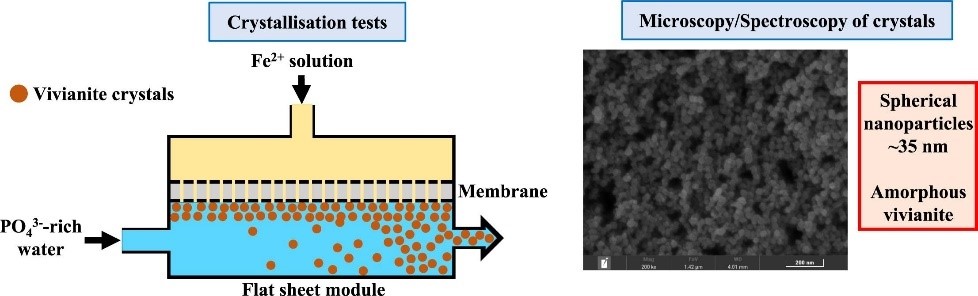
Membrane-assisted reactive crystallisation for the recovery of dissolved phosphorus in vivianite form from liquid effluents
R. Jiménez-Robles, V. Martínez-Soria, M. Izquierdo, Lo-I. Chen, K. Le Corre Pidou, E.J. McAdam.
(2023). ArticleSeparation and Purification Technology. No.326, 2023, 124712.
DOI: 10.1016/j.seppur.2023.124712 -
Stability of Superhydrophobicity and Structure of PVDF Membranes Treated by Vacuum Oxygen Plasma and Organofluorosilanisation
Ramón Jiménez-Robles, Marta Izquierdo, Vicente Martínez-Soria, Laura Martí, Alicia Monleón, José David Badia.
(2023). ArticleMembranes. No.13(3), 314.
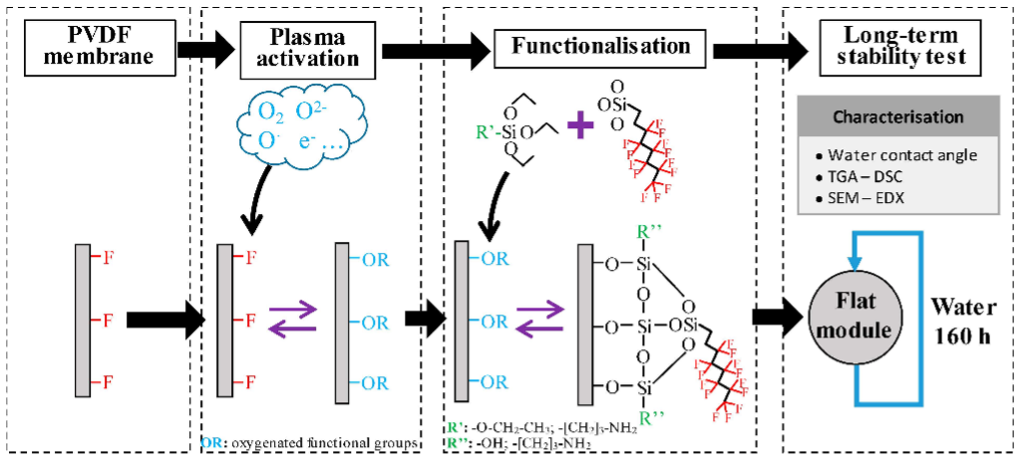
Superhydrophobic poly(vinylidene fluoride) (PVDF) membranes were obtained by a surface treatment consisting of oxygen plasma activation followed by functionalisation with a mixture of silica precursor (SiP) (tetraethyl-orthosilicate [TEOS] or 3-(triethoxysilyl)-propylamine [APTES]) and a fluoroalkylsilane (1H,1H,2H,2H-perfluorooctyltriethoxysilane), and were benchmarked with coated membranes without plasma activation. The modifications acted mainly on the surface, and the bulk properties remained stable. From a statistical design of experiments on surface hydrophobicity, the type of SiP was the most relevant factor, achieving the highest water contact angles (WCA) with the use of APTES,...
Superhydrophobic poly(vinylidene fluoride) (PVDF) membranes were obtained by a surface treatment consisting of oxygen plasma activation followed by functionalisation with a mixture of silica precursor (SiP) (tetraethyl-orthosilicate [TEOS] or 3-(triethoxysilyl)-propylamine [APTES]) and a fluoroalkylsilane (1H,1H,2H,2H-perfluorooctyltriethoxysilane), and were benchmarked with coated membranes without plasma activation. The modifications acted mainly on the surface, and the bulk properties remained stable. From a statistical design of experiments on surface hydrophobicity, the type of SiP was the most relevant factor, achieving the highest water contact angles (WCA) with the use of APTES, with a maximum WCA higher than 155° for membranes activated at a plasma power discharge of 15 W during 15 min, without membrane degradation. Morphological changes were observed on the membrane surfaces treated under these plasma conditions, showing a pillar-like structure with higher surface porosity. In long-term stability tests under moderate water flux conditions, the WCA of coated membranes which were not activated by oxygen plasma decreased to approximately 120° after the first 24 h (similar to the pristine membrane), whilst the WCA of plasma-treated membranes was maintained around 130° after 160 h. Thus, plasma pre-treatment led to membranes with a superhydrophobic performance and kept a higher hydrophobicity after long-term operations.
Read more HideKeywords: functionalisation; membrane stability; polymeric membrane; polyvinylidene fluoride; oxygen plasma; superhydrophobicity
Ramón Jiménez-Robles, Marta Izquierdo, Vicente Martínez-Soria, Laura Martí, Alicia Monleón, José David Badia. Stability of Superhydrophobicity and Structure of PVDF Membranes Treated by Vacuum Oxygen Plasma and Organofluorosilanisation. Membranes 2023,13, 314.
(This article belongs to the Special Issue Surface Modification and Performance Enhancement in Membrane Separation Technologies)
[Read more] [Hide] DOI: 10.3390/membranes13030314
 MATS Materials technology and sustainability


© 2026 UV. - Av. de la Universitat, s/n. 46100 Burjassot (València). Phone number: (+34) 963 544 319