- Universitat de València (12,5%)
- Fundación INCLIVA (87,5%)
- Cervantes Ruiperez, Andres Manuel R
- PDI-Catedratic/a d'Universitat
- Francisco Gimeno Valiente
- Jorge Martín Arana
- Noelia Tarazona Llavero
Minimal residual disease (MRD) indicates the presence of cancer cells during or after cancer treatment that are not visible by imaging tests. The detection of MRD has become a specialised test to assess the risk of relapse and to establish more effective treatment.
It is currently performed using flow cytometry, polymerase chain reaction (PCR) and next-generation sequencing (NGS) techniques. These traditional methods based on reported tumour profiles or customised panels tend to underestimate tumour heterogeneity and clonal evolution, thus reducing their ability to identify MRD in patients who subsequently experience recurrences.
Although detection of MRD by circulating DNA (ctDNA) analysis has proven to be crucial in identifying patients at high risk of relapse, current methods show significant limitations in sensitivity, especially in patients after surgery.
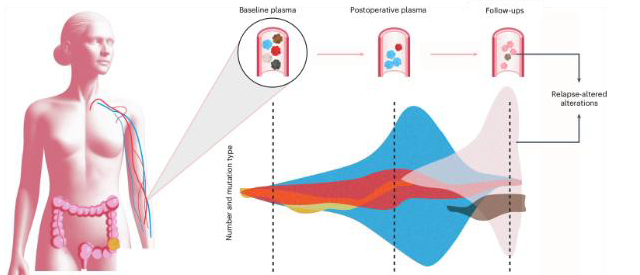
Researchers of INCLIVA and UV have developed a tumour-diagnostic method for the highly sensitive detection of minimal residual disease (MRD) in cancer patients by analysis of circulating tumour DNA (ctDNA) with high sensitivity that allows for better clinical decision-making. The methodology is validated in colon cancer with an external cohort and is currently being validated in other cancers.
This invention would be of application in health sector, for detection of minimal residual disease and treatment of cancers.
The main advantages of the invention are:
- Higher sensitivity than conventional methods.
- Early detection of MRE.
- Follow-up of tumour evolution.
- Possibility of personalised treatments.
- Reduction of the risk of over- or under-treatment.
- Broad clinical applicability (tumour-diagnosis).
- Patent applied
Blasco Ibáñez Campus
C/ Amadeu de Savoia, 4
46010 València (València)