

-

Development of a Geographic Database on Spanish Theaters: A Comprehensive Tool for Analyzing Cultural Infrastructure.
Virgilio Pérez, Vicente Coll & Pau Rausell-Köster
(2026). ArticleThe cultural sector plays a significant role in economic and social development, contributing to approximately 3% of the world’s GDP. Despite its importance, detailed spatial analysis of cultural infrastructures has been hindered by a lack of comprehensive databases. This study presents the development of the Spanish Theatre Geo-Database, a unique dataset that integrates geospatial and cadastral information on public theatres in Spain. By combining data from the Spanish Cadastre and Redescena (the Spanish Network of Public Theatres), this database provides a replicable tool for analysing spatial endowment of cultural infrastructures. The methodology, although tailored for Spanish theatres,...
The cultural sector plays a significant role in economic and social development, contributing to approximately 3% of the world’s GDP. Despite its importance, detailed spatial analysis of cultural infrastructures has been hindered by a lack of comprehensive databases. This study presents the development of the Spanish Theatre Geo-Database, a unique dataset that integrates geospatial and cadastral information on public theatres in Spain. By combining data from the Spanish Cadastre and Redescena (the Spanish Network of Public Theatres), this database provides a replicable tool for analysing spatial endowment of cultural infrastructures. The methodology, although tailored for Spanish theatres, is highly adaptable and can be applied to other infrastructure studies. Four indicators—Theatre Density Rate (TDR), Theatre Area Rate (TAR), Public Building Density Rate (PBDR), and Public Building Area Rate (PBAR)—are proposed to quantify public investment in cultural facilities. The results reveal marked territorial heterogeneity and statistically significant spatial clustering, especially for theatre density, patterns that remain robust under sensitivity checks. These findings underline the importance of integrating cultural infrastructure into spatial planning agendas, while also highlighting the need for more complete data to fully capture regional differences. Future work could extend the dataset to additional variables and territories, enabling more precise analysis and evidence-based cultural policy both in Spain and internationally.
Read more Hide -
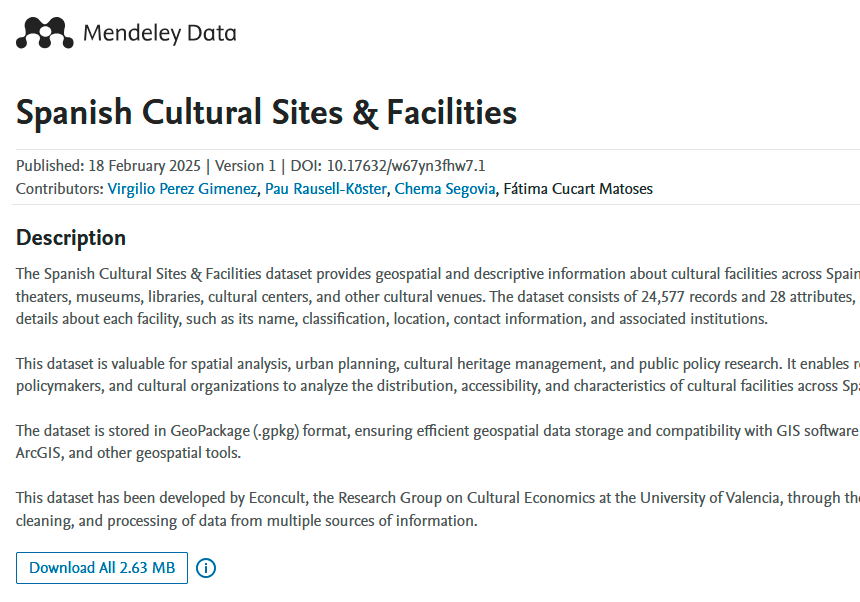
Spanish Cultural Sites & Facilities
Virgilio Pérez, Pau Rausell-Köster, Chema Segovial & Fátima Cucart.
(2026). InformesMendeley Data. No.Dataset / Base de datos geoespacial
El conjunto de datos Spanish Cultural Sites & Facilities proporciona información geoespacial y descriptiva sobre equipamientos culturales de toda España, incluyendo teatros, museos, bibliotecas, centros culturales y otros espacios culturales. El dataset contiene 24.577 registros y 28 atributos, recogiendo información clave sobre cada equipamiento, como su nombre, clasificación, localización, datos de contacto e instituciones asociadas. Este recurso resulta útil para el análisis espacial, la planificación urbana, la gestión del patrimonio cultural y la investigación en políticas públicas. Permite a investigadores, responsables políticos y organizaciones culturales analizar la...
El conjunto de datos Spanish Cultural Sites & Facilities proporciona información geoespacial y descriptiva sobre equipamientos culturales de toda España, incluyendo teatros, museos, bibliotecas, centros culturales y otros espacios culturales. El dataset contiene 24.577 registros y 28 atributos, recogiendo información clave sobre cada equipamiento, como su nombre, clasificación, localización, datos de contacto e instituciones asociadas. Este recurso resulta útil para el análisis espacial, la planificación urbana, la gestión del patrimonio cultural y la investigación en políticas públicas. Permite a investigadores, responsables políticos y organizaciones culturales analizar la distribución, accesibilidad y características de los equipamientos culturales en España. El conjunto de datos se distribuye en formato GeoPackage (.gpkg), un estándar que facilita el almacenamiento eficiente de información geoespacial y su utilización en programas SIG como QGIS, ArcGIS y otras herramientas de análisis territorial. El dataset ha sido desarrollado por Econcult mediante la recopilación, depuración y procesamiento de información procedente de múltiples fuentes.
Read more Hide DOI: 10.17632/w67yn3fhw7.1
 Chair of Space and Equipment for Culture, Creation and Innovation
© 2026 UV. - Campus dels Tarongers. Facultad de Economía. Edificio Departamental Oriental Av. dels Tarongers, s/n 46022 València (València)