On the 27th of july, at 10:00 , in the classroom of Lise Meitner, Faculty of Physics, Av. Vicent Andrés Estellés, 19. 46100 Burjassot, will take place the PhD thesis defense of Marco Cusinato that has been supervised by Miguel Angel Aloy Torás and Martin Obergaulinguer professors of that department.
Title:
The impact of rotation and magnetic fields on the dynamics and potential observables of core‐collapse supernovae
Abstract:
Core-collapse supernovae mark the final, explosive stage in the evolution of stars more massive than eight times the mass of the sun. They are key sites of heavy-element synthesis and prime targets of multimessenger astrophysics, emitting neutrinos, gravitational waves, and electromagnetic radiation. These signals probe different aspects of the collapsing core: neutrinos trace the energetics of the explosion, while gravitational waves encode the dynamical evolution of the proto-neutron star and its surroundings.
Interpreting these signals remains challenging due to nonlinear dynamics and degeneracies with respect to progenitor rotation, magnetic fields, and the nuclear equation of state. In this thesis, we establish quantitative links between these physical parameters, core-collapse dynamics, and multimessenger signals.
We perform multidimensional simulations of core-collapse supernovae in special-relativistic magnetohydrodynamics using the Aenus-ALCAR code, covering collapse and up to several seconds post-bounce. Our models include multiple progenitors (a red supergiant and two Wolf–Rayet stars), six equations of state, and varying rotation rates and magnetic field strengths.
In 29 axisymmetric simulations of the red supergiant, we analyze the connection between convection and gravitational-wave emission shortly after bounce. Using ensemble empirical mode decomposition and spectral analysis, we identify six intrinsic mode functions: three linked to proto-neutron star oscillations (including the f-mode) and three to convection. Strong magnetic fields reduce rotational support and modify mode excitation, while convection drives a persistent low-frequency signal largely independent of rotation. We also find that prompt convection can rival or exceed the core-bounce signal, complicating its identification.
For a Wolf–Rayet progenitor, we identify a pre-collapse rotation regime that enhances gravitational-wave emission via resonance between the proto-neutron star f-mode and epicyclic oscillations at the inner-core boundary. This intermittent resonance produces correlated modulations in both gravitational-wave and neutrino signals. With characteristic frequencies of the order of one kilohertz, such signals may be detectable up to one megaparsec.
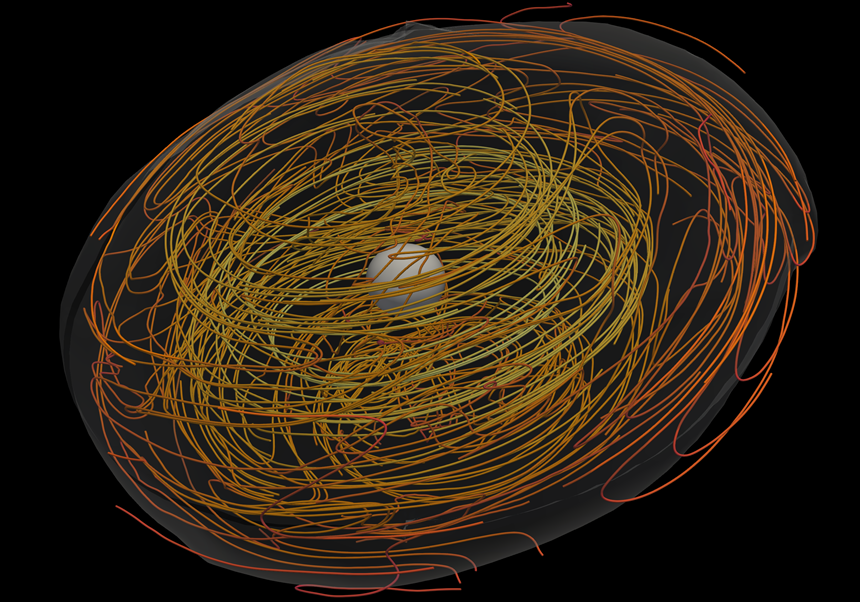
Finally, we perform fully three-dimensional simulations of a rapidly rotating, weakly magnetized Wolf–Rayet progenitor to assess the impact of the nuclear equation of state. While all models develop strong non-axisymmetric instabilities, we find that the equation of state leaves distinct signatures in the multimessenger emission. In particular, the peak frequency of the gravitational-wave signal depends sensitively on the stiffness of the equation of state. Moreover, the equation of state significantly influences the proto-neutron star structure, angular momentum redistribution, magnetic-field amplification, and the morphology of the ejecta.