

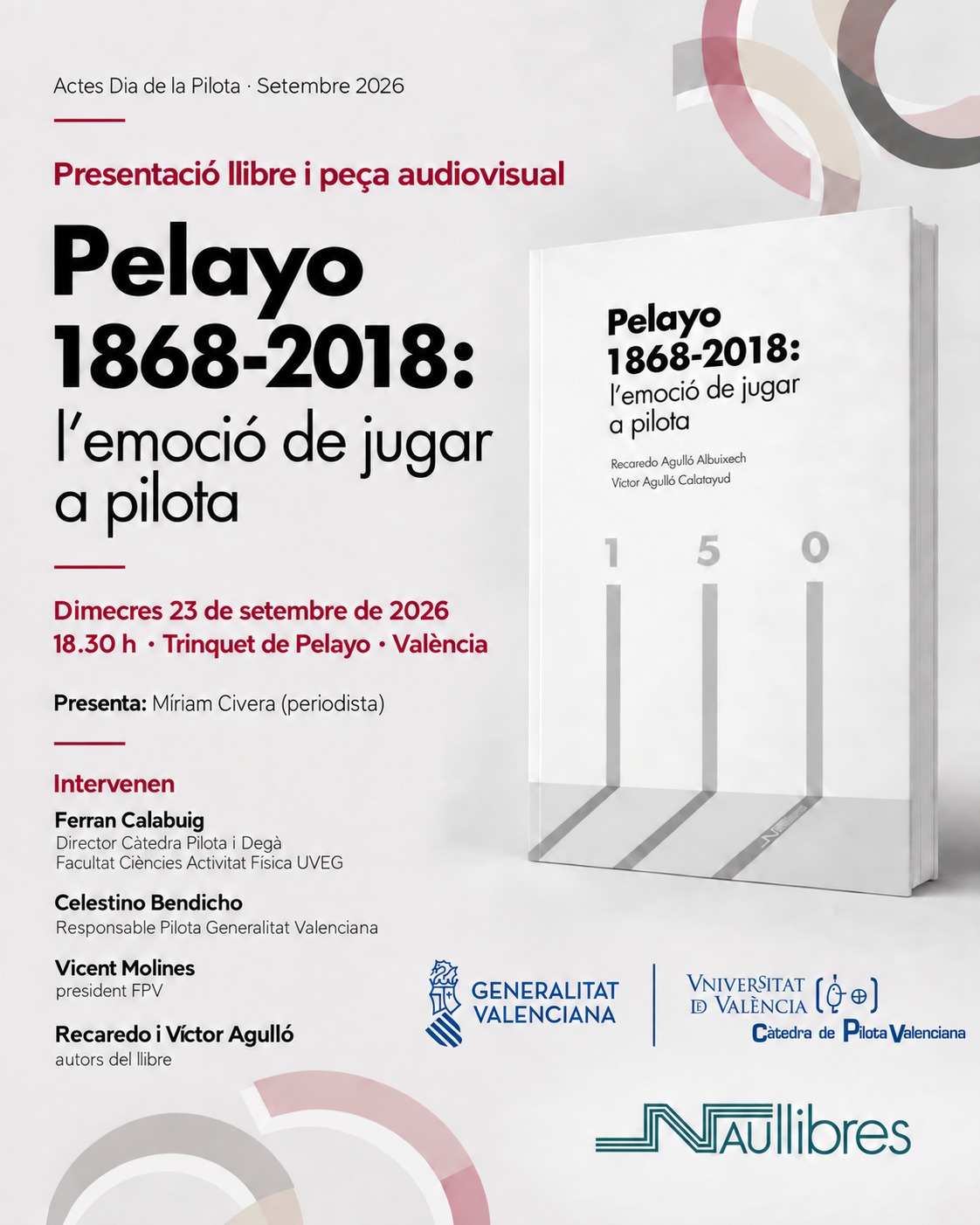
València will hold next Wednesday, 23 September, from 6:30pm, the book presentation “Pelayo 1868-2018: l’emoció de jugar a pilota” (Pelayo 1868-2018 – the excitement of playing Pilota), as well as the booktrailer. This work reconstructs the historical path of the Pelayo trinquet. The act, free and open to the public, will take place at the same Pelayo Trinquet in Valencia. It is part of the official acts of the 35th edition of the Pilota Day, coinciding, this way, with the anniversary of the discipline in a tribute to one of its most emblematic places.
A book for a story of resilience
Funded on 20 August 1868, at the Pelayo street number 6, the Pelayo Trinquet was born three years after the beginning of the demolition of the walls that surrounded the city. The press of that era already held the inauguration with the following words: “On Thursday afternoon, the new trinquet was inaugurated, with great enthusiasm by the Pilota fans. It has been built next to the tiro de la gallina, between the doors of Ruzafa and San Vicente. The event was led by the mayor-corregidor, who gave the gloves to the players, accompanied by a music band”. Since then, and for more than a century and a half, the Pelayo trinquet remains open, generation after generation, becoming one of the most ancient active sports venues in Europe.
Trinquets are part of the city of València since the 15th century, when the capital had more than fifteen similar venues, in which one of the keen practitioners stood out: Joan Lluís Vives. The book names the great figures who have graced the courts of the Pelayo trinquet, players such as Nel de Murla, Quart, Juliet d’Alginet, Rovellet and Genovés, and current players such as Ana de Borbotó, Mar de Bicorp, or Victoria de Valencia, and the chroniclers that left a written testimony like Millo, López Egea, Bausset, Durà or Soldado. The work also supports the linguistic and social dimension of the trinquet: a space where, in a context in which the Valencian bourgeoisie often underestimated this sport associated to “the town’s language”, Valencian remained alive through generations.
This year, the presentation of the book is incorporated within the programme of the 35th edition of the Pilota day that the Pilota Valenciana Federation (FPV) organises. An annual celebration that brings together players, entities and fans around the Pilota Valenciana game. In addition, it consists of a collective work in which more than half a hundred people of the Valencian civic, cultural and journalistic field participated, who express their memories and affection for the Pelayo trinquet.
It must be noted that the edition that is now being presented is the translation in Valencian of the original work, published by Nau Llibres-Edicions Culturals Valencianes in collaboration with the Valencian Pilota chair (UVEG), a fact that strengthens commitment to the project with the language and culture of their own. The book will be available to purchase during the event, and attendants will enter a giveaway of two copies.
Voices of the project
Víctor Agulló –professor of Sports Sociology at the Universitat de València and coauthor of the book along with Recaredo Agulló– put the focus on the sociological dimension of the project: “Studying the Pelayo trinquet is studying how a popular space resisted more than 158 years of social, political and urban transformations without losing its function as a meeting and cultural transmission space. This book is, above all, an exercise of collective memory: we want both the university community and the Valencian society at large to recognize the heritage value of spaces like this one, often overlooked despite its historical relevance”.
Ferran Calabuig –dean of the Faculty of Physical Activity and Sports Sciences (FCAFE) of the Universitat de València and director of the chair that supports this initiative– underlined the importance of matching the presentation with the Pilota Day: “the fact that this book is released precisely in the framework of the Pilota Day reinforces the sense of the anniversary: to recover and put into value the memory of the spaces and the people that turn Valencian pilota into a living heritage. From the Chair, we are committed to continue supporting projects that combine academic research and commitment with our sports and cultural heritage”.
Information about the call
- Activity: Presentation of the book and booktrailer “Pelayo 1868-2018: l’emoció de jugar a pilota” (Valencian edition)
- Date and time: Wednesday, 23 September, 6:30pm
- Place: Pelayo Trinquet, València
- Framework: 35th edition of the Pilota Day
- Edition: Valencian translation, published by the Nau Llibres-Edicions Culturals Valencianes in coedition with the Pilota Chair UVEG
- Event presented by: Míriam Civera, journalist and teacher at the Universitat de València
- Participants in the presentation table: Recaredo Agulló and Víctor Agulló (authors), Celestino Bendicho (coordinator of pilota of the Generalitat Valenciana), Vicent Molines (president of the Pilota Valenciana Federation), and Ferran Calabuig (dean of the FCAFE and director of the Pilota Chair UVEG)
- Purchase and giveaway: the book will be available to purchase during the event. Attendants will enter a giveaway of two copies of the book.



