.jpg)
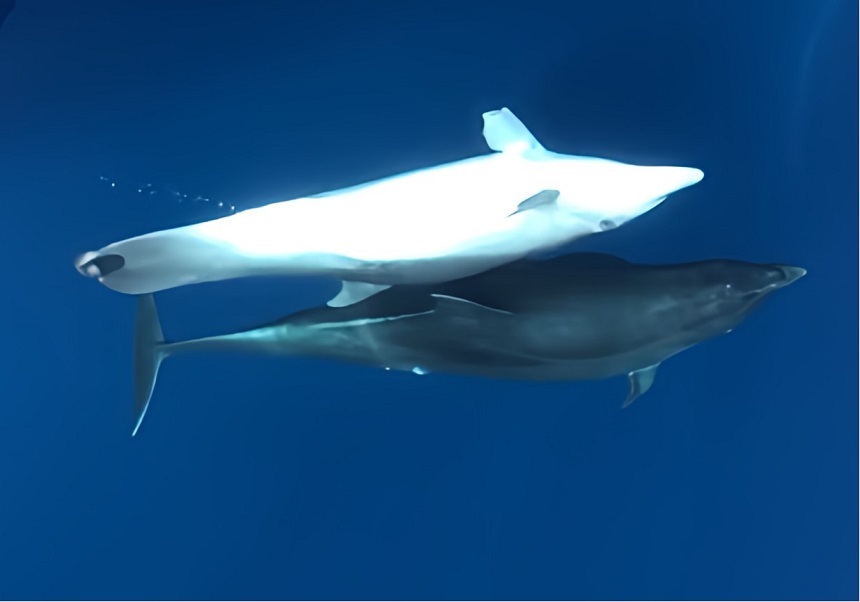
A study by the Cavanilles Institute of Biodiversity and Evolutionary Biology (ICBIBE) of the University of Valencia (UV) documents the longest known case of survival in the wild of a cetacean with major mutilations. The research, published in the journal Aquatic Mammals, describes a male bottlenose dolphin, approximately six years old, which was probably mutilated as a result of an interaction with fishing activities in waters off the Valencian Community (Nules). The animal survived for more than two years without tail flukes and with its left pectoral fin partially amputated – a condition that would normally severely compromise swimming and feeding.
The caudal fin is essential for dolphin propulsion, which is why the animal had to develop a compensatory locomotor pattern, moving the rear part of its body sideways in a crocodile-like manner. This behaviour demonstrates a high degree of functional plasticity in cetacean locomotion in response to severe injuries. This type of swimming has previously been described in dolphins lacking a tail fluke and is likely to reduce hydrodynamic efficiency, manoeuvrability and fine control during hunting.
Observations from the study, whose first author is Patricia Gozalbes, a researcher at the Cavanilles Institute, reveal that the flukes and the right pectoral fin had been severed, possibly due to the dolphin becoming entangled in a fishing net. Despite the functional loss of the caudal fin, the necropsy showed that the animal was in very good physical condition, with a weight higher than expected for its body length. In addition, its stomach was full of recently ingested prey, confirming that its feeding capacity had not been impaired.
“It is a mystery how this dolphin survived for so long. Its last meal before dying included fish and cephalopods of commercial value, which suggests that after the mutilation the animal may have been feeding on fishing catches or discards. However, we also cannot rule out that it may have been assisted by conspecifics, especially by its mother, if it still had a close bond with her”, explains Francisco Javier Aznar, co-author of the article, researcher at the Cavanilles Institute and professor in the Department of Zoology at the University of Valencia.
This bottlenose dolphin was first sighted by a recreational vessel on 12 October 2021; it was later observed on 12 August 2023 and eventually stranded on Nules beach (Castellón) on 26 April 2024, more than two and a half years later.
Although it managed to survive for several years, evidence suggests that the final cause of death was drowning during a new interaction with fishing gear, underlining the persistent impact of these activities on cetaceans. According to fishermen’s observations, bottlenose dolphins frequently interact with fishing activities in the waters of the Valencian Community, making them particularly prone to accidental capture.
This study was supported by the VARACOMVAL project, run by the Biodiversity Foundation of the Ministry for Ecological Transition and Demographic Challenge (MITECO) of the Spanish Government, within the framework of the Recovery, Transformation and Resilience Plan (PRTR), funded by the European Commission–NextGenerationEU. It also received support from the Regional Ministry for the Environment, Infrastructure, Territory and Recovery of the Valencian Government, with the collaboration of the Oceanogràfic Foundation and the NGO Xaloc.
Reference: Patricia Gozalbes Aparicio, Raúl Míguez-Lozano, Juan Antonio Raga, Jose Luis Crespo Picazo, Francisco Muñoz, Mariana Saubidet, Emma Plá González y Francisco Javier Aznar. «Spirit in Motion: A Flukeless Bottlenose Dolphin Survives for Over Two Years in the Western Mediterranean». Aquatic Mammals 2026, 52(1), 47-53, DOI https://doi.org/10.1578/AM.52.1.2026.47