

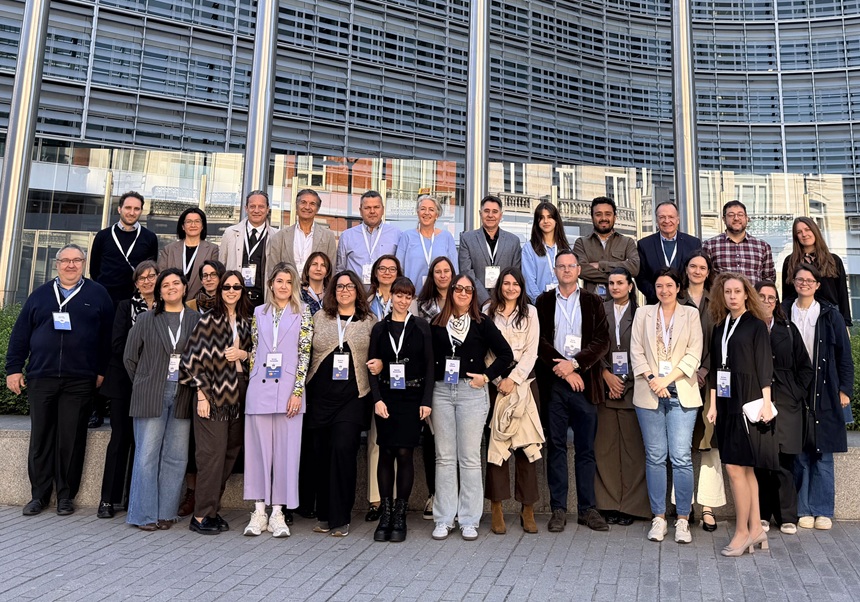
The Construction Blueprint 2 project held its third transnational meeting on April 23 and 24 in Brussels, Belgium, where 20 partners from 10 European countries participating in the initiative reviewed the project’s progress and strengthened coordination among the organizations. Participants also defined the next steps to promote skills development in the construction sector, in line with the Construction Pact for Skills.
On the first day, representatives from the European Commission provided a strategic overview of the current state of the sector. Roman Horvath, Head of Policy at the Directorate-General for the Internal Market, Industry, Entrepreneurship, and SMEs, Roman Horvath, highlighted the importance of relaunching the European Construction Observatory to identify the skills needed to meet the sector’s needs. For her part, the Project Manager at the European Education and Culture Executive Agency, Rocío Leza, discussed the potential of artificial intelligence in project implementation.
In addition, a seminar was held focusing on the importance of integrating women and young people into the sector, during which the Head of Policy at the European Commission’s Directorate-General for Employment, Social Affairs, and Inclusion, Pirkko Pyörälä, discussed European policies on inclusion and youth employment.
Regarding the project’s progress, the partners worked on the various outcomes of the initiative, coordinated by the Construction Labor Foundation, presenting the actions taken to implement the Construction Skills Pact and analyzing the milestones achieved, next steps, and the growth in the number of participating organizations.
Discussions focused on developing a strategic approach to sectoral cooperation on skills, with a presentation of the new features integrated into the European Construction Observatory, which were first introduced in the previous Construction Blueprint initiative and will be relaunched in this new phase of the project.
On the second day, the focus was on identifying urgent skills needs through continuing vocational education and training (CVET), with particular attention to the structuring of training content on digital platforms. To this end, the partners planned to implement pilot programs in each of the consortium’s countries.
In addition, members of the consortium explored the possibility of implementing training programs at the European level to help advance greater harmonization of skills and qualifications across Europe.
Through the ARTEC research group, IRTIC will contribute to the project through the design and development of innovative digital tools, accessible and adapted to the needs of the construction sector, as well as oriented to vocational training. The Construction Labour Foundation is coordinating the initiative, funded by the Erasmus+ programme.
More information:

Funded by the European Union. The opinions and views expressed are those of the author(s) alone and do not necessarily reflect those of the European Union or the European Education and Culture Executive Agency (EACEA). Neither the European Union nor the EACEA can be held responsible for them.
Images:
.jpg)
.jpg)
.jpg)
.jpg)




