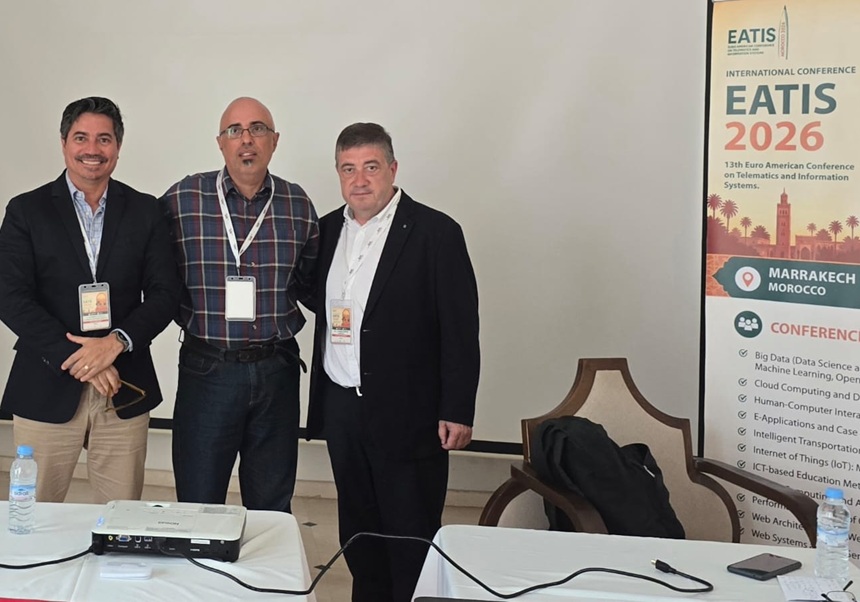
The 13th Euro-American Conference on Telematics and Information Systems (EATIS) took place from 24 to 26 June in Marrakesh, Morocco. IRTIC researchers Javier Samper, José García and Julián Gutiérrez, who are also lecturers, along with David Sánchez and Rubén Tarazón, took part in the sessions, which covered topics such as data spaces, the work carried out as part of the SIDENCA project, and the Connecta platform developed during the term of the Chair in Smart and Sustainable Territories of the University of Valencia and the Valencia Provincial Council.
EATIS is focused on the communities, contents and technologies belonging to smart cities. In particular, EATIS 2026 encourages the use of Information System (IS), Information and Communication Technologies (ICT) and Telematics Systems, making it easier for citizens to access government and public services at various levels, without any adverse impact on ethic aspects.
On behalf of IRTIC, the papers «Semantic Infrastructure for Fire Disaster» and «Semantic Transformation and Geospatial Visualization of Urban Open Data from the CONNECTA platform», were presented, relating to the SIDENCA project and the work carried out within the scope of the Chair in Smart and Sustainable Territories, respectively.
Javier Samper, who is also the current vice-president of the EATIS organization, acted as coordinator for one of the sessions. José García also coordinated another session, as well as being responsible for ensuring that the papers presented at the conference met the requirements of the Association for Computing Machinery (ACM).
As for Julián Gutiérrez, he spoke as a guest speaker on the importance of data spaces for data sharing and interoperability, as well as on the work carried out in this area at the IRTIC.
David Sánchez, via teleconference, and Rubén Tarazón highlighted the work carried out on the aforementioned initiatives relating to geospatial visualization and open data, amongst other topics.
The SIDENCA project will develop an interoperable, scalable and multisectoral platform to manage information aimed at strengthening the actors involved in the prevention and management of disasters resulting from climate change in the Valencian Community, which will improve the efficient use of natural resources and minimize damage to ecosystems and biodiversity.
As for the Chair of Intelligent and Sustainable Territories, its aim was to promote digital transformation in the rural environment by encouraging the development and implementation of technological and sustainable solutions that favor the competitiveness and innovation of the business network of the territory.

The content of this publication is the sole responsibility of IRTIC (UV) and does not necessarily reflect the views of the European Union.
Images:
.jpeg)
.jpg)
.jpeg)
.jpeg)
.jpeg)
.jpeg)
.jpeg)