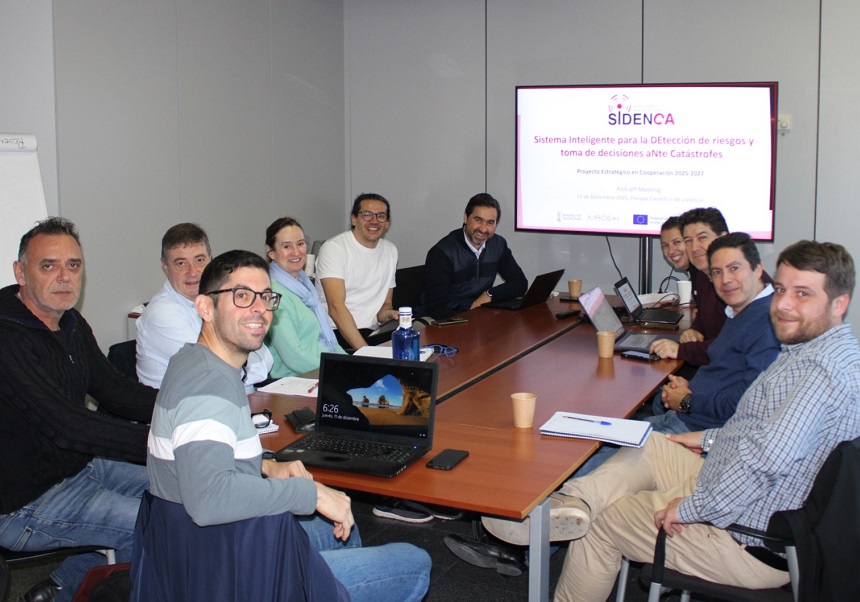
The project “Intelligent System for Risk Detection and Decision-Making in the Event of Disasters” (SIDENCA) will develop an interoperable, scalable and multisectoral platform to manage information aimed at strengthening the actors involved in the prevention and management of disasters resulting from climate change in the Valencian Community, which will improve the efficient use of natural resources and minimise damage to ecosystems and biodiversity. The members of the consortium, who will be working on the initiative from October 2025 to December 2027, met on Thursday 11th December at the University of Valencia Science Park to present the overall work plan and prepare the next steps.
Through IRTIC, the role of the University of Valencia will focus on collecting, processing and structuring data such as satellite remote sensing, RPAS (Remotely Piloted Aircraft Systems), in-situ sensors and socio-economic parameters relevant to the prevention, detection and analysis of extreme weather events characteristic of the Valencian Community, among which are forest fires, floods, severe storms and heat waves.
The research institute will also develop an interoperable semantic model that will enable this heterogeneous information to be structured and linked, facilitating its use by SIDENCA.
In this context, the initiative will be accessible via a web geoportal, compatible with desktop and mobile devices, and will include geospatial information, interactive viewers and information based on Earth observation (EO) imagery, derived products, the aforementioned in-situ sensors, drones and light detection and ranging (LiDAR).
This data infrastructure will enable the generation of pre-event risk maps, real-time damage and evolution maps, and post-event assessments, supporting all phases of the emergency management cycle and adapting decision-making to the growing impact of natural hazards that climate change has exacerbated.
The SIDENCA consortium is led by the company Albavalor, and the private centre AINIA, the companies Innovageo and Lãberit, the University of Valencia and the Jaume I University are participating in it. The entities, which met on Thursday 11th to define the immediate steps to be taken, will contribute their knowledge of remote sensing; agriculture and drones; web platforms and geoportals; software development, technological solutions and sensors; data semantics and artificial intelligence; and geomodelling to the initiative respectively.
The total amount of the grant is 872.680,06 euros, corresponding to European Union funding through the Strategic Cooperation Projects programme promoted by the Valencian Institute of Competitiveness and Innovation (IVACE+i).
Crucial support for decision-making
The tool will be modular and interoperable in design, with API integration capabilities and automatic report export in standardised formats, facilitating its integration with existing systems and its territorial and functional scalability. The long-term viability and replicability of the solution developed within the framework of the project are also among its objectives.
The platform will contribute to the work of the Advanced Command Post and to the strategic coordination, advisory and communication tasks carried out by advisory committees and information offices. It will also provide crucial support to the Territorial Planning Offices by distinguishing between areas with greater or lesser relative exposure to different extreme weather events.
In this way, policymakers will have tools to support decision-making, and first responders will have solutions for early warning and effective action.

The content of this publication is the sole responsibility of IRTIC (UV) and does not necessarily reflect the views of the European Union.