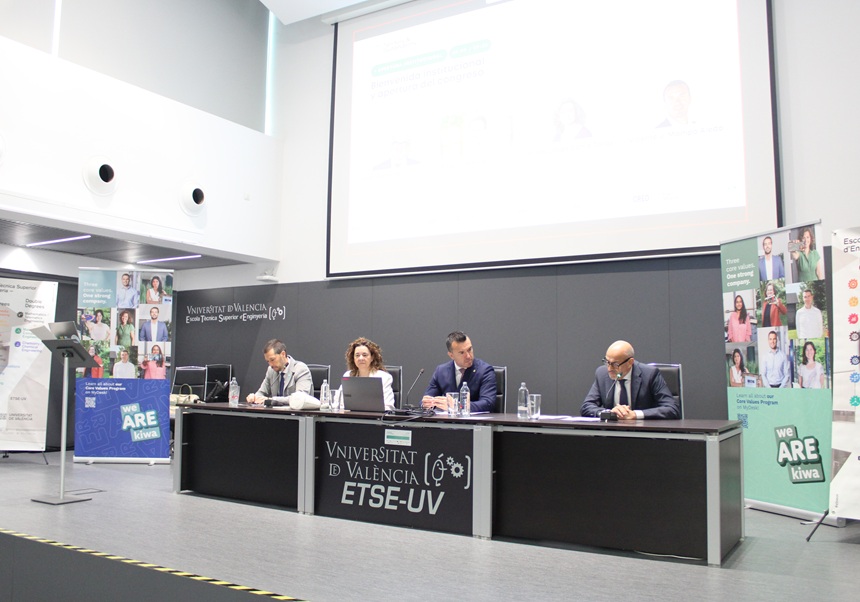
The conference “Territory and Sustainability: Data that Transforms the Common Good”, organized by Kiwa Spain and the Institute on Robotics and Information and Communications Technologies (IRTIC), took place on Thursday, May 28th, at the ETSE-UV. The sessions addressed the strategic role of data spaces in the digital and sustainable transformation of the territory by facilitating new models of collaboration between sectors, interoperability between organizations, and management based on shared, secure and governed data.
The round-table discussions also covered the circular economy and waste recovery, agri-food sustainability and water efficiency, traceability and environmental certification, as well as federated ecosystems and trusted environments.
During the event, it became clear that data spaces are establishing themselves as strategic infrastructures for Europe, enabling information to be shared in an interoperable, secure and governed manner in order to improve decision-making and generate new models of collaboration.
The President of the Valencia Provincial Council, Vicente José Mompó; the Vice-Rector for Digital Transformation at the University of Valencia, Inmaculada Coma; the Director-General for the European Green Capital initiative at Valencia City Council, Antonio García; and the Director-General of Kiwa Spain, Juan Cardona, took part in the official opening ceremony.
The presentations brought together institutional representatives, innovation experts, those in charge of strategic projects, and organizations currently involved in initiatives launched under the Recovery, Transformation and Resilience Plan (PRTR), funded by the European NextGenerationEU programme and linked to programmes run by the Ministry for Digital Transformation and the Civil Service.
In this regard, the director of IRTIC, Juan José Martínez, took part in the panel discussion on governance, regulation and trust frameworks for the data economy. The director of the Innovation Department at Kiwa Spain, Rosa Valenzuela, emphasized during the sessions the importance of sharing innovation and taking into account the characteristics of the region in order to preserve its distinctive features.
Local authorities, cooperatives, government bodies and experts agreed that data generates value when it is linked and transformed into useful knowledge for people and the areas in which they live.
Images:
.JPG)
.JPG)
.JPG)
.JPG)
.JPG)
.jpg)
.JPG)
.JPG)
.JPG)
.JPG)
.JPG)
.JPG)
.JPG)
.JPG)
.JPG)
.JPG)
.JPG)
.JPG)
.JPG)
.JPG)
.JPG)
.JPG)
.JPG)
.JPG)
.JPG)
.JPG)
.JPG)