

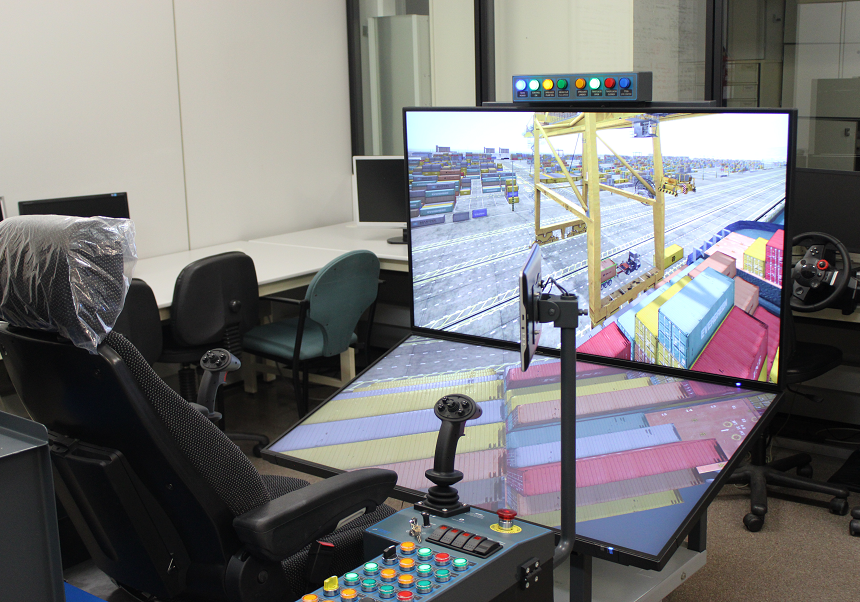
The innovation project “Challenge-based learning of risk prevention techniques in the handling of port machinery using operator training simulators” is an initiative that combines technology and innovative methodology to enhance students’ professional skills. The action, coordinated by the CPIFP Marítimo Zaporito in San Fernando, Cádiz, and involving the CPIFP del Mar in Gijón and the University of Valencia (UV), has enabled the design of a training model tailored to the real needs of the port sector.
In this way, Vocational Education and Training (VET) is moving towards innovation by developing a project funded by the European Union, with grants aimed at supporting innovation and applied research projects, as well as knowledge transfer within vocational education and training in 2023, as part of the Recovery, Transformation and Resilience Plan, NextGenerationEU.
The collaboration between the centres and the University Research Institute on Robotics and Information and Communication Technologies (IRTIC), specifically with the Laboratory for Simulation and Modeling (LSyM), a research group affiliated with the University of Valencia (UV), has focused on the integration of quay crane simulators (STS Crane) and ship crane simulators (SP Crane). These devices are designed for training in the operation of loading, unloading and stowing cargo on ships in scenarios that simulate real-life extreme situations.
The CPIFP Marítimo Zaporito, as the coordinating centre, has led the project planning and teacher training to promote the integration of these tools into the classroom, whilst the UV has provided technical support and developed improvements to its simulation system.
This initiative has established itself as a benchmark for innovation in vocational training, using simulators and innovative teaching methods to bring the realities of the workplace into the classroom, thereby reducing the costs and risks associated with traditional training.
 Funded by the European Union -NextGenerationEU. However, the views and opinions expressed are solely those of the author(s) and do not necessarily reflect those of the European Union or the European Commission. Neither the European Union nor the European Commission can be held responsible for them.



