.svg)



The ICMol will develop a new material for capturing carbon dioxide under high-humidity conditions with European funding
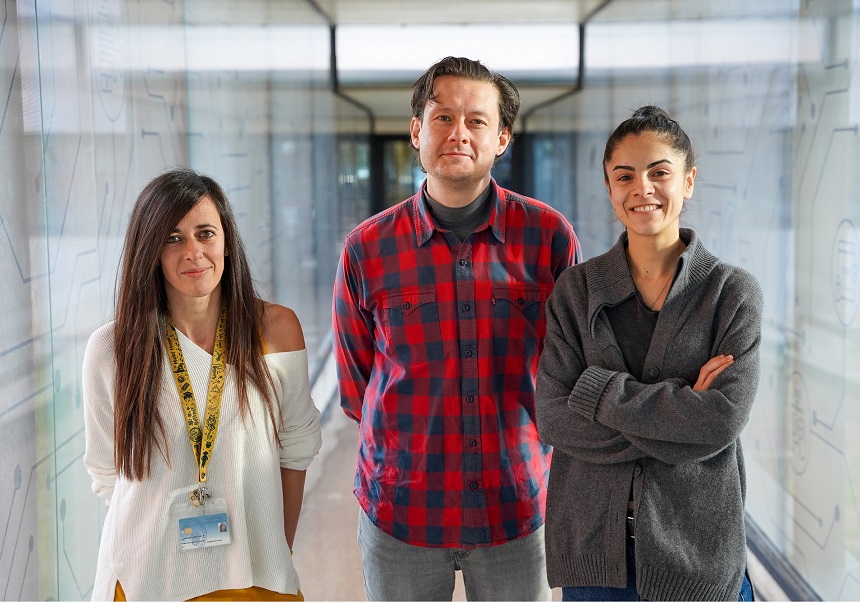
(From left to right). Natalia Muñoz, Carlos Martí Gastaldo and Clara Chinchilla.
Capturing carbon dioxide (CO₂) in the presence of water is one of the major challenges for current decarbonisation technologies. The FUNIMAT research group (Functional Inorganic Materials Team) at the Institute of Molecular Science (ICMol) of the University of Valencia (UV) has developed a new material capable of maintaining its effectiveness even in highly humid environments, a common condition in real industrial processes. This advance has been recognised with an ERC Proof of Concept grant from the European Research Council (ERC), which will bring the material closer to validation and industrial application.
The development originates from the ERC project LIVINGPORE, led by Carlos Martí Gastaldo, head of the group and professor in the Department of Inorganic Chemistry at the UV. Its aim is to progress from innovation generated in the laboratory to scaling up, validation and potential market transfer. The grant is awarded to researchers who have already received core ERC funding (Starting, Consolidator, Advanced or similar) and wish to explore the commercial or social impact of pioneering research results arising from their projects.
Under controlled conditions, many materials can absorb carbon dioxide. The challenge arises when CO₂ is mixed with other components that interact more strongly with the material, particularly water vapour. In this competition, CO₂ is often displaced, significantly reducing the ability to capture it and making operation in real environments difficult.
The material MUV-92 (MUV stands for materials from the University of Valencia), developed within the LIVINGPORE project and now at the core of the new WETCAP project, stands out precisely for its performance in humid environments. It retains a very high fraction of its CO₂ capture capacity as relative humidity increases – an essential attribute for applications in which the presence of water vapour limits current technologies or increases their cost.
Although the project is being developed within the framework of the ERC Consolidator Grant LIVINGPORE, the result that led to this proof of concept was not an original objective of the project. Martí Gastaldo highlights the value of this type of research finding: “It is a good example of how curiosity can open up an application pathway that was not initially foreseen”. The material emerged from curiosity-driven explorations by Ramón y Cajal researcher Natalia Muñoz and PhD students Víctor Carratalá and Clara Chinchilla, as part of the methodological work on the design of new porous materials carried out in the project. Only later was its potential for CO₂ capture under high-humidity conditions identified.
Specific chemical design
The material is based on a specific chemical design developed by FUNIMAT, related to pyrazole-type ligands, used to prepare advanced porous structures. From this discovery, the team has defined a clear application niche: scenarios in which other cutting-edge materials lose performance due to the presence of water. In Martí Gastaldo’s words, this approach reflects a broad vision of the impact of research: “I do not believe in the dichotomy between basic and applied research: generating knowledge is always an advance; what changes is how close or far we are from its application”.
In the field of CO₂ capture, there are classical adsorbents (such as zeolites or silica) and more recent MOF-type materials with strong scientific and industrial impact. However, many of them significantly reduce their capacity in the presence of water. The ICMol proposal is structured around three main indicators: effective capture in high humidity; easy regeneration, since the interaction between CO₂ and the material is weak enough to allow release without energy-intensive thermal cycles; and durability, as the material retains its performance after repeated capture and release cycles.
Reduce or avoid preliminary gas drying steps
One of the most relevant operational benefits is the potential to reduce or eliminate upstream gas drying stages, which are commonly required when humidity compromises capture performance. Removing this step can reduce investment in equipment and operating costs, improving overall process viability.
The team considers those processes involving very humid gas streams to be particularly relevant, including: biogas upgrading, where CO₂ must be separated to enrich methane; fermentation gases and associated biological processes, such as wastewater treatment, where mixtures of CO₂ and methane are generated in highly humid conditions; and industrial flue gas streams, in which moisture is a routine component of real emissions.
In parallel, the development is supported by the protection of results through patents and by an exploitation strategy based on licensing to academic spin-offs – such as the start-up founded by members of the FUNIMAT group, Porous Materials in Action – or to industrial partners, with the aim of facilitating future transfer and application. As Carlos Martí Gastaldo emphasises, this dimension is key in scientific research: “Seeing how a result born out of scientific curiosity can help address real problems is one of the greatest values of research”.