Introduction
Without intending to delve deeper into the specifics of legal science, the truth is that the systemic idea prevailing in the construction of the concept of the legal system clashes with the dominant practice of dividing law into different branches for teaching purposes. Thus, areas of knowledge emerge, with their corresponding departments, and they are delimited according to the subject matter to be taught. However, reality shows that regulations are generally multifaceted, making it difficult to confine them to a single area of knowledge into which legal science is divided.
The necessary cross-cutting analysis of legal research has been the embryo of this institute. In this case, Patrimonial Law has been the focal point around which various collaborations of PhDs trained in different legal areas have been gathered.
The institute aims to develop new lines of research, consolidate a transfer structure, and establish mechanisms for incorporating new researchers that can hardly be accommodated within the framework of a single department. Furthermore, the proposal is clearly interdisciplinary, with objectives that transcend the individual interaction capacity of its members if they continue to carry out their activities without a structure that allows for the centralization of this work.
This is clearly reflected in the group's subsidised R&D&I projects, which consistently feature an interdisciplinary, international, and comparative component. For instance, while Tort Law is categorised under Civil Law within the traditional summa divisio, its preventive counterpart, Insurance Law, is a discipline proper to Commercial Law. Furthermore, market integration following globalisation demands an analytical approach from Private International Law, just as Procedural Law (with the rising prominence of group actions and dispute resolution systems) and the tax implications that define various insurance types cannot be ignored, all without forgetting the patrimonial liability of public administrations. Consequently, if the project aims to offer a comprehensive view of the subject under analysis, it simply cannot be restricted to professors from a single academic area.
The publications generated within the group, which have been highly relevant both nationally and internationally, have succeeded one another without any structure to capitalize on the prestige they hold, given that the directors or coordinators do not coincide and are not even affiliated with the same department. All members now belong to the University Institute of Patrimonial Law, which allows for a constant presence while boosting the brand.
Added to this is the fact that in publications produced within academic associations or transnational networks, we can now present ourselves as a consolidated, interdisciplinary group capable of playing a leading role.
Furthermore, training and postgraduate courses, both tailor-made training for companies and professionals, as well as those organized for the general public through ADEIT, can now be clearly identified following the creation of the Institute.
Likewise, in terms of research transfer, the Institute can submit proposals backed by an interdisciplinary group of renowned specialists in each of their fields. Certainly, when drawing up a transfer proposal, it is feasible to incorporate other researchers. However, reality proves that accessing interdisciplinary transfer projects is no easy task if the counterpart perceives them merely as a collection of individuals. Increasingly, there is a need for a structure that contracting parties perceive as solid and proven, thereby facilitating a more institutionalized transfer.
Ultimately, the goal during this founding period is to turn multidisciplinarity into a virtue, overcoming the dispersion of researchers across various departments of the Faculty of Law. Only in this way will it be possible to make a qualitative leap toward consolidating an internationally recognized research centre, widely known in the transfer market, and capable of promoting prestigious postgraduate and training courses.
SWOT Matrix
SWOT analysis is a well-established tool used to implement a strategic plan. It is currently widely extended over all kinds of organisations and enterprises in their decision-making processes, which is why we have decided to present it as the first step in the configuration of the Institute’s strategic plan. However, in order to make it even more significant, we chose to restrict it to three elements for each area of the matrix.
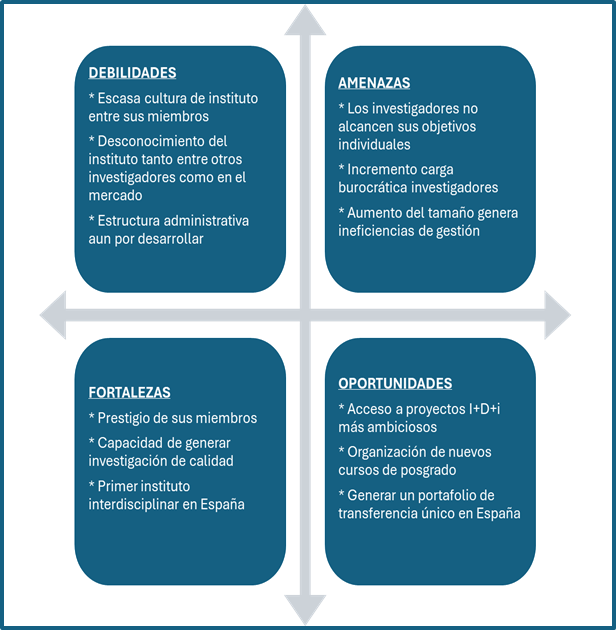
Goals
The Institute has set three major goals for itself to pursue:
- Contributing to the establishment of the Universitat de València as a model research centre on Patrimonial Law relevant at a national and international scale.
- Developing and promoting a multidisciplinary research environment in which scientists trained in Civil Law, Mercantile Law, Private International Law, Financial and Tax Law, Procedural Law and Administrative Law constantly interact in a pre-established manner, as well as creating the opportunity to cooperate with other researchers and research centres.
- Establishing connections with public administrations, entities, associations, organisations, enterprises and professional offices interested in Patrimonial Law in order to tackle the different issues which concern our society and the implied professionals in its study and application.
Guidelines
In order to achieve these goals, three guidelines aligned with the rationale the University Institute of Patrimonial Law have been proposed:
- Scientific excellence: continuing to work in the research results obtained by the group thus far, promoting the synergic interaction between high-quality scientific groups closely linked to one another.
- Knowledge transfer: promoting activities which transfer technological knowledge, creating the opportunity to interact with enterprises and professional offices in the matters concerning the Institute, thus contributing towards a more institutionalised entity model.
- Postgraduate education: forming new courses which become true models in the field of Patrimonial Law and the foundation for young doctors.
Lines of work
The different feats we aim to accomplish throughout the next six years of activity at the Institute are, at least, the following, which have been listed in four separate lines of work:
-
Basic research
- Increasing the gathering of resources for subsidised R&D&I projects.
- Incrementing the amount of global publications both in indexed journals and in international publishing houses.
- Forming our own prestigious international subscription service for our publications alongside a publishing house.
- Creating at least one job position for a specialised technician in managing research projects.
-
Plan to inform of the research process and publish the results at a global scale
- Solidifying the institute’s image.
- Improving the visibility of our research and the education of the institute’s members.
- Having our publications and events make an impact at the highest scale (citation in scientific publications, being host to in-person and online attendees at the institute’s events, gaining traction on social media).
-
Influence and reach
- Obtaining resources from sponsorships, without ruling out the possibility of creating an enterprise university chair.
- Increasing the presence of the Institute’s members in advisory offices in public administrations and institutions.
- Promoting the elaboration of the Institute’s own reports, as well as on-demand courses.
-
Postgraduate and doctorate
- Turning the Institute into a postgraduate education pillar at a global scale, especially but not exclusively in Latin America.
- Becoming a model source of doctors specialised in Patrimonial Law.
Core ideas
This strategic plan has been developed in accordance with the previously explained general goals, as well as with the high-priority lines of research orienting the Institute’s work. From this point, the strategic plan must be articulated based on five core ideas.
- Consolidating our multidisciplinary lines of research already in existence. This first step consists in continuing the work we have been doing with satisfactory results thus far. The Institute's members already enjoy great prestige as a result of their hard work. Now, we must simply capitalise on this multidisciplinary research at the Institute, an activity centre that encourages the creation of new initiatives. The most important part is to preserve the positive dynamics our multidisciplinary activities already benefit from, especially by receiving grants for R&D&I projects, scientific publications and organising scientific events. Moreover, it is of the utmost importance to continue purchasing books, journals and databases specialised in Patrimonial Law for our library.
- Implementació d’una gestió de la investigació professionalitzadaImplementing a new system for managing professionalised research. Something legal research typically lacks is indeed the existence of a support network for research. This culture rooted in multiple spheres of legal science is a hindrance for its evolution since it interferes with the creation of a research plan, it forces researchers to spend their time on certain management tasks (for which they are not prepared), it obstructs the communication of scientific matters and, overall, it makes the process of transferring knowledge more difficult for the Institute. For these reasons, we must move past this stage in which we find ourselves in order to introduce a professionalised management system that is more dynamic and optimised for research.
- Orienting our scientific and technological skills towards transferring knowledge. After identifying the Institute's strengths, we could develop a portfolio that benefits from the multidisciplinary character of its members dedicated to transferring knowledge. This is, without a doubt, one of the Institute's main singularities, since no academic institution has been able to bring together such a remarkable team of researchers specialised in so many areas who enjoy such immense prestige.
- Developing new lines of research. The Institute must be structured as a flexible organic entity in the scientific field capable of adapting to any new challenges and opportunities emerging in the sector of Patrimonial Law. The work carried out by the Institute thus far has already been explained, but becoming more efficiently coordinated and more professionalised is the motivation we need to develop more lines of research.
- Turning the Institute into a model centre at a global scale for creating scientific networks and obtaining both public and private resources. The Institute must strengthen the connections already in existence with other renowned researchers.
Actions to implement
The tasks to be carried out by the Institute throughout the next six years are huge yet exciting. The following are the main tasks we wish to fulfil, which we have ordered adhering to the structured listed in the goals section without being overly explanatory:
-
Basic research
- Obtaining research projects related to the Institute’s lines of research in regional, national and sectorial calls, as well as those organised by the European Union
- Creating the Institute’s own International Conference as a central biennial event
- Bringing more prestige to the publishing houses and journals where we publish our findings
- Organising seminars with researchers of great renown at a global scale
- Strengthening our connections with other institutes and research centres, both national and international ones
- Establishing our own administrative structure which supports researchers in managing subsidies
-
Plans to inform of the research process and publish the results at a global scale
- Earning a prestigious reputation
- Being present on social media and developing our own website to draw attention towards the Institute’s research and teachings.
- Creating a public profile for each researcher
- Promoting events aimed at renowned enterprises and professionals
- Encouraging the collaboration with media outlets (newspapers, radio stations, etc.)
-
Influence and reach
- Creating a commission for enterprises and professional offices
- Advertising the Institute’s activities among public administrations, enterprises and professional offices in the interest of finding resources (art. 60 LOSU)
- Promoting our own courses for enterprises and professionals
- Collaborating in education initiatives with other entities (professional associations, offices, etc.)
-
Postgraduate and doctorate
- Creating the Institute’s own official Master’s degree
- Creating the Institute’s own official doctorate
- Receiving grants for University Staff Training and Research Staff Training courses in the different national and regional announcements