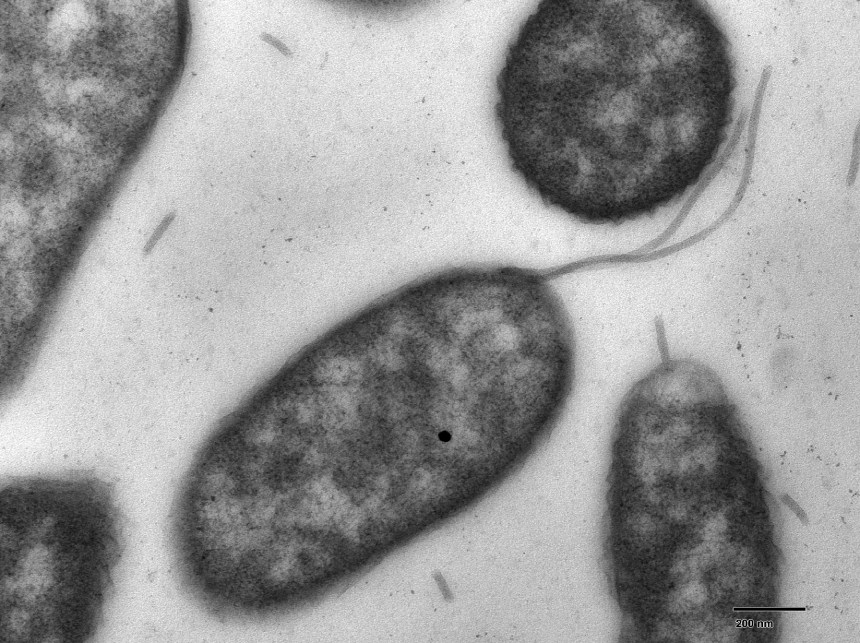
Headlines about the ‘flesh-eating’ bacterium (Vibrio vulnificus) are alarmist: the risk in the Mediterranean is minimal for healthy people.
You’ve no doubt come across some alarming news stories recently about the infamous ‘flesh-eating bacterium’ (Vibrio) and the supposed danger we face when swimming in the Mediterranean. Let’s bring a bit of calm and scientific rigour to the matter.
This sort of sensationalist headline tends to blow a real but very rare problem out of proportion, turning it into a collective fear. Whilst this bacterium does live in marine environments, the likelihood of it causing a serious infection in a healthy person is incredibly low. In science, context is everything, and as things stand, this microorganism does not pose a real threat to the health of most bathers.
To begin with, it’s worth clarifying the concepts, because lumping everything together only leads to confusion. Speaking casually of ‘flesh-eating bacteria’ and Vibrio isn’t entirely accurate. On the one hand, Vibrio is a genus of aquatic bacteria. On the other hand – and here lies the crux of the matter – the one with the notorious ‘flesh-eating’ reputation is a very specific species: Vibrio vulnificus.
This bacterium affects fish but can sometimes jump to humans (what we in science call a zoonotic pathogen). How? By entering through open wounds whilst we are swimming or by eating contaminated raw seafood. However, although this bacterium has the means to try and attack us, our immune system is an incredible fortress: a healthy body is more than capable of standing up to it.
So, who needs to be careful? The picture changes when we’re talking about people with a weakened immune system. We’re referring to the very elderly (aged 90 and over), immunocompromised patients or those with serious medical conditions, or people with liver disease (such as cirrhosis) or haemochromatosis (high levels of iron in the blood, which this bacterium loves). This group of people is indeed highly vulnerable to Vibrio vulnificus. But bear in mind, this is not because this bacterium is an infallible ‘monster’, but because these people’s bodies are weaker; in fact, they face the same risk from this microorganism as they do from practically any other common infection.
Our research group has been studying Vibrio vulnificus and how it acts—that is, its mechanisms of pathogenicity—for many years (1). It is true that in recent years this team has managed to detect and isolate the bacterium in natural environments such as the Albufera and its neighbouring beaches (2). But, and this is the most important point, the quantity present is minuscule when compared with the rest of the beneficial microorganisms that make up the normal microbiota of our Mediterranean Sea. It is, quite literally, a drop in the ocean.
Focusing alarmingly on a microorganism that represents an insignificant fraction of marine life merely demonstrates a desire to get easy clicks online. True scientific communication does not seek to frighten, but to provide accurate information so that we can take preventative measures without needing to fear the sea.
(1) Carmona-Salido H, Salvador-Clavell R, Jäckel C, Schulze I, Satchell KJF, Hammerl JA, Amaro C. Emergence, climate-driven expansion, and diversification of a European Vibrio vulnificus lineage (L4) with multi-host pathogenic potential. Emerg Microbes Infect. 2026 Dec;15(1):2601370. doi: 10.1080/22221751.2025.2601370.
(2) Salvador-Clavell R, Carmona-Salido H, Amaro C. Draft genomes of Vibrio vulnificus strains from the Albufera ecosystem in Valencia: isolates from summer 2022 to summer 2023. Microbiol Resour Announc. 2025 May 8;14(5):e0003525. doi: 10.1128/mra.00035-25.