- Babeș-Bolyai University (16%)
- Universitat de València (84%)
- Gaviña Costero, Pablo
- PDI-Catedratic/a d'Universitat
- Guillot Garcia, Antonio Jose
- PDI-Ajudant Doctor/A
- Martinez Navarrete, Miquel
- PI-Pred_Conselleria Acif Gva
- Melero Zaera, Ana
- PDI-Titular d'Universitat
- Coordinador/a de Mobilitat
- Vicedega/Vicedegana / Vicedirector/a Ets
- Mariana Barros Nogueira
- Alina Sesarman
- Manuel Banciu
Nowadays, drug delivery system based on nanoparticles and liposomes represent an advanced strategy for improving the efficiency and safety of oncological treatments, as they allow different active ingredients to be encapsulated and reduce their systemic toxicity.
Nevertheless, the majority of the available liposomal system, present passive or non-selective release what limits the clinical effectiveness and provokes side effects by failing to adequately differentiate between healthy tissue and tumor tissue.
Although, liposomes sensitive to external stimuli like pH, temperature, light or enzymes have been developed, these systems show limitations in specificity and activation control under real physiological conditions.
There is, therefore, an unmet need to develop delivery systems that are activated in a highly selective in the tumor environment and enable controlled, localized release, reduce systematic toxicity, and are compatible with clinically validated liposomal platform.
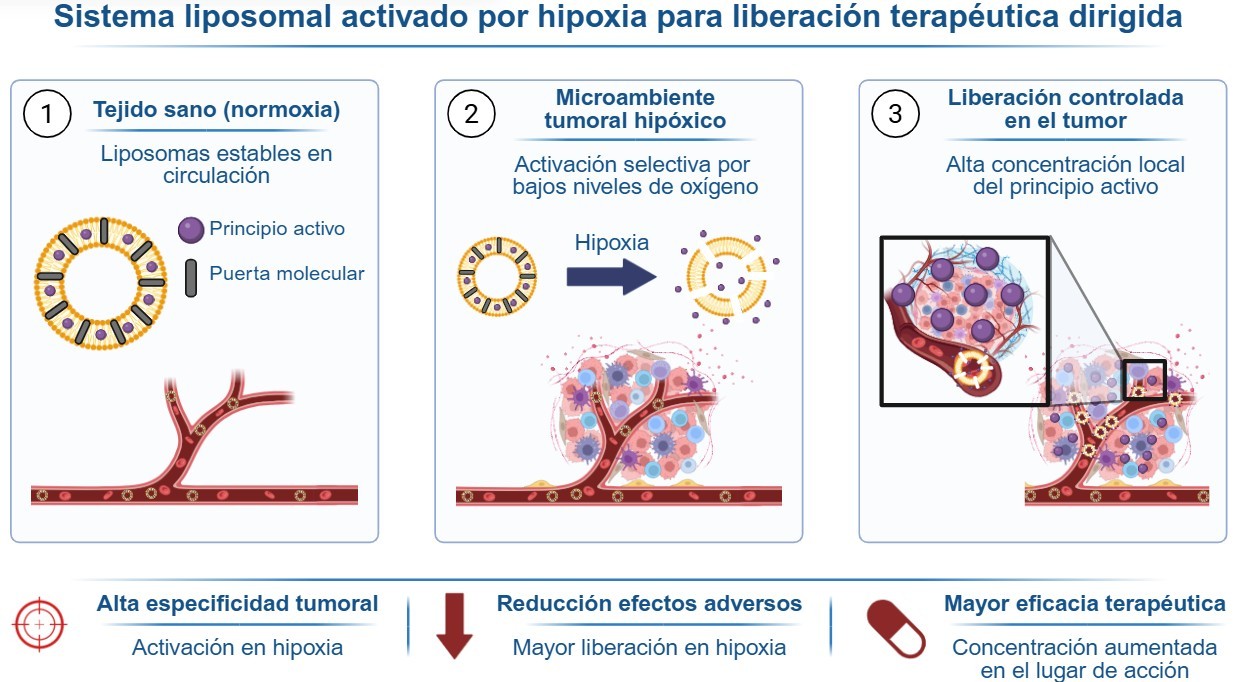
The researchers from the Universitat de València and Babes-Bolay University have developed a liposomal intelligent system intended for the selective release of therapeutic agents in tumor tissue. The system is designed to respond to condition of hypoxia, a common feature of tumor microenvironments.
The liposomes incorporate molecular gates that remain closer under the normal physiological conditions, ensuring the stability of the drug during circulation and preventing its release into the healthy tissue. When the system reaches areas with low oxygen levels, typical of tumor tissue, these gates are activated, allowing for the controlled and localized release of the encapsulated therapeutic agent.
The developed technology is versatile and allows for the encapsulation of different types of active ingredients, which facilitates is adaptation to different treatment strategies and expands its potential for clinical application.
The invention is mainly applicable in the field of nanomedicine and oncology, highlighting:
- Treatment for hypoxic solid tumors
- Controlled-release antitumor therapies
- Advanced drug delivery systems for hospital use
The invention offers multiple advantages compared to the prior technology:
- High tumor specificity, as its activated only under hypoxic conditions
- Side effects reduction by minimizing release into healthy tissue
- Greater therapeutic efficacy, increases the concentration of the drug in the tumor.
- Versatility, compatible with different therapeutic agents and combined strategies.
- Patent applied
Blasco Ibáñez Campus
C/ Amadeu de Savoia, 4
46010 València (València)