

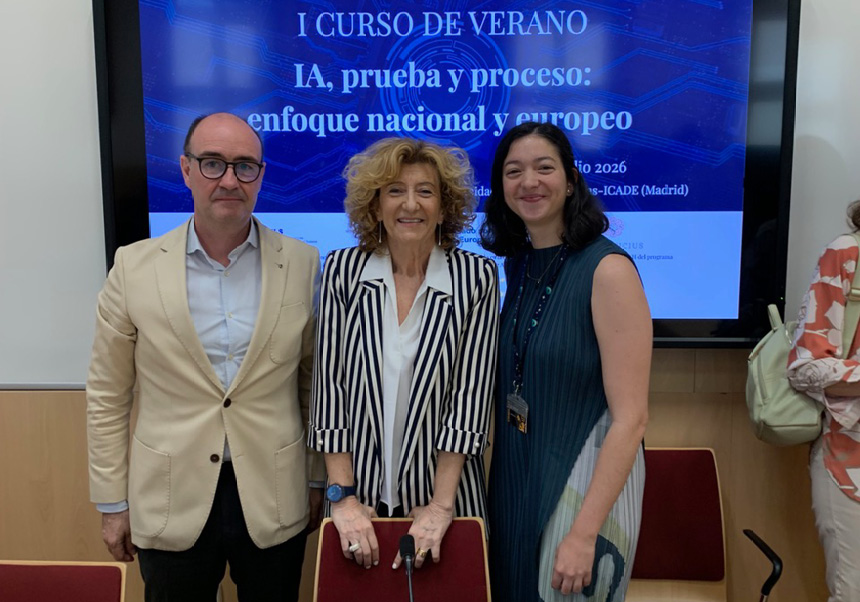
Professors Silvia Barona Vilar and Fernando Martín Diz, members of the research team of the Justicia sostenible en estado de mudanza global (JUSOST) project, participated on 1 July 2026 at the congress «IA, prueba y proceso: enfoque nacional y europeo» (AI, tests and processing – national and European approach), hosted at the Comillas Pontifical University (ICADE), as part of the 1st Summer Course of the Jean Monnet IECELS Module (The Influence of European Case Law on the Evidence Law of National Legal Systems).
The meeting gathered highlighted national and international specialists to analyse the impact of artificial intelligence about evidence law, judicial process, and the evolution of European jurisprudence, addressing the main legal challenges that the incorporation of algorithmic technologies arises at the Justice Administration.
Professor Dr Silvia Barona Vilar took part of the discussion dedicated to artificial intelligence in legal decisions, with the conference «Decisión judicial con algoritmos y por algoritmos, ¿es posible? Límites y marco jurídico», in which she analysed the possibilities and limits of algorithmic systems use in the jurisdictional function, insisting in the necessity to preserve the procedural guarantees, judicial independence, and fundamental rights in a context of increasing digitalisation of the justice system.
Professor Dr Fernando Martín Diz presented the lecture «Empleo de soluciones IA por el juez en la valoración de la prueba», focused on the analysis of artificial intelligence tools applied to the probative activity and the challenges that these tools create for the judicial assessment of the test, the motivation of the resolutions and the transparency of the decisions.
The participation of both researchers brings to light the involvement of the JUSOST project in the study of the effects of artificial intelligence on the judicial process and the protection of fundamental rights, contributing to the European academic debate about the digital transformation of the justice system and the development of procedural models that are sustainable, adapted and with guarantees to the technological challenges of the 21st century.




