According to the latest published statistics, reading is widespread and relatively universal amongst the Spanish population (Pizzi and Rius-Ulldemolins, 2024). From a demographic perspective, studies such as the Barometer of Reading Habits and Book Purchasing in Spain (Federation of Spanish Publishers’ Guilds, 2023) show that the overall percentage of people who read books in their free time stands at around 60%. However, these estimates conceive of reading as a generic form of consumption of cultural goods, frequently linked to the idea of leisure and free time. In this way, a series of questions that probe, in a more complex manner, Spanish society’s relationship with the specific reading of literary texts—that is, with literary reading—are overlooked or glossed over. Questions such as, for example, what percentage of the reading rates shown by the studies cited relates to the reading of literary texts, who reads them and under what conditions, what are the most widespread practices of reading literary texts today, and how have these developed historically.
Alongside the influence of social ties (primarily the family environment), it is within the educational context that the onus has historically fallen when it comes to encouraging the development and establishment of literary reading habits and practices amongst the general population. Schools and universities are therefore the settings where regular readers—and, in the best-case scenario, critics of literary texts—are produced (or should be produced). These readers will form a reading public understood not merely as a collection of consumers of cultural goods (which is what the statistical studies seem to suggest) but as a diverse group of people who read in various ways.
For the purpose of understanding the processes of formation and the specific behaviours of these ‘people who read’, the PRA-LEC group focuses on analysing current ways of reading literature and how these reading practices are shaped within different educational settings. Since we understand that behind every context of literature teaching there are reading practices and policies at work that shape the development of readers from school through to university, the aim of this conference is to reflect collectively on these practices and reading policies within the context of education.
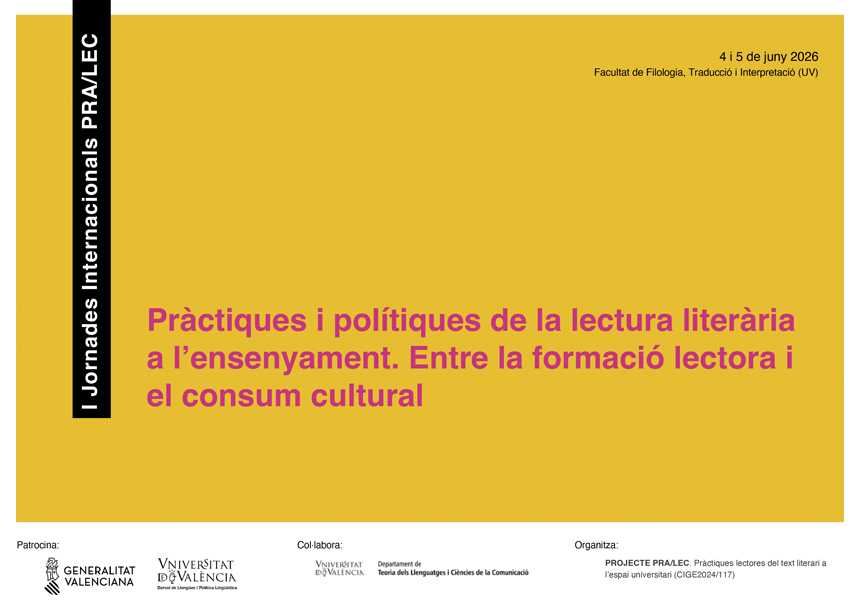
Event details:
- Dates: 4 and 5 June 2026
- Location: Faculty of Philology, Translation and Communication, University of Valencia (Cultural Space and Graduation Hall)
Organised by: Violeta Ros (Department of Language Theory and Communication Sciences)