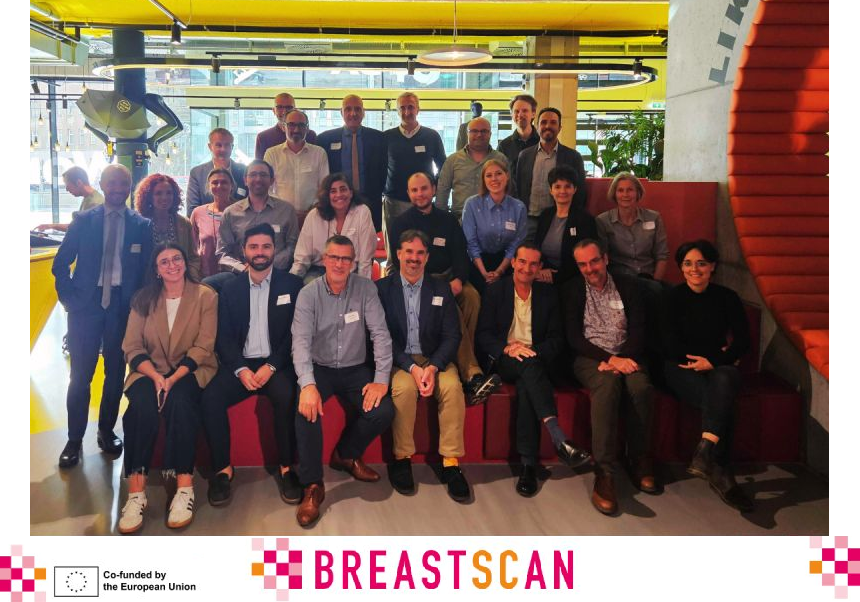
The Institute on Robotics and Information and Communication Technologies (IRTIC) at the University of Valencia (UV) is participating in BreastSCan, a European initiative that will create one of the largest and most diverse databases of breast cancer images ever compiled in Europe and will use it to push forward artificial intelligence (AI) in the early detection of the disease. The legal and ethical management of this project, which will run from September 2025 to August 2029, will be led by Doctor Ricard Martínez.
Breast cancer is the most common cancer among women in Europe, and early detection is crucial to saving lives. The initiative, co-funded by the European Union's EU4Health 2021-2027 programme with around 3.658.000 euros, brings together 20 partners from nine countries and will make use of advances in digital technologies and AI to make detection more accurate, efficient and accessible.
The consortium will collect more than one million breast images, including mammograms, ultrasounds, and magnetic resonance imaging (MRI) scans, from more than 250.000 imaging procedures. This will include at least 30.000 images from 7.500 confirmed cases of breast cancer. The data will be used to develop and test AI tools in eight use cases, such as breast density classification, lesion detection and characterisation, and cancer risk stratification.
In the short term, BreastSCan will establish common guidelines for breast cancer imaging to improve the quality and consistency of data across Europe. It will also integrate existing datasets into the Cancer Image Europe platform.
In regard to medium-term actions, hospitals are expected to increasingly use AI to support diagnosis, making it faster and more personalised. In the long term, the result will be a unique pan-European dataset that will be available to developers and researchers, strengthening Europe's competitiveness in AI-driven cancer research. The new tools will help detect cancers earlier, improving treatment outcomes and survival rates.
An interdisciplinary approach
The BreastSCan project takes a highly interdisciplinary approach by combining the expertise of 20 partners from 9 Member States. The consortium consists of leading universities, university hospitals, other healthcare providers, research institutes, national cancer screening organisations and a patient advocacy organisation.
The overall coordination of the project is carried out by the European Institute for Biomedical Imaging Research (EIBIR) in Austria, a European research management organisation in the field of biomedical imaging, while scientific coordination is handled by Professor Francesco Sardanelli of the Italian League for the Fight against Cancer (LILT).
In particular, the consortium includes 14 organisations that will provide breast screening data to BreastSCan. The partners bring a wide range of expertise in key areas such as breast radiology, oncology, data science, information technology, patient advocacy, project management, dissemination, law and ethics.
Spanish participation is fundamental to the project structure, with partners covering key roles in integration with European infrastructure, data management, technical management, and ethical and legal compliance.
The Polytechnic University of Valencia (UPV) participates through the Institute of Instrumentation for Molecular Imaging (I3M), a joint centre of the UPV and the Spanish National Research Council (CSIC), as the entity responsible for integrating this project into the European Cancer Imaging Infrastructure (EUCAIM). Professor Ignacio Blanquer of the UPV is the technical manager of the central node of the EUCAIM infrastructure, in which the UPV participates.
The Aragon Health Sciences Institute (IACS) is the main technical coordinator of the BreastSCan project, under the direction of Dr. Carlos Tellería. The IISLAFE Health Research Institute at the La Fe University and Polytechnic Hospital in Valencia, through the Biomedical Imaging Research Group (GIBI230) of the Clinical Imaging Area, led by Dr. Luis Martí Bonmatí, is the entity responsible for data management and preparation.
The University of Valencia is responsible for the ethical and legal management of the project, under the direction of Dr. Ricard Martínez, to ensure that patient data is handled in accordance with the highest standards of privacy and security.
The project is closely linked to the European Cancer Imaging Initiative through EUCAIM, as it benefits from the knowledge of its experts and thus contributes directly to the European platform Cancer Imagen Europe. EIBIR, HULAFE (IISLAFE), UPV and UV are EUCAIM partners involved in BreastSCan, ensuring synergies and avoiding duplication.


BreastSCan is co-funded under the EU4Health Programme 2021–2027 under grant agreement no. 101219312. Funded by the European Union. Views and opinions expressed are however those of the author(s) only and do not necessarily reflect those of the European Union or European Health and Digital Executive Agency. Neither the European Union nor the granting authority can be held responsible for them.