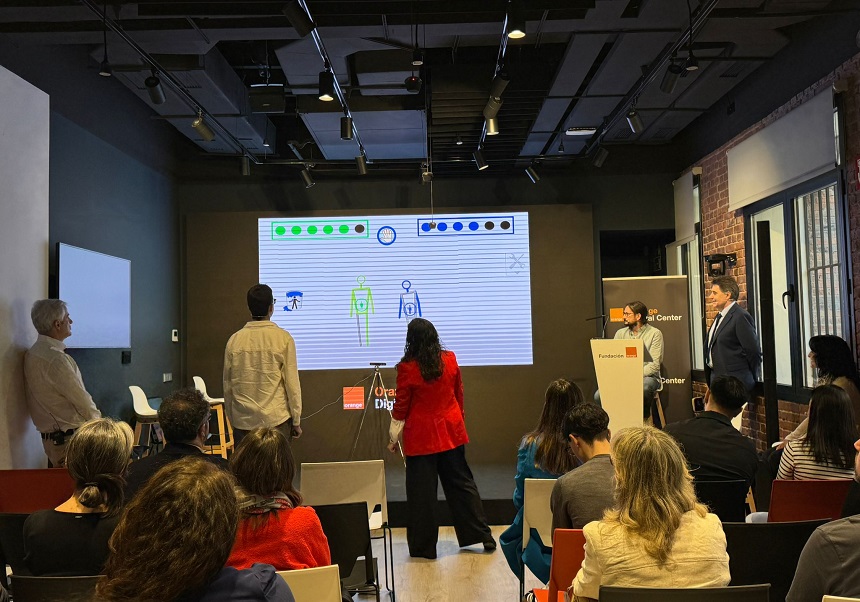
The launch of a new version of Pictogram Room, which now includes advanced body tracking and new activities designed to support the development of children with autism, took place on Tuesday, March 24th at the Orange Digital Center in Madrid. The Fundación Orange, the organisation behind the project alongside IRTIC, organised a conference that brought together professionals from the fields of education and technology, as well as associations specialising in autism, and featured a first-hand account from a family.
Pictogram Room is an initiative started in 2006 that offers a fun and engaging way to support progress in key areas of development for people with autism, whilst building on each user’s strengths. Its approach combines technology and educational methods to develop key skills such as body awareness, joint attention and imitation, areas which are fundamental to the social and communicative development of children and young people with autism.
Among the tool’s technological and usability improvements is a body-tracking system based on state-of-the-art 3D cameras, which enables more precise and natural interaction, as well as the use of augmented reality technologies that transform the experience into an interactive mirror designed to support learning.
The new version of Pictogram Room is now available free of charge on the Fundación Orange website: https://fundacionorange.es/aplicaciones/pictogram-room/
In addition, the organisation has set up an information page detailing all the improvements included in the update and explaining how they work in an accessible way: www.pictogramas.org
The improvements have been scientifically validated with children with autism and intellectual disabilities, demonstrating their effectiveness in developing body awareness, joint attention and imitation. The new version includes activities designed to develop cognitive concepts such as object permanence or the attribution of false beliefs, expanding the tool’s educational potential beyond the skills mentioned.
Technology to improve people’s lives
The MasOrange Director of Institutional Relations, Nani Fernández, noted that “technology only makes sense when it meets real needs and helps to improve people’s lives”. With this new version of Pictogram Room, she said, “we are reinforcing our commitment to autism and to the development of accessible, evidence-based and person-centred solutions”.
The psychologist and science communicator Alberto Soler chaired the roundtable discussion that formed part of the event. Participants included experts and project leaders such as the head of the AdaptaLab laboratory, Gerardo Herrera, and professor Marcos Fernández of the University of Valencia (UV); the tool’s developers, Lucía Vera and Daniel García-Arocas, all of whom are affiliated with IRTIC, and the professor of the Department of Evolutionary and Educational Psychology at the UV Patricia Pérez-Fuster.
In addition, Ángel Jiménez Pérez, a member of Autismo Ávila, and his mother, María José Pérez Obregón, contributed a first-hand account of their experience using the app to the discussion.
In the words of Gerardo Herrera, “Pictogram Room was born out of the need to develop key skills such as body awareness, joint attention and imitation through an innovative approach”. The head of AdaptaLab emphasised that “the incorporation of advanced body-tracking technologies and augmented reality allows us to offer an experience that is more precise, natural and tailored to each user”.
“Pictogram Room has been a dynamic and motivating way to develop key skills”, stated María José Pérez Obregón, “and it makes it easier to support children at home thanks to the backing of the educational environment”. In this regard, Ángel’s mother emphasized “we’ve seen improvements in independence, comprehension and social interaction, so I’d encourage other families to give it a try”.
The app has grown and evolved over the years through collaboration with universities, educational institutions and specialist associations, becoming a leading tool in the field of education. The tool is also backed by various scientific studies that have demonstrated its effectiveness, such as the one recently released in the journal Scientific Reports from the publisher Nature.
Ultimately, the event provided an opportunity to reflect on the role of technology as a tool for support and learning, and highlighted the importance of designing it from a neurodiversity-centered approach, in which solutions are tailored to people’s actual needs rather than the other way round.
Images:
.jpeg)
.jpeg)
.jpeg)