

A team of researchers from the University of Valencia (UV) has published the article “Data Semantics for Earth Observation: A technical guide to ontology-based integration for environmental data monitoring” in the international scientific journal IEEE Geoscience and Remote Sensing Magazine, one of the most prestigious publications in the field of remote sensing and environmental data analysis.
The study proposes a technological framework based on data semantics and ontologies that enables the integration of environmental data from multiple sources, such as Earth observation satellites, ground-based sensors and drones, to facilitate their joint analysis and the conduct of environmental studies at different spatial and temporal scales.
The system has been developed and validated using the Valencia Anchor Station (VAS), a scientific environmental monitoring facility run by the University of Valencia (UV) located in the Utiel-Requena region, which enables the integration of observations from satellite missions such as Sentinel, Landsat, SMOS and MODIS. It also incorporates field measurements, facilitating multi-scale environmental analysis and the study of key variables relating to vegetation and the Earth system.
The research proposes a technical guide for organising large volumes of environmental data using semantic technologies, thereby facilitating their interoperability and reuse in scientific studies and environmental applications. Among other applications, the system enables the analysis of key variables related to vegetation, such as FAPAR (fraction of absorbed photosynthetically active radiation by vegetation), a key indicator for studying ecosystem productivity and monitoring environmental change.
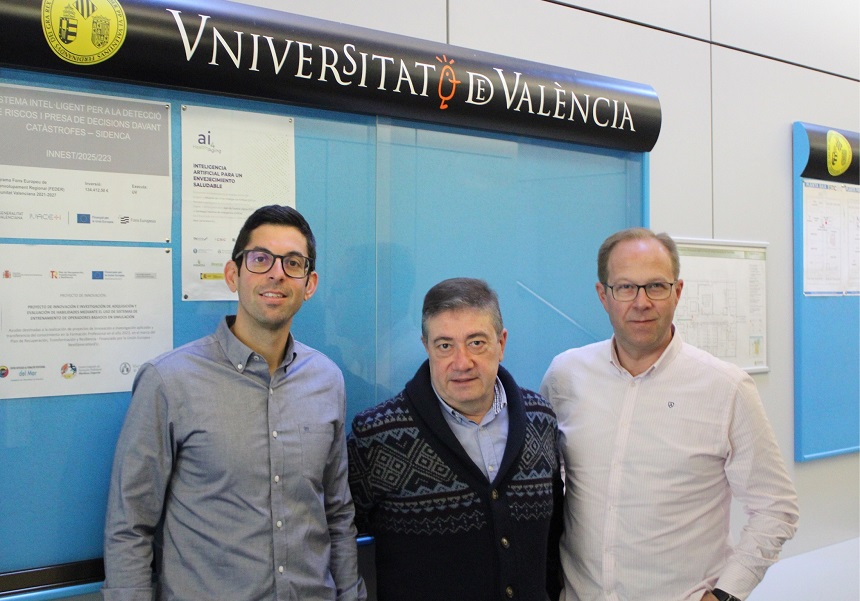
The work, led by researcher David García Rodríguez from the Department of Computer Science and the IRTIC, has involved researchers from the Department of Earth Physics and Thermodynamics and the Environmental Remote Sensing Group at the University of Valencia. This effort forms part of the research programme on AI-based semantic Earth observation for crop sustainability and adaptation to climate change, led at the research institute by Dr José Javier Samper Zapater and Dr Juan José Martínez Durá.
Samper and fellow professor Julián Gutiérrez Moret, IRTIC experts in data semantics and open data infrastructures, have made a significant contribution to the project and have championed an approach based on interoperability and open data spaces applied to Earth observation, as well as the design and implementation of these key components.
Both researchers have been responsible for articulating an advanced framework that integrates artificial intelligence techniques with semantic models and data architectures. This consolidates an innovative approach to the intelligent and sustainable management of agricultural systems in the context of climate change.
The results demonstrate the potential of semantic technologies to improve the management and use of Earth observation data, with applications in environmental monitoring, precision agriculture, spatial planning and climate change studies.
The study forms part of the Ministry of Science and Innovation’s R&D project “PID2020-120438RBI00”, granted to fellow researcher Juan José Martínez Durá. Specialists Pablo Catet Ruber, Beatriz Martínez, Ana Pérez Hoyos and Ernesto López Baeza contributed to this work as well.
DOI: https://doi.org/10.1109/MGRS.2026.3667059
Also in:
Science Park of the University of Valencia

This article is part of the R+D+i project PID2020-120438RB-I00, funded by MCIN/ AEI/10.13039/501100011033.



