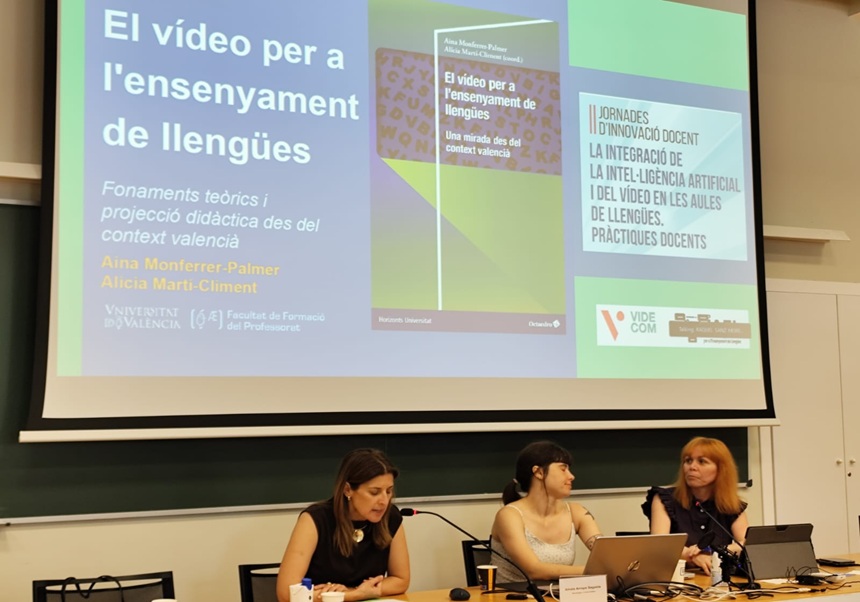
The VIDECOM research project has participated in the 2nd Conferences on Audiovisual Productions and Artificial Intelligence at the language classroom. Teaching experiences about video creation with different communications.
On the one hand the communication named ‘El vídeo para la enseñanza de lenguas: fundamentos teóricos y proyección didáctica desde el contexto valenciano’ (‘The video for language teaching: theoretical principles and didactic projection from the Valencian context’), presented by Aina Monferrer and Alicia Martí, offered a systematic vision and based on the role of the video within language teaching and learning. This work is based on the research developed in the El vídeo para la enseñanza de lenguas (‘The video for language teaching’) book, published by Octaedro, which constitutes the reference framework of the proposal.
The main goal of the communication was to describe the epistemological, discursive, and didactic principles that explain the value of the video as an educational resource. In this regard, the speech went beyond the instrumental consideration of the video and suggested a deep reflection on why is the video an effective resource, from which theoretical frameworks can it be understood, and which are the required conditions for it to be included in the teaching practice.
During the presentation, it was highlighted that the video represents a multimodal discursive genre that combines verbal, visual, and sound language, which turns it into an especially powerful tool for the development of the communicative competence. Additionally, its possibilities to create significant learning contexts, which are connected to the real use of language and the students’ cultural references.
From a didactic perspective, the communication underlined the need for a conscious and planned inclusion of the video in classrooms, based on clear pedagogic criteria. This implies not only using videos as a support material, but also promoting audiovisual production by the students, fostering active processes of knowledge construction and the development of digital competences.
On the other hand, Ana Reig and Paula Cruselles presented the communication ‘Producción de videopódcast académicos para el desarrollo de la voz docente’ (‘Academic videopodcast production for the development of the teaching voice’), in which the potential of audiovisual creation as a tool for building the identity and the communicative competence for future teachers was explored.
Participating in these conferences allowed the VIDECOM project to share its theoretical framework and its lines of work with the university community, while it contributed to the discussion on the role of audiovisual productions in language teaching.